

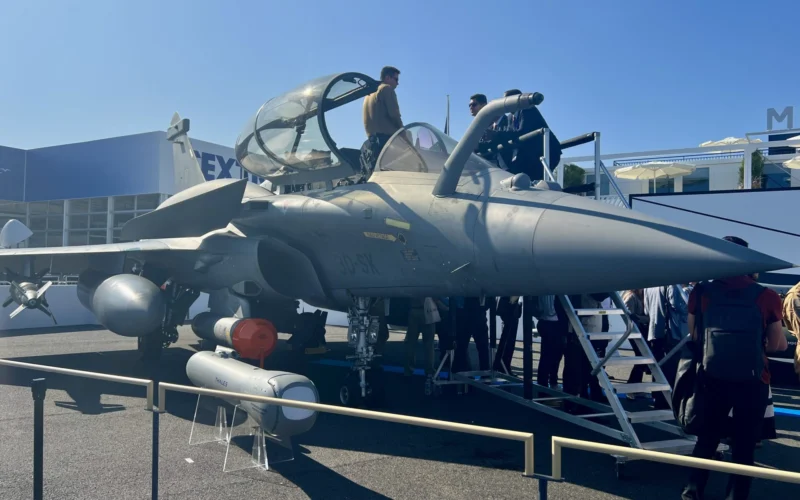
The French defense procurement agency has ordered development work on five Rafale F5 systems ahead of the formal launch of the standard, which it now places at the end of 2026.
The Direction générale de l’armement (DGA) said on September 10, 2026, that it notified the contracts over the summer of 2026 to Dassault Aviation, Thales, Safran Aircraft Engines and MBDA France.
The agency framed the awards as a way to de-risk the standard before the program enters its realization phase, the stage at which French procurement commits to full development and production. It did not disclose contract values or individual notification dates.
Five Rafale F5 systems covered by new contracts
The awards cover a very low drift inertial navigation unit built around a hemispherical resonator gyroscope, contracted to Dassault Aviation; the Inter-Vehicle Data Link (IVDL) and the RBE2-XG radar, both to Thales; the SPECTRA F5 self-protection suite, to Thales and MBDA France; and the preliminary design phase of the M88 T-REX engine, to Safran Aircraft Engines. Dassault Aviation will integrate the equipment on the aircraft.
M88 T-REX targets 20% increase in thrust
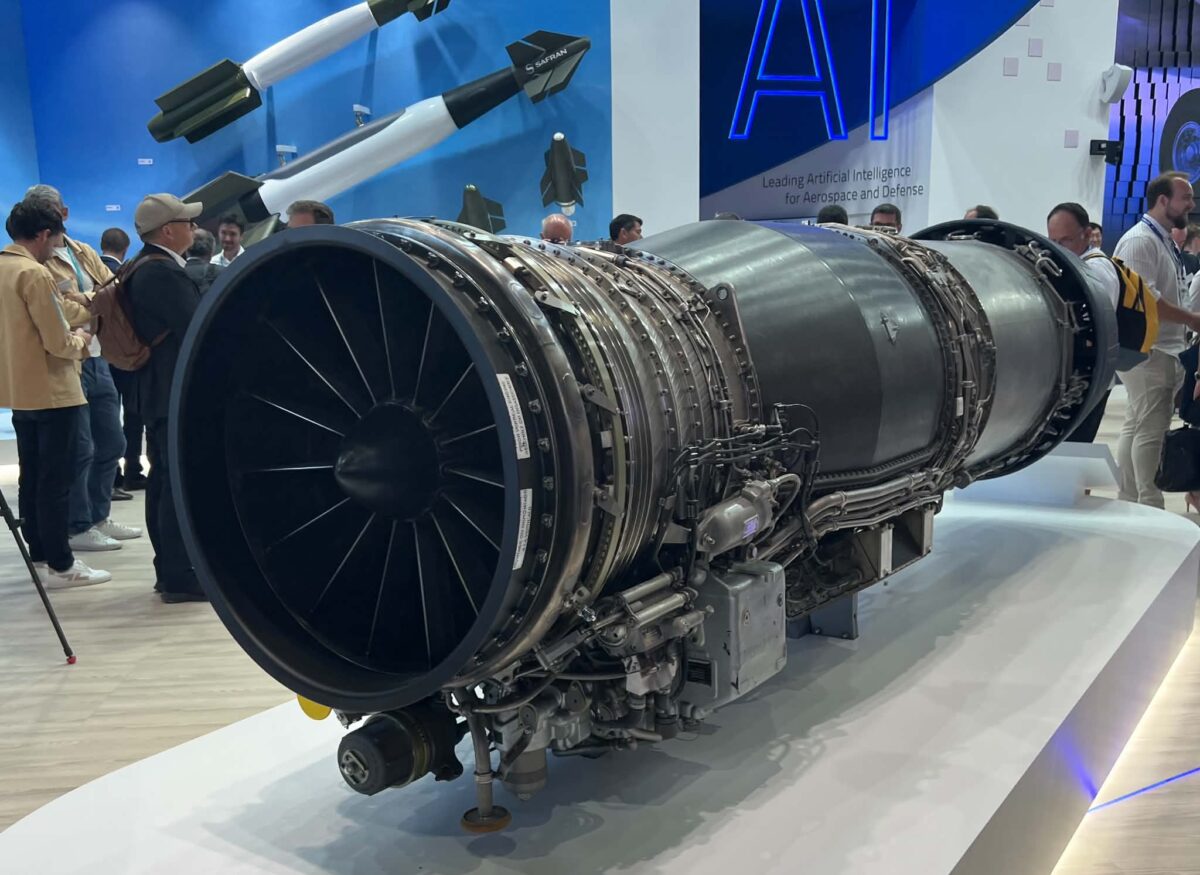
The M88 T-REX contract covers preliminary design only, leaving the engine a stage behind the sensor and electronic warfare work. Safran unveiled the T-REX at the Paris Air Show on June 17, 2025, targeting nine metric tons of afterburning thrust, 20% above the 7.5 tons of the M88-2 in service.
According to Safran, the increase comes from an improved low-pressure compressor admitting greater airflow, a high-pressure turbine using new materials and next-generation cooling circuits, and a nozzle with optimized aerodynamics, all inside the existing engine’s dimensions.
The DGA said the T-REX keeps the M88-2’s modular architecture, allowing modules to be swapped without stripping the engine down, and traced the work to upstream studies it ran with Safran and the national aerospace laboratory ONERA. Safran said in June 2025 that it was conducting risk reduction studies ahead of development and that qualification was aligned with the F5’s entry into service.
The T-REX is now Safran’s only fighter engine effort. Chief Executive Officer Olivier Andriès said on July 28, 2026 that the company had the resources to develop just one combat aircraft engine and would prioritize the French roadmap as Franco-German propulsion funding expired in September 2026.
RBE2-XG and SPECTRA prepare Rafale for 2035 threats
The DGA said the RBE2-XG keeps the same physical envelope as the RBE2 AESA radar in service while gaining transmit power and detection range, improved identification of very low radar cross-section targets, and additional processing capacity for artificial intelligence.
It said F5 sensors will work with each other without pilot input, and set the radar’s requirement horizon at 2035 and beyond.
The IVDL is described as a discreet, jamming-resistant high-bandwidth waveform, and SPECTRA F5 moves the electronic warfare core to an all-digital architecture.
Rafale F5 qualification targeted around 2033
The DGA said the F5 is due to be qualified around 2033 before entering service with the French Air and Space Force and subsequently the French Navy.
The standard will also carry the renewal of France’s airborne nuclear component through the ASN4G hypersonic missile. The DGA notified MBDA of the ASN4G development contract on June 2, 2026, with entry into service planned around 2035.
Dassault Chairman and CEO Eric Trappier said in August 2026 that the company was targeting 2033 to 2035 for the F5 and expected to be able to offer it for export from 2035. He also said there was currently no foreign co-development partner. That follows reported talks with the United Arab Emirates over a potential contribution to the F5 program, which collapsed in December 2025.
France’s updated Military Programming Law, promulgated on August 16, 2026, retains an overall combat aviation format of 225 aircraft at the 2035 horizon, including at least 47 Rafales at the F5 standard.
Waiting for F5 creates a near-term fleet problem
The F5 timetable has become entangled with a separate debate over fleet availability. During a Senate hearing on May 5, 2026, French Air and Space Force Chief of Staff General Jérôme Bellanger said he wanted the F5 as soon as possible but warned that the service also needed more aircraft in the near term. If F5 production could not begin before 2033, he said France might have to buy additional F4s despite the cost and complexity of later upgrading them or reduce the French Air and Space Force’s fighter commitments.
The debate followed the government’s decision to defer 22 Rafales previously due in 2031 and 2032 to 2033 and 2034 so they could be delivered at the F5 standard. Bellanger’s concern was therefore the capacity gap created by waiting for F5 aircraft, rather than opposition to the F5 roadmap itself.