

Australia’s Defence Science and Technology Group will host the Australian Defence Science, Technology and Research Summit (ADSTAR) in Adelaide from August 4 to 6, 2026, bringing together leaders from government, academia, and industry to discuss defense innovation.
One of the summit’s four key themes is “Integrated Ecosystem,” which focuses on how collaboration across sectors can accelerate the development of defense capabilities. A recent project exploring AI-enabled training for air battle managers illustrates that concept in practice.
Developing AI agents as realistic role players
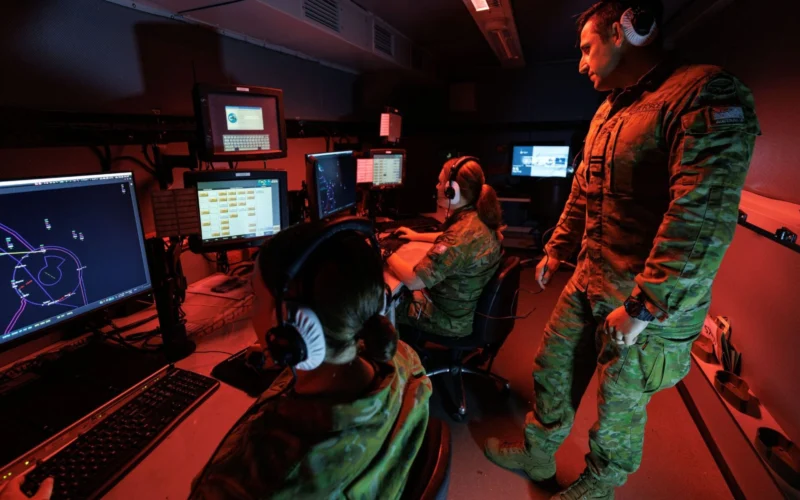
Defence Science and Technology Group partnered with Macquarie University and Australian simulation company PLEXSYS to develop AI agents capable of acting as realistic role players in Royal Australian Air Force training exercises.
Air battle managers operate in high-pressure command-and-control environments, integrating sensor data, guiding aircraft, and coordinating missions. Their ability to make rapid, accurate decisions is critical in combat scenarios.
The research team set out to determine whether AI could replicate the behavior of expert human operators well enough to serve as effective training partners. The AI agents were integrated into PLEXSYS’s Advanced Simulation Combat Operations Trainer, known as ASCOT 7.
Training the future force 💻
— Defence Australia (@DefenceAust) May 18, 2026
Defence innovation rarely emerges from a single lab, team or organisation. It is created at the intersection of operational need, scientific curiosity and industrial capability. When government, academia and industry work together, innovation… pic.twitter.com/0Vs9BXDpOy
Building the system
To develop the AI, researchers observed experienced human operators working in simulated command-and-control settings. They studied how operators communicated, prioritized information, and made decisions under pressure.
The AI was then refined to mirror the behavior, communication styles, and decision-making patterns of high-performing teams. More recently, the team incorporated large-language models to help the AI communicate more naturally with trainees.
Defense scientist Simon Hosking said the project evolved significantly over time.
“We went from looking at whether we could train AI agents to replicate the behavior of expert operators to considering how to utilize the huge increase in the capability of large-language models to help the AI system communicate naturally with the trainees,” Hosking said.
Feedback: Trainees couldn’t tell the difference
During trials, participants worked alongside both human role players and AI agents. Feedback showed that trainees could not reliably distinguish between the two, indicating the system’s effectiveness in replicating human behavior.
Hosking said seeing the research move toward real-world application was a milestone.
“To see our research transition from the lab to defense industry is a really proud thing to have achieved,” he said.
Funding and development
The project has been supported through multiple funding streams, including Defence Science and Technology Group, Australia’s Next Generation Technologies Fund, and the Centre for Advanced Defence Research in Robotics and Autonomous Systems.
Most recently, the work was extended under the Advanced Strategic Capabilities Accelerator through the Emerging and Disruptive Technologies – Decision Advantage program, with a contract valued at more than $3 million. The extension is intended to further develop the capability and align it with defense priorities.
Early-bird registration for the ADSTAR Summit closes May 29, 2026.