

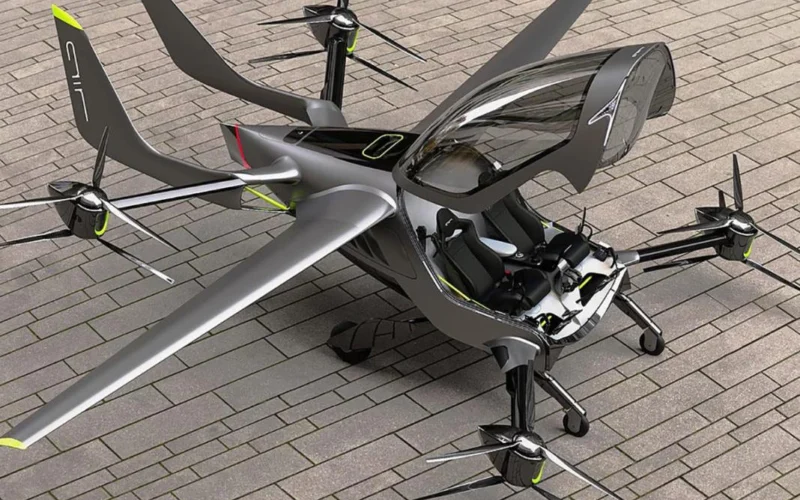
The US National Transportation Safety Board (NTSB) is investigating the crash of an uncrewed AIR ONE electric vertical takeoff and landing (eVTOL) prototype in Indiantown, Florida, on October 23, 2025. The aircraft, built by the Israeli advanced-air-mobility company AIR VEV Ltd., was destroyed by fire after going down in a rural field about 40 miles northwest of West Palm Beach, according to investigators. No injuries were reported.
In a brief post on X (formerly Twitter), the NTSB said the “unmanned Air VEV Inc. Zero eVTOL” crashed “for unknown reasons and was consumed by post-crash fire.” The agency said it has opened an investigation to determine the cause.
According to FAA registration data, the aircraft, N514AX, was an experimental technology demonstrator for AIR’s two-seat AIR ONE, which the company hopes will bring personal electric flight to a broad market. The prototype had recently received an FAA experimental airworthiness certificate, allowing flight testing in the United States.
AIR, headquartered in Pardes Hanna-Karkur, Israel, established a US flight-test center near West Palm Beach earlier in 2025. The company has been conducting demonstration flights in Florida since summer 2025 and had showcased the aircraft at Indiantown Airport (X58) earlier in the week for local officials, partners, and potential investors.
The Florida prototype loss marks a setback for AIR’s testing campaign but does not appear to have caused injuries or property damage. The company issued the following statement to AeroTime after the incident:
“AIR is working closely with the NTSB to research the root cause of the event, and once we have the full details, after validation, we will release them. Incidents like this are why we conduct extensive testing beyond standard operating parameters, so we can learn, evolve, and ensure our production aircraft meet the highest safety standards. We anticipate no delays or setbacks regarding AIR’s path to certification. The certification under MOSAIC was planned from the get-go for the production aircraft. Naturally, these unmanned flights of prototypes are a key source of data and evolution for us. Such an event contributes a great deal to the maturation process, and takeaways from this event will be implemented, as much as relevant, in the production aircraft.”
AIR said it will resume flights with the pre-production prototype in early 2026. “The production prototype will have a maiden flight by the end of this year in Israel,” the company added. “A similar, production aircraft will arrive at our Florida facility early 2026 to start flying.”
AIR’s website describes the AIR ONE as a light sport-category eVTOL built for everyday personal flying. The aircraft uses eight fixed rotors and an advanced wing-rotor configuration designed to generate up to 60% of its lift without tilt or pusher motors. This design, combined with AIR’s patented Fly-By-Intent flight-control system, allows the pilot to direct the aircraft simply by pointing a joystick in the intended direction of flight, the company says. The system is designed to automatically stabilize and scan for hazards in real time.
Founded in 2017, AIR VEV has been developing and testing full-scale prototypes for more than eight years. It previously completed forward-flight transition tests in Israel in 2022 and moved into the next phase of the US Air Force’s AFWERX Agility Prime program in 2023. AIR claims to have more than 800 pre-orders for the AIR ONE from customers interested in personal ownership and utility missions.
The company’s broader goal, according to its mission statement, is to make short-range electric flight accessible and environmentally responsible. AIR emphasizes a design philosophy centered on simplicity — only eight critical moving parts — and minimal infrastructure requirements, aiming to enable everyday “commuter-grade” air mobility.
The NTSB’s investigation will focus on flight data, control-system performance, and battery safety. Because the aircraft was operating under an FAA experimental certificate, testing was permitted for research and development rather than commercial purposes.
Editor’s note: This article was updated on October 28, 2025, to include a statement from AIR.
1 comment
Without wanting to preempt the concusions of the NTSB investigation, fire after crash points to a more general problem of all AAM’s using Lithium batteries: the danger of thermal runaway in case of nechanical shocks or distortion/damage.