

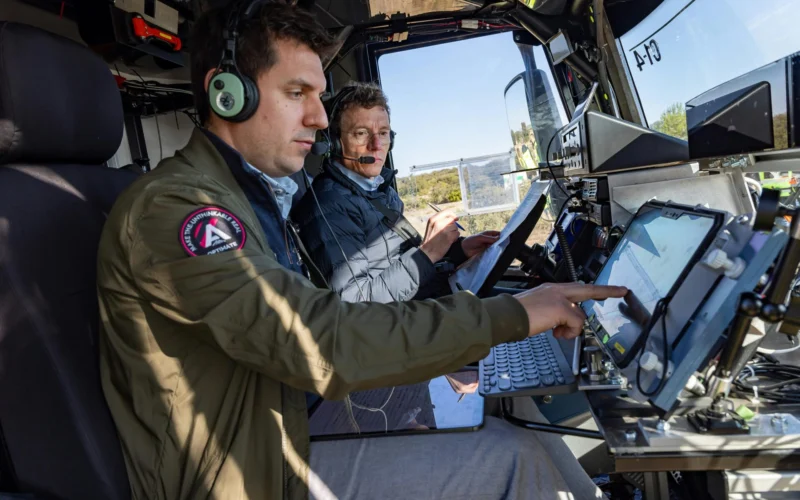
Airbus has demonstrated a concept in which diverse aerial and ground assets share a common data picture during a wildfire response, allowing water-dropping aircraft to receive precise targeting information in near real time.
The company announced the results of the trial on March 26, 2026, saying it marked a significant step toward reducing the gap between fire detection and suppression.
The exercise took place at the Garrigues military camp outside Nîmes, in southern France, and was developed in partnership with French departmental fire services and Entente Valabre, a public body under the French Ministry of the Interior responsible for evaluating aerial firefighting equipment and running training programs domestically and abroad.
Assets and infrastructure
The trial brought together a range of platforms: an H130 FlightLab helicopter, an ATR 72 acting as a stand-in water bomber, a Cirrus SR20 light aircraft, four drones including an Airbus Aliaca, and mobile ground units from the Le Gard Departmental Fire and Rescue Service (SDIS 30). Airbus set up a private mobile network on-site to link the assets, routing communications through Agnet, its push-to-talk and data platform used by emergency and security services.
Reconnaissance was handled by the drones and the light aircraft, which fed both visible and infrared footage back to a ground command vehicle in real time. That raw data was combined with satellite imagery, wind readings gathered by one of the drones, and the tracked positions of personnel on the ground. An AI system processed the combined inputs to produce a shared operational picture, then generated recommended flight paths and drop coordinates that were transmitted directly to the helicopter’s onboard guidance system and to the ATR 72.
Addressing a persistent coordination gap
Airbus presented the findings at the Aerial Firefighting Conference and Exhibition, held in Rome from March 24 to 26, 2026. The company framed the trial as one component of a wider portfolio it is building around wildfire response, which already includes the A400M with a dedicated firefighting conversion kit and rotorcraft equipped with water buckets. The connected coordination layer demonstrated in Nîmes is described as a new addition to that lineup, intended to improve the overall efficiency of mixed ground-air operations.
Wildfire seasons have grown longer and more destructive across southern Europe in recent years, placing greater demands on aerial suppression forces. The challenge of coordinating multiple aircraft types over active-fire terrain, while accounting for smoke, variable winds, and the location of ground crews, has long limited how quickly and accurately drops can be executed.
The choice of an ATR 72 as the trial’s surrogate water bomber might not be coincidental. French startup Kepplair Evolution is developing the KE72 “Forest Keeper,” a purpose-converted ATR 72 capable of carrying 7,500 liters of water or retardant, targeting first availability around 2027. The company has signed a cooperation agreement with Entente Valabre, the same body that helped design the Airbus trial scenarios, suggesting that the networked coordination layer demonstrated in Nîmes could in time be paired with platforms purpose-built for the firefighting mission.