
While Abra Group is one of the world’s largest airline groups, you may know it better by the individual airline brands under which it operates: Avianca, GOL Linhas Aéreas and Wamos.
The airlines in Abra Group, which is headquartered in the United Kingdom, see Latin America as their main market. Avianca has grown out of its original Colombian base to operate across the whole Latin American region as a full-service operator, while GOL is Brazil’s largest low-cost carrier. Spain-based Wamos operates mostly in the charter and ACMI markets on both sides of the Atlantic.
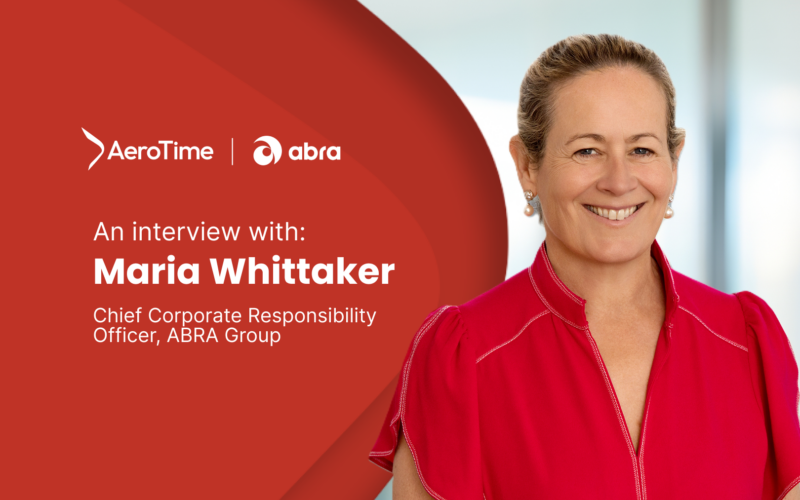
AeroTime took the opportunity to take a closer look at Abra’s wider environmental, social and governance (ESG) strategy with the company’s Chief Corporate Responsibility Officer, Maria Whittaker, in an interview conducted in September 2026.
Originally from Argentina, Whittaker has spent most of her career in finance, first in mergers and acquisitions (M&A) advisory roles and later helping Reuters build new data businesses. She also co-founded Downforce Technologies, a startup that uses satellite data and modelling to measure organic carbon in soil, with Jacqueline McGlade, former UN Environment Program chief scientist.
Whittaker joined Abra Group in 2024 as a sustainability advisor to Avianca and, in early 2025, she became Chief Corporate Responsibility Officer, with the task of setting up a new governance structure. In this role, Whittaker reports directly to group CEO, Adrian Neuhauser, which illustrates the importance that sustainability and corporate responsibility have acquired within Abra.
So, how does a group which operates with different brands and value propositions and across such a vast region get its ESG strategy together? And how much of it is taking place at group level and how much of it takes place is the responsibility of each individual airline?
“We see ourselves as one group,” Whittaker said. “From a sustainability perspective, we have the group level which drives the strategy, but we are focusing on integrating the environmental and social issues throughout all of the operations, which involve complementary airlines operating across more than 27 countries.”
“Each country has different rules and operational needs,” she continued. “So, we’re optimizing flexibility in terms of what gets done at [an] individual country level. But the strategy is set at group, and we’re all aligning to that. That’s very important from our perspective.”
Given Abra Group’s geographical focus, its ESG approach must strike a fine line between its core regions’ pressing developmental needs. At the same time, there is the fact that the airline’s core region is home to ecosystems that are extraordinarily important for the whole planet from an ecological point of view.
“We operate in quite a unique and vast region in terms of connectivity needs,” Whittaker said. “If you think of Colombia, it is crossed by three mountain ranges, in Brazil, distances are vast and so on…Also, the frequency of air travel is quite low compared to regions like the US or Europe and there are opportunities that are fairly exciting. We operate in locations that have very critical ecosystems, like the Galapagos or the Amazon, that are important for the world. The region also has the possibility of contributing to a lot of the solutions on climate change and we need to make sure that we’re doing what we can here.”
The social component in ESG
So, what is Abra Group doing in this regard?
“We are working together with all stakeholders to drive systemic change that is suitable for the region, and I think the social impact side is very important,” Whittaker said. “First, we provide connectivity. We transported 71 million people within the region last year. We also go to places where no one else goes. We build infrastructure.”
“We also employ 30,000 people and have over 10,000 suppliers in the region,” Whittaker continued. “So, we focus on how we can enhance our impact in that respect.”
“Then, we also have voluntary projects. I’m going to give you an example that brings all of that together,” Whittaker added.” We operate in a region like San Andrés [a Colombian archipelago in the Caribbean – ed. note], which is a biosphere reserve. It’s a fragile ecosystem, and a series of huge storms driven by climate change resulted in this ecosystem being more challenged.”
“The mangroves that protect the population from floods have been decimated,” she added. “But we fly there, we bring tourism, and we thought how can we bring our capabilities together to support the area?”
Whittaker explained how Abra Group engaged with local authorities to devise a program for the San Andrés archipelago. For example, the group launched a voluntary program helping to bring scientists and equipment for free to the islands. The airline group also matched donations [through Avianca’s Miles Bank program] from customers to help restore the ecosystem.
Other programs involved plastics, another scourge of riverine and oceanic ecosystems. Plastics take a long time to degrade, and tend to break down into microplastics, which harm wildlife and contaminate water and soils.
“We realized that in island destinations, plastics are an issue,” she said. “We were arriving with full bellies and leaving empty. We now bring plastic and aluminium back for recycling in the mainland for free.”
Even more surprisingly, another island-centric initiative involved seashells.
“We also have an initiative about activating awareness and responsible travel,” Whittaker said. “We had an activation at the airport, alerting passengers not to take seashells home. That’s because that has a significant impact on the destination.”
She continued: “In 2025, we also repatriated over 500 kilograms of seashells that had been confiscated and brought them back to their ecosystem.”
Abra Group has also been working with local communities on the islands to support mangrove restoration projects.
The Latin American perspective on aviation emissions
But what about emissions?
“Emissions are our biggest concern, and fuel is where the largest impact is,” Whittaker said. “We obviously focus on our operational efficiency. Avianca was named by Cirium as the airline that reduced their emissions intensity the most between 2019 and 2024, and we’ve continued to do that. That’s critical from an environmental side.”
“The two concerns we have in terms of moving away from fossil fuels onto more renewable fuels are first, how do we do it well and truly sustainably without consequences? And by consequences, meaning the potential consequences on water and biodiversity.”
“Many solutions promote the view that only carbon matters, but we don’t want to impact ecosystems which are fragile or haven’t been mapped or fully understood. So, we’re working with all of stakeholders on that front, in Colombia, Brazil and other countries to devise solutions that have no unintended consequences.”
Whittaker also touched upon the topic of sustainable aviation fuel (SAF) and its availability in Latin America, or its lack thereof. A key obstacle on this front is financial since SAF tends to be a lot more expensive than fossil fuel.
“We’re also working on the issue of affordability and the bankability of the demand,” she said. “Lower carbon fuels are more expensive, and the reality is that the domestic passenger in our region needs to be supported to be able to fund a transition. It’s only fair also that in the less developed countries there’s a shared but differentiated responsibility.”
“In Europe, the issue of affordability is still being debated. Also, there are certain revenue certainty mechanisms, even in the UK. So, the affordability of lower carbon fuels is not unique to us, but the impact on demand is,” Whittaker added. “We need to think about it all as a system. It’s all related.”
Whittaker added that Abra Group is also looking at solutions with countries outside Latin America to help fund the development of lower carbon fuels, so that the region can produce the fuels it needs without impacting domestic connectivity.
While some countries like Brazil are toying with the idea of introducing SAF mandates, Whittaker echoed one of the industry’s criticisms of this mechanism: mandates alone haven’t managed to stimulate supply in large enough numbers, particularly when it comes to second generation fuels, or e-SAF.
“The UK has a mandate, but there isn’t enough SAF to comply with second-generation fuel mandates,” she said. “We’ve been learning from the mistakes of the first movers too. You learn from what the US and UK are doing. There are opportunities, but they need to be right and take some time.”
Here, Whittaker insisted that it is important to know the true potential and intended consequences of some of the proposed measures so as not to create illusory solutions.
“It is crucial that we address them before embarking on a journey that is going to have an impact on connectivity and sustainability,” she said.
Affordability may be an issue, but countries like Brazil are already major exporters of biofuels and have the potential to do the same for SAF. However, Abra Group is taking a different approach to ensure the whole process is more efficient.
“We’ve come up with a solution, for example, with Brazil. Instead of exporting physical SAF, which makes no sense, transporting SAF from, say, Brazil to Japan, we are proposing to deal in [SAF] certificates. But they need to be credible and transparent; there needs to be no double counting,” Whittaker said. “That’s where Article Six comes in [Article 6 of the Paris Climate Agreements allows countries to trade emission reductions directly through bilateral or multilateral agreements – ed. Note]. It’s a mechanism that allows governments basically to trade carbon units. Instead of planting trees or protecting an area, you promote the development of a renewable fuels industry using SAF certificates.”
So, how does this work?
“Brazil has feedstock and is able to produce SAF at scale but is less able to pay domestically,” Whittaker said. “Using those certificates, airlines or the government in Japan can reduce their emissions using SAF produced in Brazil. So, instead of Brazilian passengers financing it, the development of SAF for international aviation is supported by developed countries that need it the most and have higher ability to pay.”
The system is a book-and-claim scheme in which Japanese organizations, such as the Sumitomo Corporation, would fund the production of SAF capacity in Brazil. Even if the fuel is physically used by Brazilian passengers, the Japanese entity is able to claim the emissions reduction. The Brazilian aviation sector will ultimately benefit, as well, since once SAF is produced at scale, it will be more plentiful and affordable to local operators too.
“In this structure, the domestic Brazilian airlines would benefit because the Japanese would be subsidizing the increased cost of SAF for the domestic passenger, and that subsidy is cheaper than transporting ethanol all the way to Japan to produce SAF in Japan.”
“Brazil gets financing and produces SAF of high quality without impacting connectivity,” she added. “At the same time, Japan gets the high-quality SAF it needs.”
However, Whittaker warned that, while the concept is straightforward enough, the project has been challenging on many levels.
“We initiated that project and have been working on it for eight to nine months now,” she said. “We announced it at COP last year and it’s exciting to see progress.”
“We have quite a lot of political momentum in Brazil, but it is slow,” she continued. “It’s election year and there’s a lot of documentation involved. Our first request has been for the Brazilian government to count SAF certificates as ITMOs [Internationally Transferred Mitigation Outcomes, units that count as emissions reductions when they move between countries under Article 6 of the Paris Agreements – ed. note] to make sure that those they can be traded.”
“The good thing about Brazil is that in their regulation for lower emissions fuels,” Whittaker said. “They have created the entity of these certificates. So that’s the first step. The second step is to build it. It will take a few years to come to fruition, but it’s worth doing because that’s a transparent, solid solution that addresses everybody’s problems.”
Whittaker also highlighted how Abra is targeting reductions in carbon intensity through investment in fleet renewal. In this regard, she referred to how aviation data provider Cirium had recognized Avianca, one of Abra’s airlines, for having been able to increase its capacity by 18.1% between 2019 and 2024 while cutting its carbon intensity by 19.6%.
“We’re prioritizing operational efficiency, because every emission we reduce today is more valuable than a theoretical emission tomorrow,” Whittaker said. “We also have the biggest order book for new aircraft in the region, so we are definitely leading in terms of emissions intensity.”
Here, Whittaker also mentioned that in 2025 Abra Group had 15 different ongoing initiatives with the aim of becoming more fuel efficient.
“We are always looking for new ways to reduce waste, and that is the priority,” she said. “In terms of lower carbon fuels, when these become available with the right sustainability credentials, we are going to be very careful about what we do.”
On the future of ESG in Latin America
So, how does Whittaker see the future of ESG in Latin America at a time in which this topic seems to have fallen off the priority list in the US and Europe?
Based in London and working for a group of companies operating mostly in Latin America, Whittaker has a good vantage point to witness the trends in this space in both regions.
“Being based in the UK, I see how [ESG] has gone from being marketing-led or brand-led to being integrated into operations. This is, from a delivery perspective, a good thing because the reality is now [that] the CFOs are looking at it. There are more disclosure requirements. If you look at all the disclosure requirements and regulations, those have continued to increase, even though the noise or the conversation has slightly shifted.”
“In this day and age, you can’t have sustainability as an isolated function,” she continued.
“It has to be an integral part of the day-to-day for pretty much everyone within the business. So, we’re involving finance, operations…and we are assigning and creating new roles wherever they are needed, bringing new capabilities, and aligning as much as possible in the day-to-day implementation.”
“A lot of what I do is integration into the business and advocacy inside the company and building skills and making sure that it is a topic that is day-to-day for everyone,” she said. “So, then it becomes a little bit more boring from a media perspective because you have more technical people talking about it. It becomes less of a marketing thing than a matter of disclosure and operational requirements.”
“The conversation has shifted,” she added. “But it has not come off the agenda in that respect, and it is actually more structurally connected to the business in terms of risks and opportunities. So, we see many opportunities in this space. Given my financial and operational background, and my need to make sure that the solutions work at systemic level, it’s good as it means you have everyone in the room and are able to implement and deliver change.”
“It’s a maturing process and there is a long way to go, a lot to do,” Whittaker added. “We definitely recognize the sort of the impact our operation has. We also recognize the opportunities and benefits it creates.”