

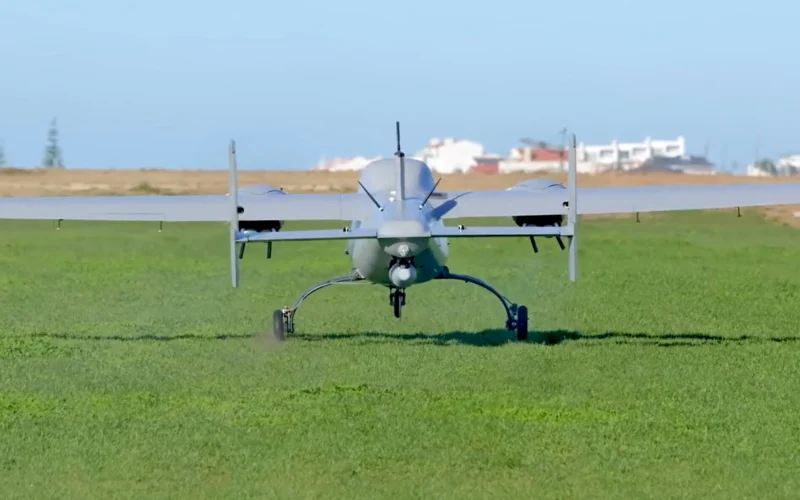
The UK Ministry of Defence has selected the Tekever AR5 to replace the British Army’s Watchkeeper drones, in a deal worth up to £400 million ($532 million) over ten years.
The announcement, made on July 25, 2026, covers an initial order of six aircraft, with up to 24 to be delivered by 2029. The drones will be built at Tekever’s Swindon manufacturing plant, which has yet to open. Subject to contract signature and final approvals, the UK MOD said the capability will begin entering service later in 2026, with support running for at least five years and options to extend.
It is the first major procurement announcement by Wes Streeting, appointed defense secretary on July 20, 2026, in Prime Minister Andy Burnham’s first cabinet, days before he appeared at Farnborough for the unveiling of BAE Systems’ Brontanax.
Streeting described the AR5 as “proven in Ukraine” and said it would keep British personnel ahead of emerging threats.
Tekever, which has supplied drones to Ukraine, is also one of four firms shortlisted for the UK’s Apache wingman program. Its Wales footprint centers on West Wales Airport at Aberporth, which it bought in July 2025, and where Watchkeeper made its first UK flight in April 2010.
A competition that produced no winner
Project Corvus was launched to deliver the British Army’s Land Tactical Deep Find requirement, providing 24-hour persistent surveillance at divisional and corps level. Defence Equipment and Support published the tender notice on July 31, 2025, with an estimated value of £130 million ($173 million) excluding VAT.
Eight responded by the closing date of February 13, 2026, and in a transparency notice’s words, “none of these responses were suitable.”
With Watchkeeper’s out-of-service date already pushed back to March 2027, the MOD opted for a sole-source award to Tekever. On the notice’s own terms, however, the finding of unsuitability covered all eight submissions, Tekever’s included.
Tender documents put the total at £336 million ($447 million) excluding tax if all options are exercised. The committed core is considerably smaller: a five-year contract worth around £136 million ($181 million), close to the original tender notice of July 31, 2025. The balance sits in options for additional equipment, spiral development and up to five further years of support, exercisable only if the capability proves cost-effective.
Less payload, more availability
The AR5 is a twin-engine, fixed-wing aircraft with a maximum takeoff weight of around 180 kilograms (397 pounds), a 50 kilograms (110 pounds) payload and a claimed endurance of 20 hours. It can operate from unprepared strips using automatic takeoff and landing and is unarmed.
The British Army initially requires two task lines, each able to sustain 24 hours of surveillance. Signature is set for no earlier than August 31, 2026, four months behind the May 2026 start advertised last year, and a formal award notice and standstill period must still follow.
Watchkeeper, developed by Thales UK and Elbit Systems and in service since 2014, carried up to 150 kilograms (331 pounds), including a dual-mode synthetic aperture radar and ground moving target indicator. Of the 54 delivered, only a fraction remained flyable.
Survivability questions remain
The choice does not settle a longstanding objection. In a RUSI commentary published on April 30, 2025, research fellow Robert Tollast argued that a medium-altitude platform sits awkwardly with the UK MOD’s own threat assessment, noting that Minister of State Lord Coaker had declared in November 2024 that Ukraine showed such drones were not survivable.
France reached a comparable diagnosis and acted on it more bluntly. Its updated military programming law, presented on April 8, 2026, canceled both the Safran Patroller and the multinational Eurodrone, the bill describing the latter as “less suited for high-intensity conflict” and the MALE requirement as reoriented toward lower-cost sovereign theater drones. French commanders had judged the original drones too slow, too large and too easily detected, and Paris is now backing five lighter national alternatives instead.