


A new study has found that flight attendants and pilots face the highest risk of dying from radiation-related cancers among more than 500 occupations studied in the United States, surpassing even workers who handle radioactive materials directly.
The findings were published August 17, 2026, in JAMA Internal Medicine.
The research, led by Dr. Vishal Patel of Harvard Medical School, analyzed more than 12 million US death certificates from 2020 to 2024 using the National Vital Statistics System, drawing on data from nearly 13 million decedents across 503 occupations, including roughly 14,000 pilots and 7,000 flight attendants.
Researchers examined deaths from cancers linked to radiation exposure, including leukemia, lymphoma, multiple myeloma, and cancers of the skin, breast, thyroid, prostate, and central nervous system, while excluding lung cancer to avoid confounding the results with smoking-related risk.
US pilots and flight attendants had the highest and second-highest percentages of deaths from radiation-related #Cancer across 503 occupations, while deaths from other cancers were not similarly elevated. https://t.co/calrvRwJ5F pic.twitter.com/kxMQqCXKqd
— JAMA Internal Medicine (@JAMAInternalMed) August 19, 2026
Odds of dying from radiation-linked cancer far higher for crew
The study found that flight attendants had about 50% higher odds of dying from a radiation-related cancer than the general working population, while pilots faced roughly 36% higher odds.
In absolute terms, radiation-related cancers accounted for approximately 6.9% of flight attendant deaths and 6.7% of pilot deaths, compared with 5% among the general working population, roughly one in 14 flight attendant deaths tied to these cancers.
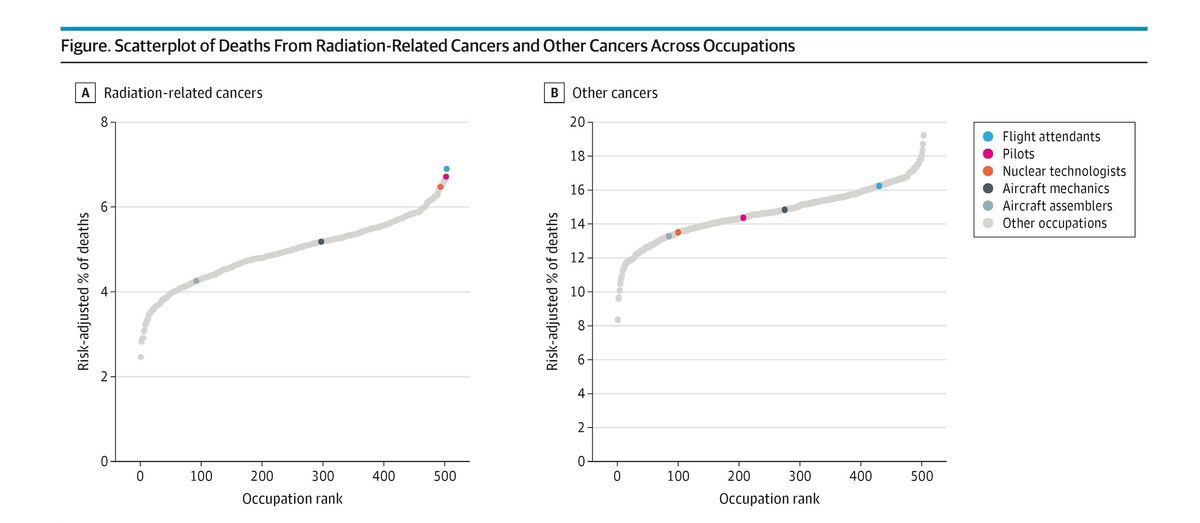
Neither group showed elevated death rates from cancers unrelated to radiation, a pattern researchers say points to workplace exposure, rather than lifestyle or socioeconomic factors, as the more likely explanation.
Aircrew are estimated to accrue between three and six millisieverts of cosmic radiation per year depending on flight paths, an order of magnitude higher than the roughly 0.4 millisieverts an average air traveler receives annually from about 10 cross-country round-trip flights, according to the Centers for Disease Control and Prevention (CDC).
While the FAA formally recognizes pilots and flight attendants as occupationally exposed to ionizing radiation, US aircrew, unlike radiation-exposed workers in other industries or aircrew in some other countries, are not subject to federal dose limits or monitoring requirements.
In a commentary accompanying the study, Australian radiation health researchers Catherine Olsen and Ken Karipidis noted that modern scheduling has largely eliminated the long, sun-drenched layovers once thought to explain elevated skin cancer rates among aircrew, pointing instead to cockpit and cabin radiation exposure as the more likely driver.
The researchers recommended annual skin exams for aircrew on high-altitude routes, along with earlier or more frequent mammograms for women in these roles.
Union response
Following the study’s release, Sara Nelson, President of the Association of Flight Attendants-CWA (AFA-CWA), which represents 55,000 flight attendants at 20 airlines, issued a statement calling for radiation-related cancer deaths to be formally acknowledged as occupational deaths.
“The risk is known, but crew are not informed or trained. And, no one is taking responsibility. Unlike standards in Europe, the FAA still does not require airlines to monitor crew exposure to radiation,” Nelson said.
She added that the findings reinforce what the union has argued for years, and called on the industry and regulators to take steps to mitigate the risk and provide care and benefits associated with occupational mortality.
Radiation risk among aircrew has drawn scrutiny for years
This is not the first time regulators and researchers have flagged aircrew radiation exposure as an area needing stronger oversight.
In June 2026, a National Academies report, requested by Congress under the FAA Reauthorization Act of 2024 and sponsored by the FAA, concluded that the agency’s current approach to tracking and communicating cosmic radiation risk was “inconsistent and insufficient.”
That report recommended treating in-flight cosmic radiation as an occupational hazard, with improved exposure tracking, clearer crew education, and practical strategies to manage cumulative radiation dose over a career, particularly for pregnant crew members.
The issue has also surfaced in individual cases. In November 2023, South Korea’s Korea Workers’ Compensation and Welfare Service ruled that the cancer death of a 53-year-old Korean Air flight attendant was directly linked to cosmic radiation exposure sustained over his 25-year career, much of it on long-haul routes to North America and Europe that passed through the Arctic, a region with comparatively higher cosmic radiation levels.
Data cited from South Korea’s Nuclear Safety and Security Commission found that flight attendants there were exposed to average maximum radiation levels of 5.42 millisieverts per year between 2017 and 2021, more than five times the standard permissible limit of 1 millisievert for the general public.
Korean Air said at the time that it strictly manages individual radiation exposure data and allows crew members to check their accumulated exposure on a monthly basis.
1 comment
The radiation exposure in high flying is a well known issue for a very long time. It seems that airlines and the regulatory authorities have ignored it as much as they could. That is so wrong. But the worse in my opinion is that apparently there is no voice of concern raised by the pilots or air crew unions to pursue airlines and authorities to implement most modern scientific strategies to protect and support pilots and flight crews. It is heartbreaking to see thousands and thousands of such young people died of cancer in this field of work, yet regulatory authorities and airlines did not see it as a serious problem to fight. This is sad.