

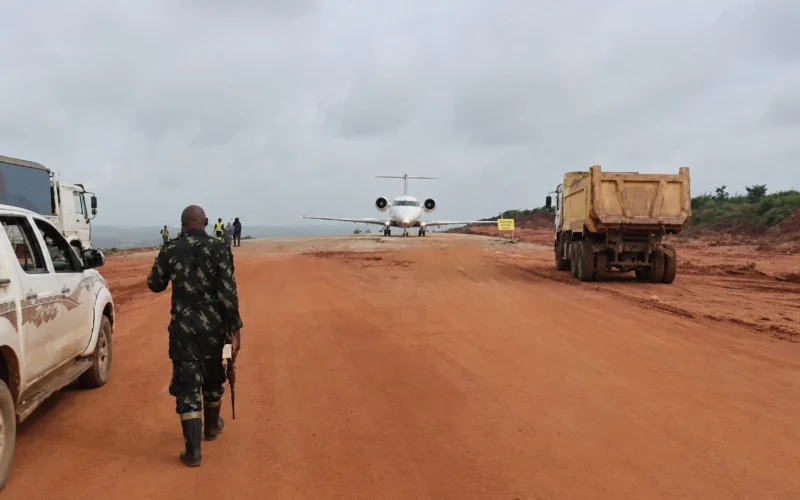
Nigerian investigators have disclosed conflicting cockpit accounts, problems programming the aircraft’s flight management system and an inoperative tower voice recorder in a preliminary report on a Bombardier Challenger 601-3A incident after the aircraft landed on a road near Asaba Airport (ABB) in Nigeria.
The Nigerian Safety Investigation Bureau (NSIB) released the report one month after the US-registered aircraft, N989BC, touched down on a paved road under construction during an attempted approach to Runway 11. The crew later took off from the road and returned to Lagos.
The report said the pilots encountered difficulties programming the flight management system before departure but believed the aircraft was established on the published RNAV approach when it lined up with the road.
Investigators also documented differing accounts from the pilot-in-command and an observer pilot over warnings and visual cues during the approach. The airport tower’s voice-recording system was not working, leaving investigators without a recording of communications between the crew and air traffic controllers.
The incident occurred on June 10, 2026, during an IFR flight from Murtala Muhammed International Airport (LOS) in Lagos to ABB in Delta State. Video posted to social mnedia showed the aircraft on the road near construction vehicles.
The aircraft, operated by VMO Aero Limited, departed Lagos at 08:01 local time with a pilot-in-command, first officer, observer pilot, cabin crew member and three passengers on board.
According to accounts gathered by investigators, the observer pilot questioned entries made while the crew programmed the aircraft’s flight management system before departure. The pilot-in-command told investigators that the crew corrected the discrepancies before takeoff.
The aircraft contacted Asaba Tower at approximately 08:31 and began an RNAV approach to Runway 11. Low cloud and intermittent visibility prevented the crew from maintaining visual contact with the airport.
During the first approach, the pilot-in-command said the navigation indications showed the aircraft aligned with the published approach, while the runway appeared visually displaced to the right. The crew discontinued the approach, completed a 360-degree turn and repositioned for another attempt.
The crew reprogrammed the approach and again reported indications showing the aircraft established on the RNAV course. However, accounts from those in the cockpit differ over what happened during the final stages of the approach.
The pilot-in-command said the observer pilot pointed out a newly paved surface ahead and identified it as the runway. The observer pilot gave investigators a different account, saying the aircraft remained in cloud late in the approach and received repeated terrain warnings. He also said he saw a telecommunications mast and called for the pilot to climb.
The Challenger touched down at 08:57 on the paved road outside the airport rather than Runway 11. The crew initially believed it had landed on a runway extension before seeing construction equipment near the end of the road.
The pilots shut down the aircraft and the passengers disembarked. The pilot-in-command inspected the aircraft, landing gear, tires and road before the crew prepared to depart.
The accounts also differ over the emergency response. The flight crew said no airport rescue personnel reached the aircraft. Nigerian Airspace Management Agency records indicated that a rescue team had been dispatched, although investigators said they found gaps and conflicting information concerning when personnel arrived.
Asaba Tower repeatedly attempted to contact the aircraft after the landing. The Challenger remained on the road for nearly two hours before taking off and returning to Lagos.
NSIB investigators met the aircraft after it arrived and recovered its cockpit voice recorder and flight data recorder. A post-flight inspection found damage to the left nose-wheel assembly. None of the seven people on board was injured.
The Nigerian Civil Aviation Authority subsequently grounded the aircraft, suspended its permit for non-commercial flight and removed both operating pilots from flight duties in Nigerian airspace pending further investigation. Nigerian officials identified the pilot-in-command as a US pilot.
FAA records identify N989BC as a 1988 Canadair CL-600-2B16. The aircraft is registered to Best Aircraft Deals LLC in Salt Lake City, Utah.
The NSIB said its investigation remains open and has not determined the causes or contributing factors.