

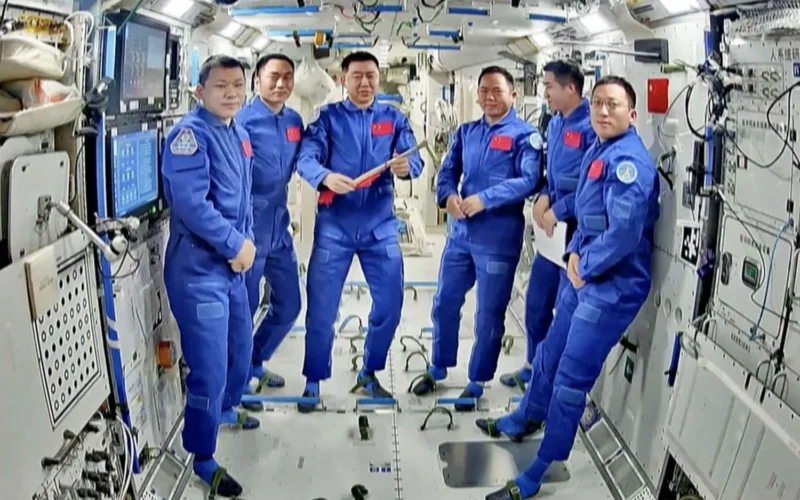
China has extended its three-person Shenzhou-20 mission, with the country’s human-spaceflight agency reporting that the spacecraft’s return capsule may have been struck by a small piece of orbital debris.
in a brief statement, the China Manned Space Agency (CMSA) said that engineers were conducting “impact analysis and risk assessment” after the capsule was “suspected of being hit by a small piece of space debris”. The agency did not specify when the suspected strike occurred or describe the extent of any damage.
The return of the Shenzhou-20 crew had been scheduled for November 5, 2025, following nearly six months aboard China’s Tiangong space station. The spacecraft remains docked as engineers assess whether it is safe to use for re-entry. CMSA has not released a revised return date.
Crew safe aboard Tiangong
The three astronauts — Chen Dong (commander), Chen Zhongrui, and Wang Jie — are reported to be in good health and continuing daily operations aboard Tiangong. Their replacements, the Shenzhou-21 crew, arrived late last week, completing a handover ceremony before the delay was announced.
If the return module is deemed unsafe, CMSA could opt to have the Shenzhou-20 crew return aboard Shenzhou-21’s spacecraft or dispatch a standby vehicle from Earth. As yet, Chinese state media have not indicated that an emergency launch is being prepared.
According to CMSA, all life-support systems aboard Tiangong are functioning normally, with both crews carrying out joint experiments while engineers evaluate the return capsule’s condition.
No timeline for re-entry
International outlets including Reuters, The Guardian and UPI cited CMSA’s statement confirming the delay, while noting that details remain scarce. The agency said that it would announce an updated landing plan “after completing risk verification”.
Shenzhou-20 was launched on April 24, 2025, from the Jiuquan Satellite Launch Center in China’s Gobi Desert. The six-month mission is part of a continuous human-spaceflight program that keeps Tiangong permanently occupied.
The delay marks the first time China has publicly acknowledged a potential debris strike affecting a crewed vehicle. While no injuries have occurred, the incident underscores the persistent danger posed by space debris in low Earth orbit. Even millimeter-sized fragments can cause serious damage at orbital velocities exceeding 25,000 kilometers per hour.
Tiangong, meaning ‘Heavenly Palace’, has been operational since 2021 and serves as the centerpiece of China’s long-term crewed-space program. Each Shenzhou mission brings a new crew for scientific research and maintenance tasks.
The country plans to expand Tiangong with additional laboratory modules and potentially open it up to foreign astronauts over the coming years.