

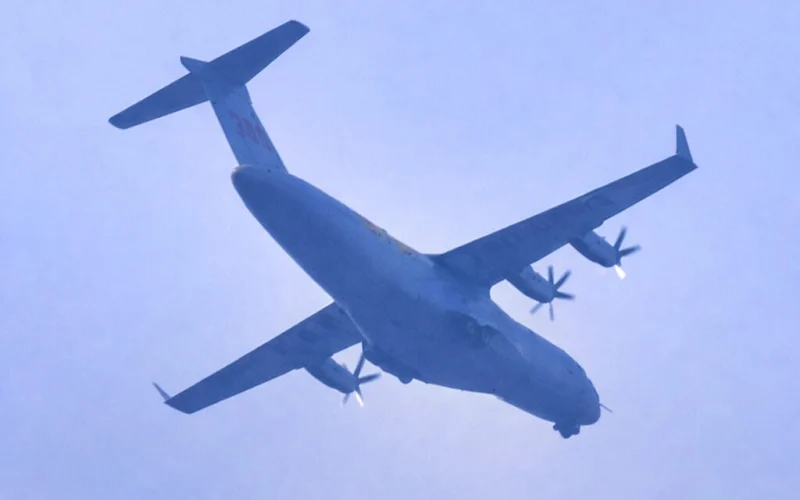
China has apparently flown a previously rumored turboprop military transport aircraft for the first time, offering the clearest indication yet that the People’s Liberation Army Air Force (PLAAF) is advancing a new medium tactical airlifter to complement its growing transport fleet.
Grainy video and still images circulating on Chinese social media on December 18, 2025, appear to show the aircraft, unofficially referred to as the Y-30, flying from an airfield in Xi’an, in central China.
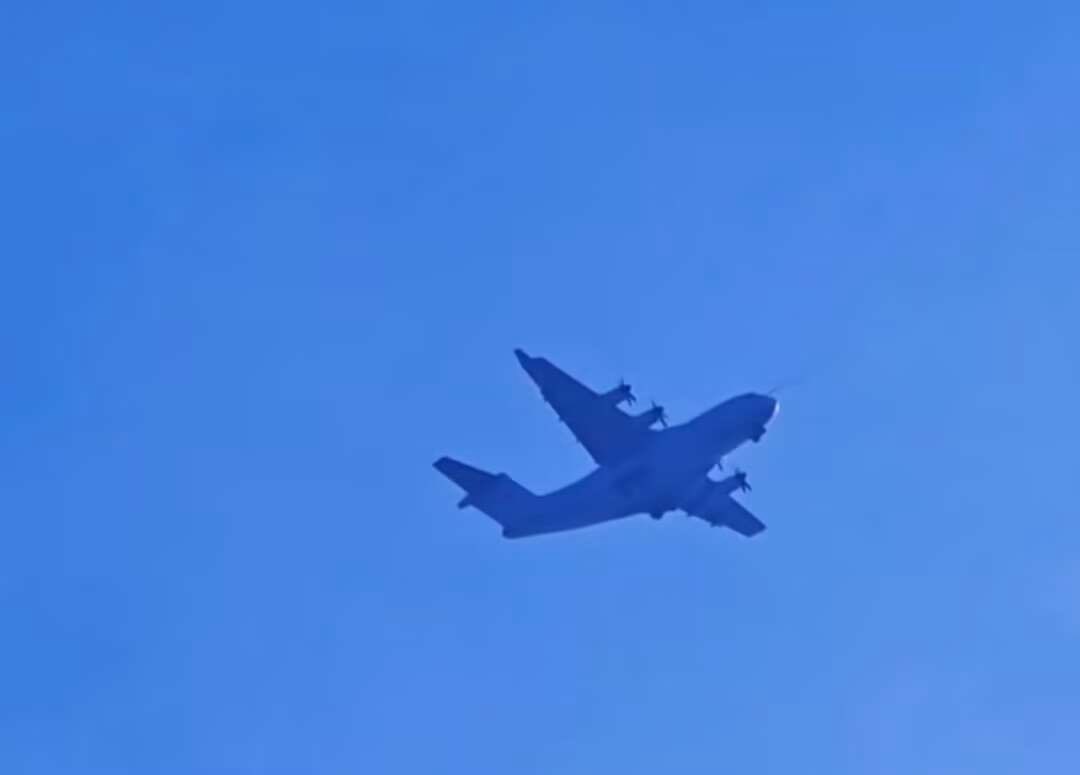
The Y-30 is believed to be a product of Shaanxi Aircraft Corporation, which also produces the Y-8 and Y-9 transport families. While Chinese authorities have not formally acknowledged the program, the aircraft’s appearance in flight marks the first time the long-discussed design has been observed as a flying prototype.
Imagery shows a high-wing transport with four turboprop engines, a T-tail configuration, and winglets, indicating a focus on fuel efficiency and short-field performance. The aircraft also features a rear loading ramp and robust landing gear, consistent with operations from austere or semi-prepared airstrips.
China first displayed a model of the Y-30 at the Zhuhai Airshow in 2014, after which the program remained out of public view for more than a decade. Its emergence in flight testing aligns with the PLAAF’s broader effort to modernize its airlift capabilities and reduce reliance on aging Soviet-derived platforms.
On the internet, several users posted an apparently AI-enhanced look at the Y-30 that seems to be based on still shots taken from the grainy first-flight video. Based on the model of the Y-30 displayed at Zhuhai, the rendering appears to be strikingly similar, and therefore probably at least somewhat accurate.
The design places the Y-30 between China’s existing Y-9 medium transport and the larger Y-20 strategic airlifter. Analysts estimate a payload capacity of around 30 metric tonnes, compared with approximately 25 tonnes for the Y-9 and more than 60 tonnes for the Y-20. This positions the Y-30 closer to the Lockheed Martin C-130J in terms of its overall role, though with a wider fuselage and greater internal volume.
Propulsion is believed to come from WJ-10 or WJ-16 turboprop engines, each producing between 5,100 and 6,800 horsepower. These engines drive six-bladed propellers, unlike the eight-bladed scimitar props used on the Airbus A400M, a larger transport often cited as a visual comparison.
The aircraft observed in flight carries a nose-mounted air-data boom, a feature typical of early flight-test aircraft used to collect aerodynamic and performance data. No aerial refueling probe was visible, though such equipment could be added on later variants.
If the Y-30 enters service, it is expected to gradually replace older Y-8 aircraft and supplement the Y-9 fleet, providing the PLAAF with a more flexible platform for regional transport, humanitarian missions and rapid deployment operations.