
The story of how Cirrus Aircraft decided to go all-in on the flight training market with the newly introduced TRAC10 begins with an airplane the company once chose not to build.
Years later, Cirrus returned to that trainer, certified through a joint program with its Chinese parent company, AVIC, and reworked nearly every detail around the needs of large flight schools. The result is substantially different from the original design — and, by most measures, considerably better.
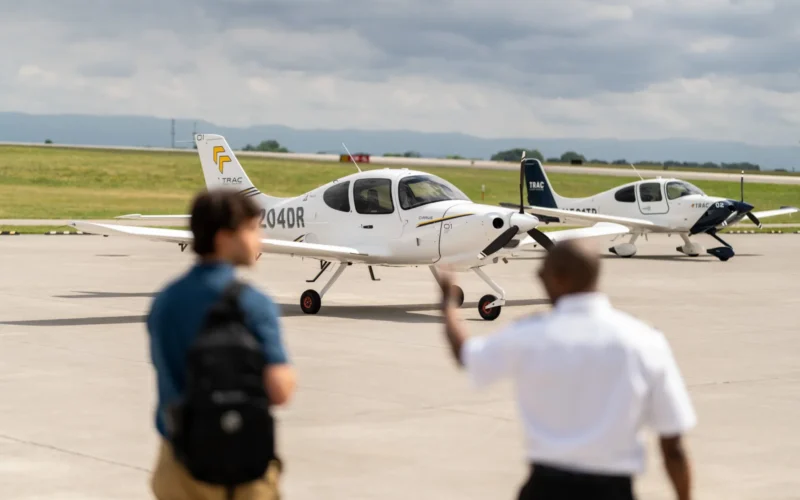
The redesigned TRAC10 is a three-seat, parachute-equipped trainer with a turbocharged 160-horsepower Rotax engine, modern Garmin avionics and a cabin designed to let two students take part in the same lesson.
TRAC stands for Training Aircraft. Cirrus already offers the TRAC20, TRAC22 and TRAC22T, fleet-focused versions of its SR20, SR22 and SR22T models with equipment packages tailored to flight schools.
Flight schools appear to be responding in a big way to the new model. The TRAC10 starts at $499,900, with US deliveries scheduled to begin in 2027. Cirrus has already secured more than 100 firm orders from over a dozen schools, according to Ivy McIver, Executive Director of SR Series and Product Programs at Cirrus.
From AG100 to TRAC10
Several years ago, Cirrus and an engineering team in China worked in parallel on two versions of the same basic aircraft, McIver explained. AVIC certified the AG100 in China and put it into production there, while Cirrus secured FAA approval for its version, then known as the SR10.
Cirrus decided not to produce the SR10 at the time, as demand for its larger SR-series aircraft was growing, production capacity was tight and the COVID-19 pandemic added further complications.
“We received the production certificate but decided it really wasn’t the right time for us to commercialize that airplane,” McIver said during an interview at EAA AirVenture 2026.
But Cirrus kept the design in reserve while it watched the flight-training market evolve. Busy airports, congested practice areas and growing airline-cadet programs began creating demand for an aircraft that could move more students through training without simply adding more airplanes and instructors, McIver explained.
“As the years went on, we really saw there was a growing demand and a growing need in the training market for something much more modern,” McIver said. That’s when Cirrus decided to revive the program, but not by simply dusting off the FAA-approved SR10 and putting it into production.
“Instead of just sticking with the aircraft we certified years ago, we decided to take the opportunity to update it and make it more desirable for deliveries in 2027,” McIver said.
Cirrus replaced the original powerplant with a turbocharged Rotax 916 iSc engine controlled by full-authority digital engine control. It also added a three-blade composite propeller and the Cirrus Perspective Core flight deck, based on Garmin’s new AXIS avionics platform.
The Cirrus Perspective Core flight deck uses two 11.6-inch touchscreen displays and integrates navigation and communication functions into the Garmin system. The TRAC10 also includes electronic stability and protection, a blue Level button, a stick shaker and a cuffed wing designed to reduce the risk of loss of control.
Cirrus lists a maximum cruise speed of 139 knots, a 14,000-foot operating ceiling and a fuel burn of 5.9 gallons per hour at 65% power. The TRAC10 has a 2,150-pound maximum gross weight, a 750-pound useful load and 33.5 gallons of usable fuel. Its flaps-down stall speed is 57 knots calibrated airspeed.

The company also upgraded the air conditioning and added USB-C charging ports, stronger cupholders, cockpit storage and headset hooks, and revised the seats and interior materials to withstand the punishment of daily flight-school use.
Built for two students
Cirrus also raised the third seat to give its occupant a clear view of the instructor, student, controls and instrument panel. Schools can equip the observer station with a fully functional Garmin display.
That will allow a student in back to tune frequencies, enter approaches, change the altimeter setting and handle other cockpit tasks while observing the flight. Schools can use the arrangement to introduce crew resource management, divide duties between students and get more training value from each sortie. “Schools can start to work on not just observational training, but engaging both of the students in a true crew-management situation,” McIver said.

The third seat also offers schools a practical scheduling advantage. At a congested training airport, an aircraft may spend considerable time taxiing, waiting for departure and flying to a practice area before a student can begin the lesson. With two students aboard, the airplane can land at a less busy airport, swap the front and rear occupants and complete a second lesson before returning home. “You basically have the ability to complete two student lessons in the time of a lesson and a half,” McIver said.
A crowded market for trainers
The TRAC10 will compete in a training market where Piper Aircraft’s Pilot 100i has gained significant traction with large flight schools. New aircraft designed under the FAA’s MOSAIC framework will add further competition.
Piper adapted the long-established PA-28 airframe into a durable, relatively affordable trainer. The TRAC10 follows a different formula, combining a newer airframe with a turbocharged FADEC engine and modern touchscreen avionics. Yet their prices are nearly identical: Piper quotes $499,000 for the Pilot 100i, while the TRAC10 starts at $499,900.
McIver said Cirrus also refined the TRAC10’s handling while retaining the feel of the larger SR20 and SR22. “The flight envelope is really big, and it’s super forgiving,” she said. “The stall characteristics and the slow-flight characteristics are very docile, but it flies like an SR.”
The TRAC10 uses the same side-yoke arrangement found in the SR series. Its single power lever reduces engine-management workload, while the wide windows and low glare shield are designed to provide good visibility.
Cirrus will initially limit TRAC10 sales to larger FAA Part 141 schools, universities, airline academies and cadet programs rather than individual owners and smaller training operations. A school must order at least five TRAC10s, McIver said.
The company has secured deposits from both current Cirrus operators and flight schools new to the brand, McIver said. Cirrus will build the TRAC10 in Duluth, Minnesota, and begin US deliveries sometime in 2027. International deliveries are expected to follow in 2028.
McIver declined to provide a firm 2027 production target but said Cirrus can adjust output across its established Duluth operation as demand dictates.
With so many firm orders already on the books, Cirrus may soon have to test that flexibility.