

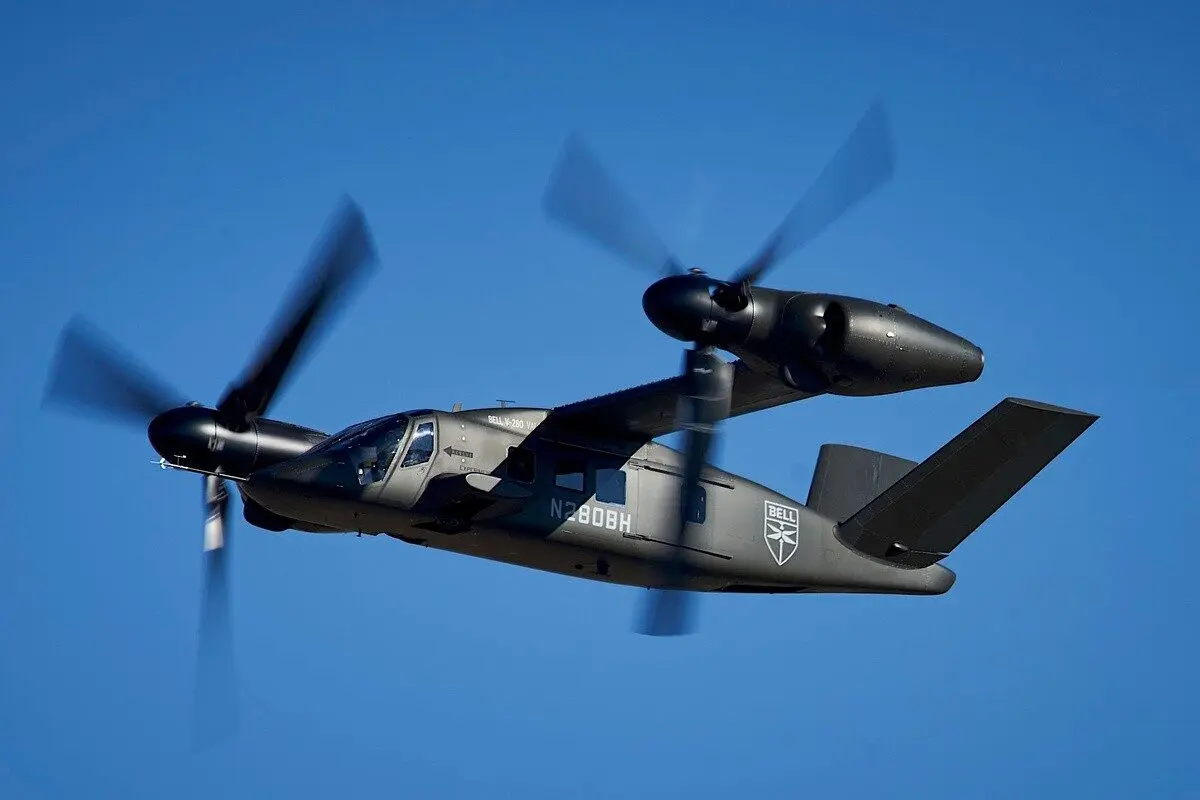
RTX’s Collins Aerospace has been selected by Bell to supply five onboard systems for the US Army’s MV-75 Future Long Range Assault Aircraft (FLRAA), the next-generation tiltrotor set to replace more than 2,000 UH-60 Black Hawk helicopters over the coming decades.
The contracts, announced on April 13, 2026, cover main power generation, an interconnect drive system, the SmartProbe air data system, cockpit seating, and an ice protection system. Collins said several of the packages will be procured through commercial acquisition authorities to speed up delivery timelines.
Commercial technology for a military aircraft
Troy Brunk, president of Collins Aerospace, framed the awards around readiness and long-term supportability. He said the company has existing manufacturing and service capacity worldwide to help the US Army deliver, modernize, and sustain the MV-75 over a 50-year service life, describing the offerings as military-grade commercial technology.
The use of commercial acquisition pathways signals that both Bell and the US Army are seeking to reduce development risk by drawing on subsystems with proven production lines, rather than pursuing bespoke military-only development for every component.
For Collins, which already holds an $80 million contract to upgrade the avionics on the US Army’s existing Black Hawk fleet, the FLRAA work deepens an already substantial footprint in the US Army rotorcraft fleet.
The FLRAA program
The MV-75 is the US Army’s first clean-sheet rotorcraft design in a generation. Based on Bell’s V-280 Valor demonstrator, the tiltrotor is designed to fly at roughly 300 knots with a combat radius that approximately doubles that of the Black Hawk it replaces. The aircraft is intended to carry up to 14 troops and four crew.
Bell won the FLRAA contract in December 2022 with an initial $1.3 billion development award, beating out the Sikorsky-Boeing SB-1 Defiant compound helicopter. The program’s total acquisition value could exceed $70 billion, making it one of the largest rotorcraft programs in US military history.
The first production MV-75 is expected around 2030, with the 101st Airborne Division at Fort Campbell, Kentucky, identified as the first unit to field the aircraft. In December 2025, Rolls-Royce began ground testing the AE 1107F engines that will power the tiltrotor, another sign that FLRAA’s industrial ecosystem is building momentum.
FLRAA is now the US Army’s flagship vertical lift modernization effort after the service canceled the Future Attack Reconnaissance Aircraft (FARA) program in 2024, redirecting those resources toward uncrewed systems and the assault aircraft.