

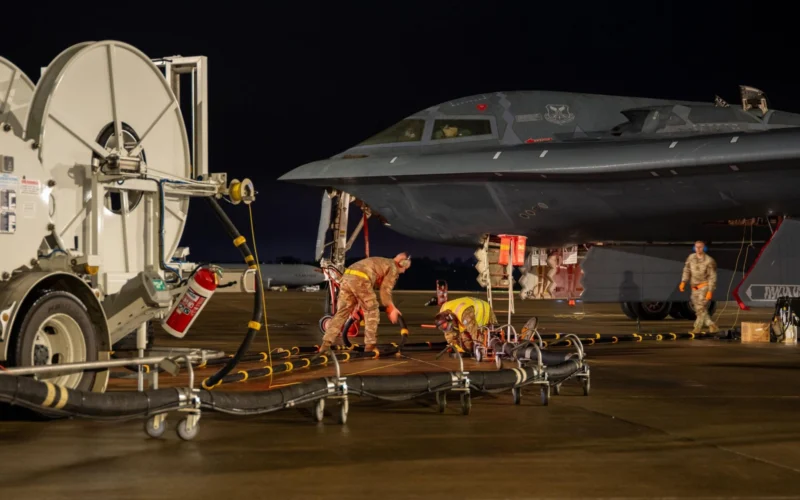
The United States Air Force (USAF) has deployed B-2 Spirit stealth bombers to Australia to train alongside Royal Australian Air Force (RAAF) personnel as part of Exercise Diamond Storm.
The exercise provided a rare opportunity for the next generation of Australian air warfare specialists to work with one of the world’s most advanced aircraft.
It took place at RAAF Base Amberley in Queensland and was designed to help candidates in the Air Warfare Instructor Course develop skills in integrating advanced air power effects.
AUSTRALIA’S next generation of Air Warfare experts have demonstrated mastery in integrated air power alongside a USAF B-2 Stealth bomber as part Exercise DIAMOND STORM. pic.twitter.com/K0QIQfTc1b
— Royal Australian Air Force (@AusAirForce) June 25, 2026
Fifth-generation integration
The B-2’s participation included integration with Australia’s F-35 fleet, air-to-air support, ground-based refueling, and logistics and security support in a high-tempo scenario. Australian personnel on the ground provided security and logistics assistance during a short operational window.
Air Commodore Pete Robinson, Director General of Air Combat Operations for the Royal Australian Air Force, suggested that the exercise is a demonstration of the strength of the partnership between Australia and the United States.
“The inclusion of the B-2 stealth bomber in the exercise is a clear example of the strong relationship and trust between Australia and the United States and proves our ability to develop practitioners who can operate at the high end of an international force,” Robinson said, as quoted in a statement by the RAAF.
He added that the training is essential to preparing the next generation of experts in integrated air power.
“The Air Warfare Instructor Course is vital to ensure the preparedness of Royal Australian Air Force personnel, and to train the next generation of experts in integrated air power effects to enable a collective strategy of denial in our region,” Robinson said.
A shared advantage
According to RAAF, the commander of the USAF 393rd Expeditionary Bomb Squadron said the training was valuable for maintaining readiness and strike capability, describing the integration as “invaluable to maintaining a top-of-state readiness, our always-ready global strike capability, and integrated lethality with our coalition partners”.
RAAF added that the commander emphasized the importance of alliances in the Indo-Pacific region, noting that “our combined network of allies and partners in the Indo-Pacific is an asymmetrical advantage that our adversaries will never match”.
The deployment was part of the Enhanced Air Cooperation program between Australia and the United States. Robinson said the exercise reinforced deepening interoperability and force posture initiatives between the two countries.
“It clearly demonstrates that our closest partner sees the value of our high-quality training and that we can seamlessly support each other,” Robinson said.