

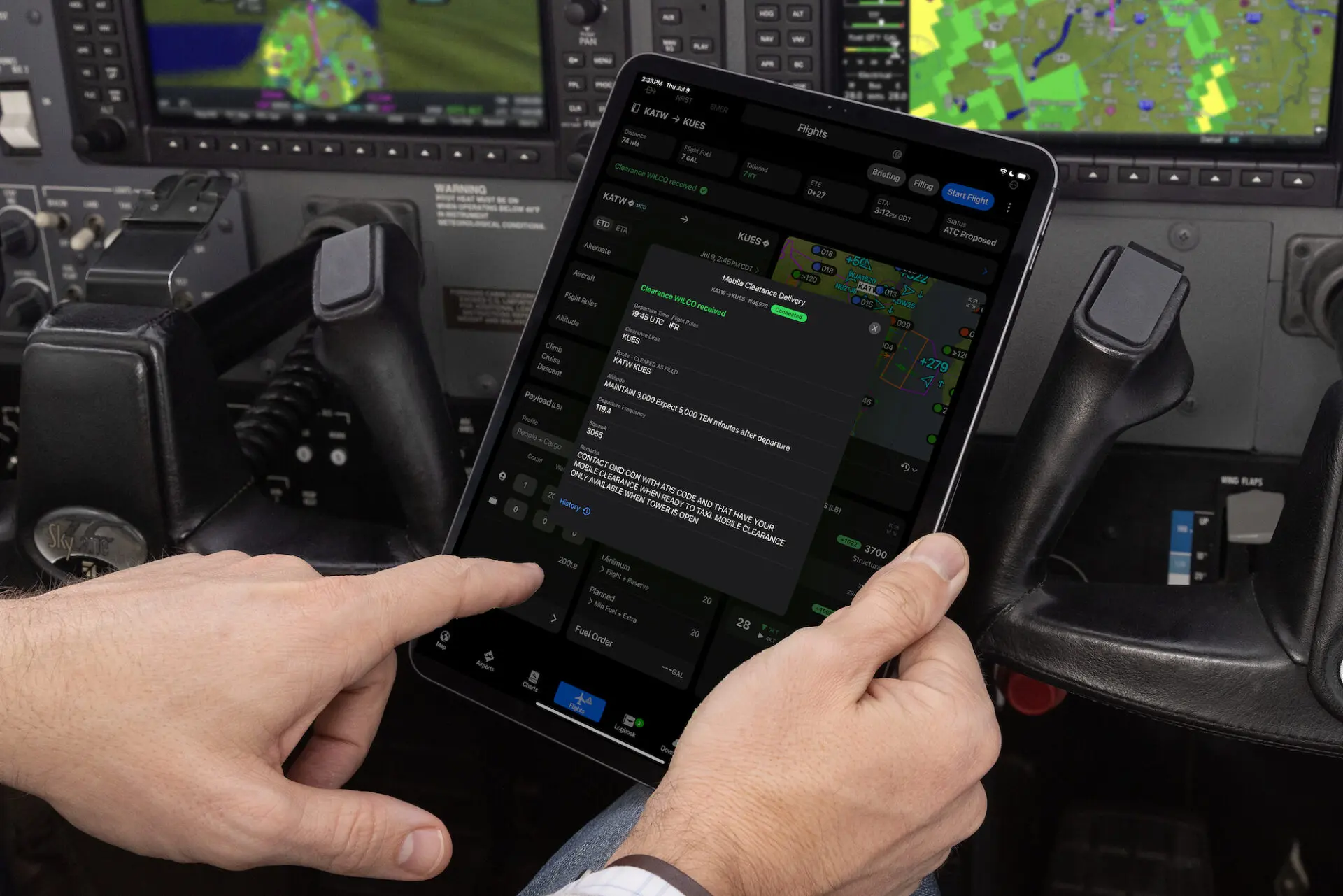
The FAA is testing a new system that allows general and business aviation pilots in the US to request and receive IFR departure clearances through ForeFlight and Garmin Pilot instead of copying them over the radio or calling air traffic control by phone.
The agency unveiled Mobile Clearance at EAA AirVenture Oshkosh on July 23, 2026, calling it a step toward bringing airline-style digital clearance delivery to smaller airports that lack existing datalink services.
Under the system, pilots file an IFR flight plan through an approved application and request their clearance from within the app. ATC returns the clearance as text, giving the pilot a written record to review before accepting it.
The FAA said the system should reduce radio congestion and the risk of errors that can occur when pilots copy and read back clearances verbally. More than half of the approximately 44,000 daily IFR departure requests in the United States are still handled by voice, according to the agency.
Mobile Clearance is now undergoing operational testing through ForeFlight and Garmin Pilot at five airports: Sugar Land Regional Airport in Texas, KSGR; Scholes International Airport at Galveston, KGLS; David Wayne Hooks Memorial Airport near Houston, KDWH; Appleton International Airport in Wisconsin, KATW; and New Century AirCenter near Kansas City, KIXD.
The FAA began testing the system at the three Houston-area airports in May 2026 before adding Appleton and New Century during the summer. Pilots departing Appleton on IFR flight plans during AirVenture were invited to try the service and provide feedback.
The process in Garmin Pilot begins after a pilot files an IFR flight plan from a participating airport.
Within 30 minutes of the planned departure, eligible Garmin Pilot Premium subscribers using iOS devices can open a Mobile Clearance Delivery session from the app’s Flights page. The pilot receives the clearance from ATC, reviews it and accepts it by selecting “WILCO.”
Garmin Pilot can then overlay the cleared route on its moving map. Pilots with compatible avionics can also send the route to the panel through Garmin’s Connext system.
The clearance remains available in the app after departure, giving the pilot a text reference for up to 48 hours.
ForeFlight is integrating the same FAA service directly into ForeFlight Mobile. The company said Mobile Clearance will allow pilots to communicate with ATC through the app when managing IFR clearances, reducing the need to use congested radio frequencies or telephone lines.
ForeFlight demonstrated the capability at AirVenture and made it available to participating pilots departing Appleton during the show.
The system is aimed largely at airports where pilots cannot obtain a conventional Pre-Departure Clearance or use FAA Data Comm.
Airlines and some business aviation operators already receive digital clearances through Tower Data Link Services at larger airports. Mobile Clearance adapts a similar process for pilots operating from smaller general aviation airports through applications they already use for flight planning, weather and navigation.
The service does not replace ATC authority or allow the app to generate a clearance. The clearance still comes from air traffic control. ForeFlight and Garmin Pilot serve as the connection between the pilot and the FAA system.
The FAA has worked with MITRE on the concept since 2016. Simulation testing with pilots and controllers began in 2024 at the agency’s William J. Hughes Technical Center in New Jersey before the first operational evaluation opened in Houston this year.
The agency also plans to add the ability to cancel IFR through participating apps after landing.
That could be especially useful at non-towered airports, or at Class D airports after the tower closes, where pilots often must cancel by radio before losing contact or call ATC after landing. An electronic cancellation would release the protected airspace for another IFR aircraft without requiring an additional telephone call.
The FAA said testing of the cancellation feature will begin in the Houston area in August. Garmin described IFR cancellation as a future enhancement to its implementation of the system.
Additional testing is planned this fall at Kansas City Downtown Airport, Johnson County Executive Airport, Austin Executive Airport, Georgetown Executive Airport and San Marcos Regional Airport.
The FAA expects the evaluation period to end in February 2027, followed by deployment at airports around the country. Garmin said availability through Garmin Pilot will expand in phases through 2028.
“Mobile Clearance is a smart, simple improvement that builds on technology pilots already use every day,” FAA Administrator Bryan Bedford said. “By moving routine clearances to a digital format, we can improve communication accuracy for pilots, reduce misunderstandings, and help controllers stay focused on aircraft movement and runway safety.”