

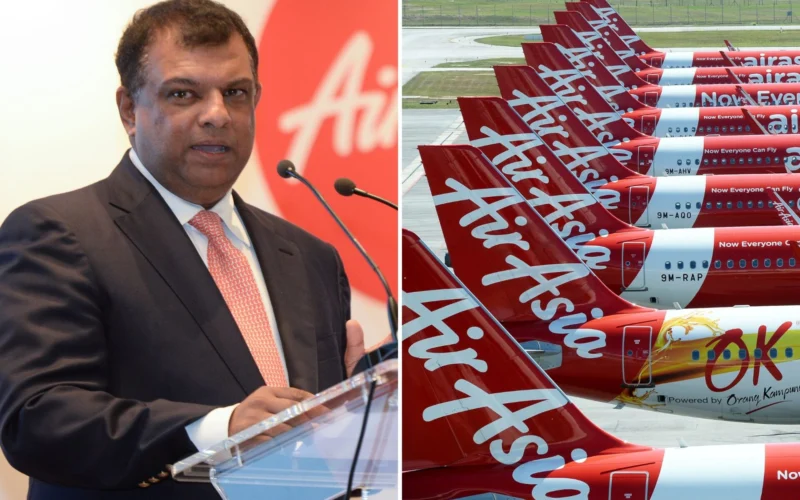
On September 18, 2026, AirAsia co-founder and group adviser Tan Sri Tony Fernandes pushed back firmly against reports of financial distress at the airline. He dismissed media coverage of the carrier as overblown and categorically denied that AirAsia had sought or received any form of government assistance.
Speaking at a press conference in Bangkok, Fernandes was unambiguous. “We are okay, we are sustainable,” he said. “We are good at managing cash and we are strong in liquidity. Things get blown out of proportion when it’s AirAsia. I sneeze, it’s a big story.”
‘Most ludicrous statement in 25 years’: Fernandes rejects bailout and contingency reports
The press conference was called in the wake of a September 16, 2026 Reuters report. Citing unnamed sources, the report claimed that Malaysia’s government had approached Malaysia Airlines and Batik Air about their capacity to absorb AirAsia’s domestic market share as part of contingency planning while authorities monitor the airline’s financial position.
The report triggered a sharp sell-off, with AirAsia shares closing 21% lower on September 17, 2026, hitting a four-year low, and falling a further 2% on September 18, 2026.
Fernandes was dismissive of the claims. “I can confirm that the government of Malaysia said not such thingt,” he said. “You cannot just say, ‘Oh, this airline is going to take AirAsia’s capacity.’ I mean, it’s the most ludicrous statement I have seen in 25 years.”
He also denied all knowledge of any purported appointment of Alton Aviation Consultancy by Malaysia’s Finance Ministry to evaluate the airline’s capital requirements, instead describing AirAsia as “not an airline about to collapse”.
‘No one can replace our 100 planes overnight’: Fernandes on AirAsia’s market dominance
Fernandes was equally direct about operations. AirAsia currently operates a fleet of 250 aircraft, with the remaining 10 expected to return to service by October 2026.
The airline has returned 25 older, less fuel-efficient aircraft as part of a broader fleet optimisation program, transitioning toward a more efficient narrowbody mix, rather than as a sign of financial strain.
Of the six newly-delivered aircraft that were offloaded, Fernandes framed the move as a response to the oil supply crisis and not a reflection of financial pressure.
Load factors, he noted, remained healthy. The airline’s seat occupancy stood at 80% in the third quarter, with strong bookings already visible for the fourth quarter.
Fernandes expressed particular optimism about AirAsia’s operations in Indonesia, the Philippines and Thailand, with the group on track to carry 60 million passengers in 2026 and targeting 80 million in 2027. As of the second quarter, the group had already carried 43 million passengers.
“No one can replace AirAsia’s 100 planes in Malaysia overnight,” Fernandes said, pointing to the airline’s estimated 60% share of Malaysia’s domestic market. “I mean, how do you replace 100 airplanes in Malaysia? You can’t. First of all, you have to have our cost structure, our brands, our markets, networks and interlining.”
The real culprit: jet fuel prices that surged 66% in a single quarter
Nevertheless, Fernandes did not downplay the financial pressure from jet fuel costs.
The airline was hit hard in the second quarter when jet fuel prices, driven by the ongoing US-Israeli conflict with Iran, surged 66% from the prior quarter to an average of US$183 a barrel, well above the sub-US$100 levels that preceded the war. AirAsia sold tickets based on a fuel price of around US$85 per barrel.
The airline reported a net loss of RM831 million (US$204 million) for the second quarter ending June 30, 2026, which also included foreign-exchange losses of RM331 million (US$81 million).
Fernandes stressed that jet fuel prices were likely to remain between US$170 and US$190 per barrel in the near term, making fare adjustments a necessity rather than a choice. He claimed that earnings were beginning to catch up with rising costs as the airline adjusted its pricing, and signaled that third-quarter results would show a stronger cash position.
“We just have to adjust our cost structure and fares and by the end of the third quarter, the liquidity is catching up,” he said. “This is an adjustment. If oil prices stay at this level, all airlines will have to adjust.”
Fernandes points to a 500-plane order book and strong investor interest to reassure markets
Beyond the immediate pressures, Fernandes pointed to AirAsia’s order book as evidence of the airline’s long-term position. The group holds a firm order for 150 Airbus A220-300 aircraft signed in May 2026, valued at approximately US$19 billion, with an option to upsize by an additional 150 aircraft, bringing the potential total to 300.
AirAsia also has 500 aircraft on order overall. “Roughly, the profit sitting in that is US$1.5 billion, because we bought them in good times,” Fernandes said. “Even if you think we are short of liquidity, we can monetise that and have a lot of cash.”
On the fundraising front, AirAsia is raising US$1 billion from international debt markets and RM700 million (US$172 million) in local credit facilities in order to restructure and refinance existing debt, consolidating multiple facilities into a lower-cost structure.
Fernandes highlighted that the response from banks and investors had been positive, with interest from European and US banks, local institutions, and even a signed term sheet from a Middle Eastern bond investor.
“We have many choices. I’m trying to get the cheapest choice,” he said.
Bo Lingam, Group CEO of AirAsia Group, reinforced this message in a separate statement. He noted that, while the airline had tactically reduced capacity by 20 to 25% in the third quarter – traditionally a weaker travel period – it was preparing to ramp capacity back toward pre-war levels in the fourth quarter to align with peak year-end travel demand.
“AirAsia has always been an airline that adapts, adjusts and finds a way forward,” Lingam said. “We are managing industry-wide headwinds from a position of strength, executing a clear and strategic plan for sustainable and profitable growth.”
A crisis, but not the worst one
Fernandes returned repeatedly to COVID-19 as his benchmark for genuine adversity, one that AirAsia navigated without any government assistance, despite operating with only about 10% of its fleet during lockdowns.
“We’ve been through many, many crises, but we’ve always come out stronger,” he said. “COVID was far, far worse than what we are dealing with now.”