

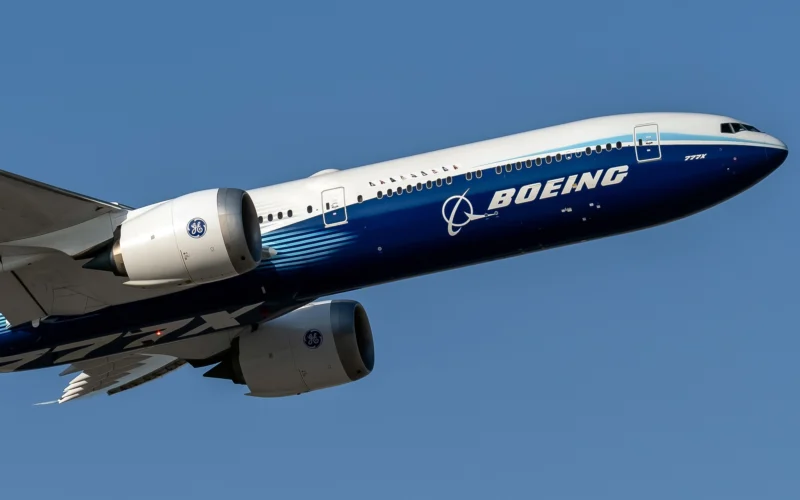
Evidence suggests that Boeing has updated the advertised range of the B777X aircraft.
The US aircraft manufacturer has not made any official announcement about these changes. However, several media outlets and industry analysts have noted that Boeing has quietly updated the marketing materials related to the B777X which are available online.
The range performance improvement seems to be across the whole family of aircraft.
The B777-9 has been increased by 715 nm (1,324 km), from 7,285 nm (13,492 km) to 8,000 nm (14,816 km), an increase of almost 10%.
The rise has been even larger for the B777-8, which has seen its advertised range expanded by 755 nm (1,398 km), from 8,745 nm (16,196 km) to 9,500 nm (17,594 km) – a boost of 8.6%.
This figure places this version of the B777X close to the 10,000 nautical miles (18,520 km) of the Airbus A350-1000ULR, which has been picked by Qantas to operate what is set to be the world’s longest commercial route, from Sydney (SYD) to London Heathrow (LHR).
The B777-8 Freighter has also had 590 nm (1,093 km) added to its advertised performance, taking it from 4,410 nm (8,167 km) to 5,000 nm (9,260 km) – in percentage terms, the largest jump at 13.4%.
What’s more, the theoretical maximum number of passengers that each of these B777X versions is able to carry appears to have been updated upwards, too.
The B777-8 is now listed as being able to carry 350 to 425 passengers in a two class-configuration, while previously the upper limit was 395.
The equivalent number of the B777-9 has been revised to a bracket of 375 to 450 passengers in two classes, while previously it stood at 426.
Richard Schuurman at aviation news platform AirInsight noted that these performance figures have been revised while leaving the aircraft’s MTOW (Maximum Take Off Weight) largely intact. This may indicate that these changes have been achieved through efficiency improvements rather than through any structural modifications.
The B777-9 is currently expected to complete its certification process by early 2027, as it continues to accumulate delays. The B777-8, in both its passenger and cargo versions, could take another two to three years to achieve certification.
AeroTime has reached out to Boeing for further comment.