

The global aviation industry is facing an unprecedented need for talent. According to CAE’s 2025 Aviation Talent Forecast, the industry will need 1.5 million new professionals over the next decade, driven by growing air demand and the subsequent global airline fleet expansion.
What’s more, even if this frantic rate of growth slows, the industry must still contend with the need to replace nearly one-third of commercial pilots, who are expected to retire or leave their posts over the course of the next decade.
These trends underscore how important it is for the world’s major airlines to have well-resourced and technologically advanced in-house training organizations. Lufthansa Aviation Training plays such a role at the eponymous airline group, keeping current staff up to date with best practices and standards, while continuing to nurture a constant talent pipeline.
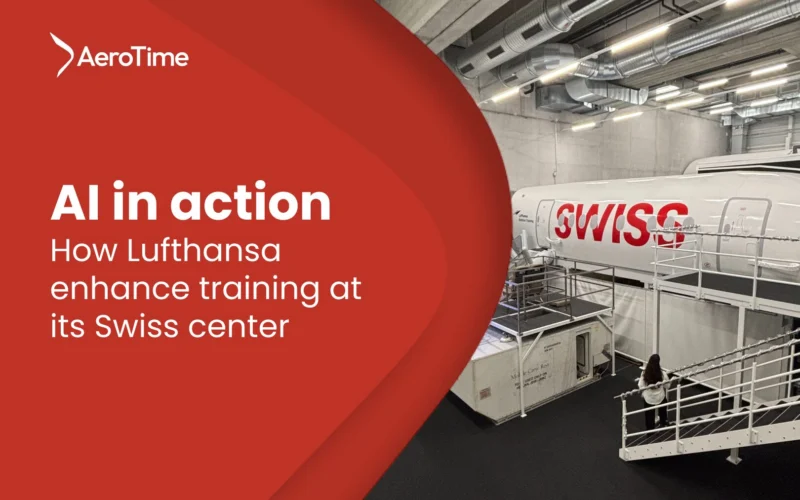
The airline group took AeroTime behind the scenes of one of its major centers in Opfikon, Switzerland, located near to Zürich-Kloten International Airport (ZRH). It is here, in a state-of-the-art facility which opened in 2019 as a replacement for a much smaller one located in the same area, that pilots and crew for SWISS and Edelweiss undergo most of their training.

The Zürich center is capable of training crews in the handling of all aircraft currently in the SWISS and Edelweiss Air fleets and serves other operators. This includes Swiss air rescue and medical transport operator REGA, for which it operates Bombardier Challenger 650 and helicopter simulators.
The center is equipped to handle virtually any training scenario, from emergency procedures to inflight service protocols. It also features 10 full flight simulators, including for the Airbus A350, the latest arrival to SWISS’ fleet, as well as three Flight Navigation Procedural Training (FNPT) machines, one of which is a mixed reality trainer, four Integrated Procedures Trainer (IPT), and one Flight Training Device (FTD), a fix base full size replica of the flight deck of an Airbus A320.

Leveraging Artificial Intelligence (AI)
Beyond traditional flight training, Lufthansa Aviation Training has pioneered digital innovation with mAIntor, an AI-powered “maintenance mentor” that exemplifies the company’s commitment to leveraging technology.
In a perfect example of intrapreneurship, professionals at the center have developed mAIntor, a sophisticated chatbot that provides instant access and sorts through the airline’s vast documentation repository, which comprises more than 1.2 million pages of documentation.
Jonas Stäuble, Head of Training Devices & Infrastructure at Lufthansa Aviation Training, explained how this digital tool was developed over the last two and a half years as an internal, bottom-up initiative when the firm’s engineers were looking for ways to shorten the technically caused training interruptions on the simulators by providing quick answers to complex technical questions that require extensive research during troubleshooting.

He explained: “Earlier, if a pilot had a technical issue during training, let’s say a display was flickering during approach or something like that, he would enter a case in our MRO platform and, afterwards, an engineer would investigate and try to fix it.”
The problem? This type of report can pile up quickly. When you have a library of some 240,000 such cases, the chances are that a specific issue has already been solved by someone else.
“If you have got to search out these 1.2 million pages in our documentation library, it is going to be time consuming,” said Stäuble.
The idea to create an AI-powered tool came from a young engineer in Stäuble’s team.
“That’s the beauty of our department,” he said. “We have a lot of smart guys, and they can write software code. They are able to create things on their own.”
“mAIntor is a chat bot, which has been fed all our documentation. I know it might not sound so innovative, but in our regulated aviation world it’s quite an advance,” he continued. “This is because we have to make sure that all our documents are protected, nothing can be left out, and wrong information is not admissible. We have to make sure everything is within our protected bubble.”
This includes MRO maintenance documentation, including all previously opened cases and work orders and their solutions. The system is currently updated daily, during the night, although Stäuble’s team is already working on an upgrade that would enable much faster updates.
“Every day, new ideas are coming up,” Stäuble said before adding that the idea is to be able to learn from what happened during the last shift.

“We have three daily shifts and, as you can imagine, they’re all human,” he continued. “Some of them are better than others in transferring information in a verbal way. The idea is to be able to have a summary of what happened in the last couple of hours with a single click.”
Access to mAIntor will be further facilitated by enabling tablet access and integrating data from across Lufthansa Aviation Training with the idea of deploying it to the other sites. In fact, this is not the first time an MRO digital tool has been created in Switzerland and later adopted by the ensemble of the Lufthansa Group and even external parties.
Lufthansa-owned AMOS (Aircraft Maintenance and Operations System), a commercially available industry-leading aviation maintenance management system, which was originally developed by Crossair, a subsidiary of the then Swiss flag carrier Swissair, which later became SWISS, before being acquired and fully integrated into the Lufthansa Group.
Interestingly, AMOS is one of the key sources from which mAIntor is fed data. If mAIntor consolidates in its role, it may even be “productized” and commercialized, or at least this is Stäuble’s vision when it comes to the tool’s potential.
As the Zürich team continues to refine its capabilities, for SWISS technicians seeking exact procedural details or troubleshooting guidance, mAIntor already represents a significant leap forward in how maintenance knowledge is accessed and applied.
Excellence beyond aviation
Not all the training center’s commercial projects are so technology intensive. Interestingly, the Swiss branch of Lufthansa Aviation Training is taking its aviation expertise to other industries, such as healthcare, catering, and hospitality, which similarly rely on strict procedural protocols and high service standards.
“We have several clinics coming here for human factors training. Learning about non-hierarchical intra-teamwork.” Stäuble said. “What does this mean? The way things are done in a cockpit can also be of use in the operating room, for example, between surgeons and nurses.”
He continued: “Many incidents originate from communication problems. We have a lot of knowledge in that area. Others, like a well-known Swiss caterer, come here, for example, to provide appearance training for their staff, things like learning how to best wear uniforms.”

For Stäuble and his team, this 24/7 operation, which trains approximately 12,000 people annually, is not just about maintaining standards, it is also about pro-actively adopting and perfecting technology and methodologies that contribute to disseminating knowledge across and beyond the industry.