
International Airlines Group (IAG) announced on June 29, 2026, that it has participated in the AU$28 million (US$20 million) Series A funding round of Australian firm MAKO through its venture capital arm, IAGi.
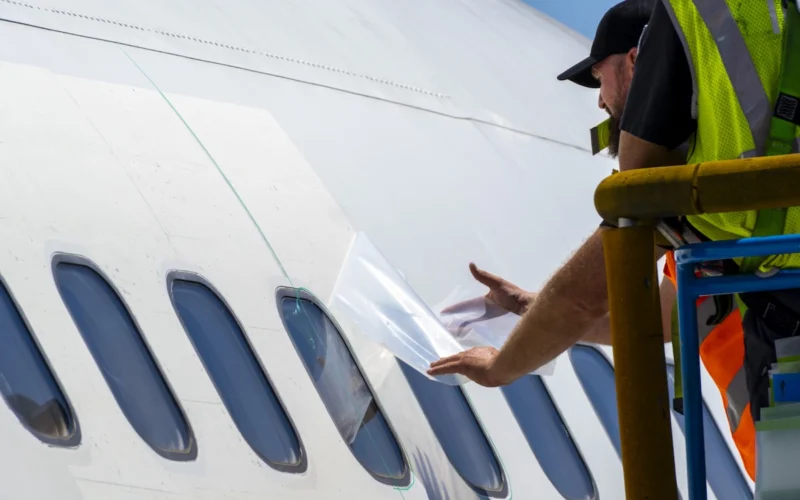
This Sydney-based startup is developing a technology called “Flightfilm”, an adhesive film layer which is added to the outer surface of an aircraft to improve its aerodynamic performance.
The coating has been micro-engineered to mimic the skin of sharks, helping smooth the flow of air over the fuselage surfaces to reduce drag and save fuel when in flight.
Flightfilm can be installed without the aircraft having to undergo any external modification, although it will need to complete its certification process and obtain a Supplemental Type Certificate (STC) before it can be rolled out commercially.
This is precisely what the current Series A aims to achieve. With the additional capital raised, MAKO will be able to advance further along its industrial rollout plan and, once Flightfilm is certified, begin to deliver on the pre-orders it already has on its books.
The current funding round has been led by Virescent Ventures and, in addition to International Airlines Group (IAG), it also counts the participation of a handful of other venture capital firms such as Zero Infinity Partners, Grok Ventures, Skip Capital, IP Group, and TreeArc.
MAKO, which was previously known as MicroTau, was established more than a decade ago. In 2015, shortly after its launch, MAKO won a contract with the United States Air Force (USAF) to test its technology on military aircraft.
So far, MAKO has conducted flight tests on the C-130J Super Hercules, in which it claims to have validated fuel consumption reductions of up to 4%. To put this figure into context, MAKO estimates that if Flightfilm is applied to an Airbus A320, it could save around 100,000 gallons of jet fuel annually, equivalent to US$330,000 and 1,000 tons of CO2 per aircraft per year. Further tests on military C-17 Globemaster III aircraft are also being planned.
In commercial aviation, MAKO is collaborating with Delta Air Lines’s Sustainable Skies Lab, the carrier’s sustainable aviation accelerator, and is planning to test its technology with several, yet-to-be-named, airlines in the Asia-Pacific region.
Following its investment in MAKO, IAG also plans to test the Flightfilm technology on its own aircraft in the near future.
Flightfilm is similar in its approach to aerodynamic improvement to aeroSHARK, jointly developed by Lufthansa Technik and German chemicals giant BASF. While aeroSHARK claims to deliver fuel savings of around 1%, it has already been deployed commercially by several airlines around the world, including the Lufthansa Group carriers, All Nippon Airways (ANA) and LATAM Airlines.