

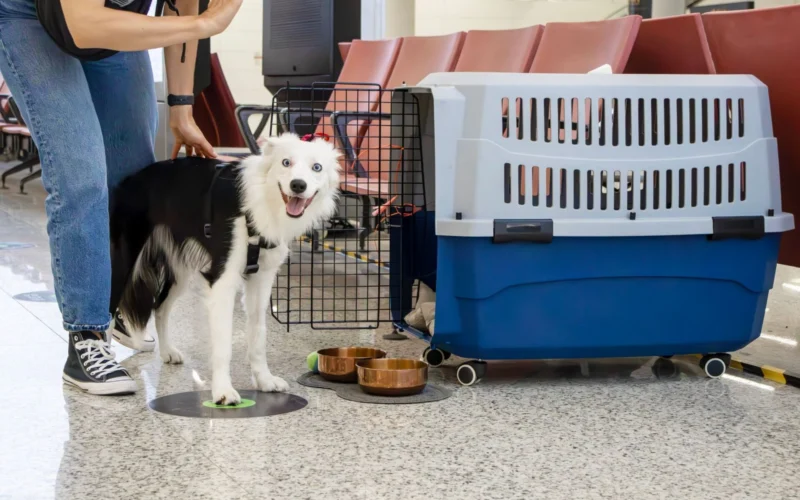
As more people opt to bring their pets along for the ride, the International Air Transport Association (IATA) has stepped in with new guidance aimed at making that experience less confusing, for passengers and airlines alike.
The organization’s newly released In-Cabin Operational Guidelines walk airlines through how to manage pet travel at every stage of a trip, from the moment a booking is made to check-in, boarding, the flight itself, and arrival.
It’s the latest move in a broader push by IATA to bring more consistency to how animals are handled in the air, following its earlier guidance on traveling with service dogs.
The timing isn’t coincidental. IATA’s 2025 Global Passenger Survey found that roughly a quarter of travelers have flown with a pet or would consider doing so, but many said they didn’t feel fully informed going in. About 41% weren’t sure whether their pet would even qualify to fly, 36% were uncertain about airline policy, and 34% said they simply didn’t understand how the process worked.
“A pet is a much-loved member of the family,” said Brendan Sullivan, IATA’s Global Head of Cargo. He said travelers need to know what to expect at each step, adding that clear, industry-wide practices help airlines deliver a safer, more consistent experience for passengers flying with pets.
What the guidance covers
Rather than dictating strict rules, the new guidelines are meant to give airlines a shared playbook: one that keeps safety, animal welfare, and operational efficiency in mind while still leaving room for individual airline policies.
IATA said that In practice, that means clearer procedures for how staff communicate with passengers, how pet carriers are labeled and handled, and how information flows between booking agents, check-in counters, and cabin crew.
According to IATA, airlines that follow the new framework can expect fewer misunderstandings at the airport, fewer service escalations, and a lower chance of pet-related issues disrupting on-time performance. The guidelines also touch on what happens after landing, encouraging airlines to offer support that helps passengers and their pets settle in once they’ve arrived.
Pets versus service animals
The guidance also draws a clearer line between pets and animals that serve a different purpose altogether.
Service animals, typically dogs trained to assist people with disabilities, are recognized under international and national law and can usually fly in the cabin at no charge, provided they meet certain documentation and behavior standards.
Emotional support animals fall into murkier territory: they aren’t universally recognized, and depending on the airline and the destination, they may end up being treated the same as an ordinary pet.
IATA says that distinction has long been a source of confusion for travelers, which is part of why it worked with airlines, service dog organizations, disability advocates, and regulators to develop separate guidance specifically for service dogs.
Together, the two documents are meant to bring more clarity to a space that has often varied significantly from one airline, or one country, to the next.
The release also reflects IATA’s continued engagement with global regulators and the International Civil Aviation Organization as part of a wider effort to make air travel more accessible and predictable for passengers traveling with animals of all kinds.
1 comment
How about the “rights” of people who do not want an animal near them in a confined space aircraft.