

Ireland is considering asking for air defense assistance from its European partners during its upcoming presidency of the Council of the European Union (EU), scheduled to begin in July 2026.
The plan could include the deployment of an allied warship to Dublin Bay equipped with anti-aircraft missiles, according to The Irish Times.
One candidate is the French Navy Aquitaine-class frigate Bretagne, which is scheduled to visit Dublin in November 2026. The multi-mission frigate (FREMM), equipped with Aster surface-to-air missiles, could form part of broader security efforts to protect Irish and visiting EU airspace during the more than 20 high-level meetings planned throughout the presidency.

Counter-drone battery at Baldonnel
As part of its preparations, the Irish government has decided to fast-track the purchase of an unspecified counter-drone system. Tánaiste [deputy Irish prime minister] and Minister for Defence Simon Harris has reportedly instructed officials to secure urgent delivery of the system to detect, track, and intercept unmanned aerial vehicles.
Under current plans, a single counter-UAS (Unmanned Aerial System) battery will be deployed at Casement Aerodrome in Baldonnel, which serves as the headquarters of the Irish Air Corps and is the country’s only airbase, located west of Dublin. This deployment aims to protect airspace during VIP arrivals and departures.
Additionally, the Gardaí are acquiring short-range anti-drone devices in cooperation with Dutch police, who have experience testing counter-UAS technologies. Among their more unconventional initiatives was a program that trained eagles to intercept small drones, which was ultimately discontinued in 2017 due to high costs and limited operational success.
Lessons from Denmark
Ireland’s situation mirrors Denmark’s own efforts to reinforce air defense after years of limited capability. After retiring its HAWK batteries in 2004, the country relied on fighters and naval systems for air defense, a gap the Danish General Staff called a “vulnerability.” Copenhagen has since launched a €7.7 billion program to field SAMP/T NG, NASAMS, VL MICA, and IRIS-T SLM systems, with the first batteries expected to arrive in 2026.
Those upgrades, however, came too late for Denmark’s 2025 EU presidency, when it faced repeated drone incursions. Thus, Copenhagen turned to its European partners for assistance.
France deployed a 35-person detachment with a Fennec helicopter configured for counter-drone operations, fitted with electro-optical sensors and snipers armed with NEROD RF rifles to jam and disable drones.
Additionally, Germany deployed the Sachsen-class air-defense frigate Hamburg to reinforce long-range airspace surveillance with its radar and surface-to-air missile systems, an arrangement closely paralleling Dublin’s consideration of the French FREMM Bretagne for a similar role.
Addressing the air defense gap
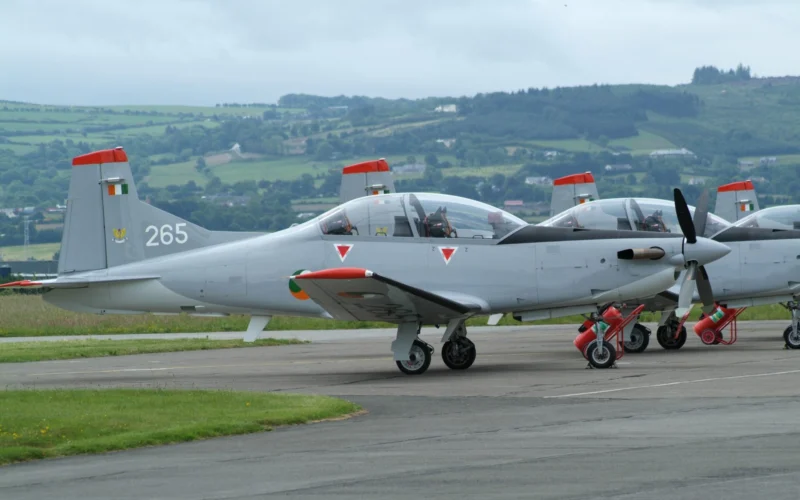
The move also highlights Ireland’s longstanding vulnerability in air defense. The country has not operated combat jets since 1998, when its Light Strike Squadron, flying Fouga CM170 Magisters, was retired. It currently relies on a secret bilateral arrangement under which the UK Royal Air Force intercepts unidentified aircraft in Irish airspace.
Former Irish Air Corps Head General Ralph James has described Ireland as “probably the most vulnerable” country in Europe, warning that neutrality cannot substitute for credible air surveillance and interception capability.
In recent years, Ireland has begun modest efforts to rebuild its air domain capabilities. The country recently completed delivery of its third and final Airbus C295 aircraft, marking the completion of a €300 million program that strengthened both maritime patrol and transport capacity.
Ireland also plans to acquire its first combat jets in more than 50 years: cost estimates range between €60 million and €100 million per year over 20–25 years, with a preferred fleet size of 12–14 aircraft, potentially bringing the total investment to as much as €2.5 billion.
While no formal requests have been made, Minister Harris has said that strengthening air surveillance and counter-drone capabilities will be “key early priorities” ahead of 2026. The new counter-drone capability will form part of Ireland’s primary radar acquisition project, a €300 million program designed to give the state its first national radar coverage by 2028.
13 comments
Jas 39 Grippens,great option, ideal for our infrastructure, superb aircraft
It’s a national shame that we do not possess a single jet fighter, it’s frankly an embarrassment. We’ve essentially been freeloading these defense capabilities from the UK. Glad at least to see some movement in the mooted acquisition of an actual jet air force such as the Gripen.
Yes you only want the UK when it suits you, and even then you want to do it in secret. We are not here to protect Eire perhaps your European buddies should station a squadron of jets which you would have to pay for.
Congratulations, you found an opportunity to slag us off. But guess what, you’re right
Yet they elect these ‘neutrality ‘ morons as Presidents. BIG mistake
Irish president is a ceremonial position,no power so irrelevant
What about protecting the Irish people first.
Successive government’s have failed in the defence and security of this country. No aircraft capable of intercepting anything that invaded our airspace. No underwater sonar for our naval service. The army with 23 years old armored personnel carrier’s.
It’s a bloody disgrace.
NEUTRALITY DOSE NOT MEAN WE DON’T PROTECT OUR BORDERS.
Ireland has a GDP of €535 billion, which is 36% higher than Denmark’s, with a comparable population of 5.2 million (compared to 5.9 million for Denmark). However, this country, which has become one of the richest in Europe alongside Luxembourg, spends only 0.25% of its GDP on defence, compared to 1.91% for Denmark… Scandalous!Its armed forces are equally small, with 7,400 active military personnel and 1,500 reservists.By comparison, Denmark organises its defence within NATO with 13,100 active military personnel and 44,200 reservists .This carefree attitude, at a time when Russian air and sea intrusions and intimidations have been recurrent for several years, raises questions about the irresponsibility of the leaders of this now very wealthy country.The countries of the European Union must raise their voices to Ireland and demand that it rapidly and significantly increase its material and human defence resources.Taking on the rotating presidency of the European Union in 2026 must be earned!
Irelands long term lack of investment in defence and infrastructure has left us in a perilous place on two fronts. Both need quick and brave decisions which have been beyond our politicians who focus on the short term and retaining their seats at the next election. All the good things that have happened here since the 60’s were forced on us by the EEC/EU or referendums.
Very hard to see how that will change unless we somehow get the courage to greatly reduce the number of seats in local constituencies and the number of constituencies too and increase the time attendance required in the Dail (parliament) while at the same time being pressured by the EU to up our act defensively.
They sit on their hands and hide behind the neutrality banner, which under international law they are in breach of. A governments first duty is to protect it’s citizens and it’s sovereign territory. But they would rather waste money on bike sheds & security huts & pay four times the original budget for the national children’s hospital, plus I’d bet they’d raise their hands quickly enough to get a wage rise for themselves.
I would like to give some credit to Simon Harris for the progress so far but it is not enough & it’s very slow. These upgrades are ten years in the making. Given the fact that these measures are supposed to be urgently needed, why is it taking so long. Go to the European defence fund if necessary if you can’t get Michael Martins backing..
Thousands of Irish died inthe trenches in France fighting for your country 160 Thousand in first world War including my grandfather he is buried in France the Irish guards in market garden
It is said that around 75% of telecommunications cables in the northern hemisphere pass through or near Ireland’s exclusive economic zone.