

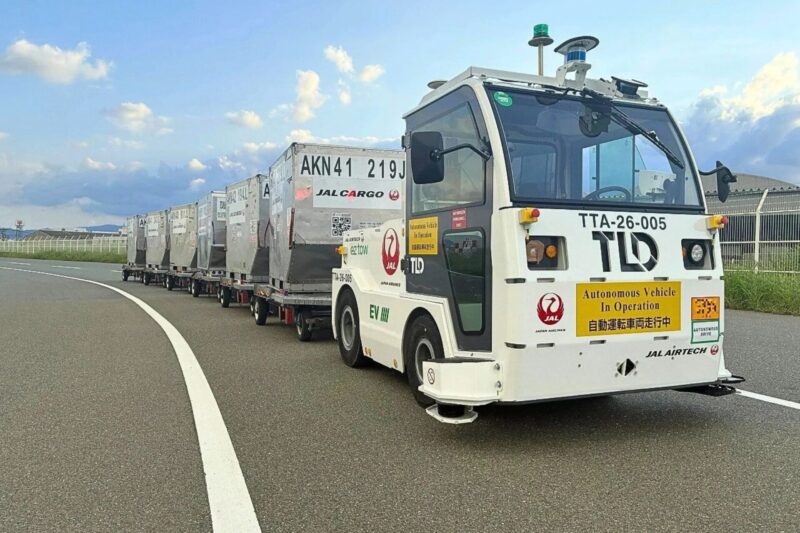
Japan Airlines (JAL) announced it has started Level 4 autonomous towing tractor operations at Fukuoka Airport (FUK), making it the third airport in its domestic network to use driverless vehicles for airside logistics.
The operations began on October 26, 2026, and were introduced together with airport operator Fukuoka International Airport Co, (FIAC).
Level 4 autonomy means the vehicles run fully driverless within specified operating conditions.
The move follows JAL’s launch of Level 4 towing tractor operations at Tokyo Haneda Airport (HND) and Narita International Airport (NRT) in December 2025. It is the airline’s first such deployment outside the Tokyo metropolitan area.
Driverless cargo runs at Fukuoka
At Fukuoka, the autonomous tractors transport cargo containers along a route of about 1.7 kilometers between the domestic cargo terminal and the ground support equipment (GSE) holding area. JAL and FIAC have set joint operating rules and upgraded airside infrastructure to allow the vehicles to run without a driver.
The airline said demand for both domestic and international travel at Fukuoka continues to grow rapidly.
The tractors are EZTow electric vehicles made by TLD Robotics, formerly known as TractEasy. Each measures 3.2 meters long, 1.84 meters wide and 2.05 meters high, weighs 4.07 tons and can tow up to 14 tons.
Responding to labor shortages
JAL has been introducing advanced airside technologies since 2018 as part of the Autonomous Driving Committee initiative led by the Civil Aviation Bureau of Japan’s Ministry of Land, Infrastructure, Transport and Tourism (MLIT).
The airline said automating routine ramp logistics helps offset labor shortages caused by Japan’s shrinking working-age population. It added that the electric vehicles produce zero emissions and reduce the risk of human error on busy ramps, where aircraft, specialized vehicles and ground staff operate side by side.
Plans for wider rollout
JAL plans to gradually expand its autonomous vehicle fleet, operating routes and coverage to more airports across Japan.
Alongside the towing tractors, the airline is using other automated equipment, including remote-controlled aircraft tugs, automated aircraft washing equipment and snowplows that can be run by a single operator.
With MLIT’s support, JAL also plans to deepen cooperation across the industry, including with All Nippon Airways (ANA), which is considering adopting similar systems.