

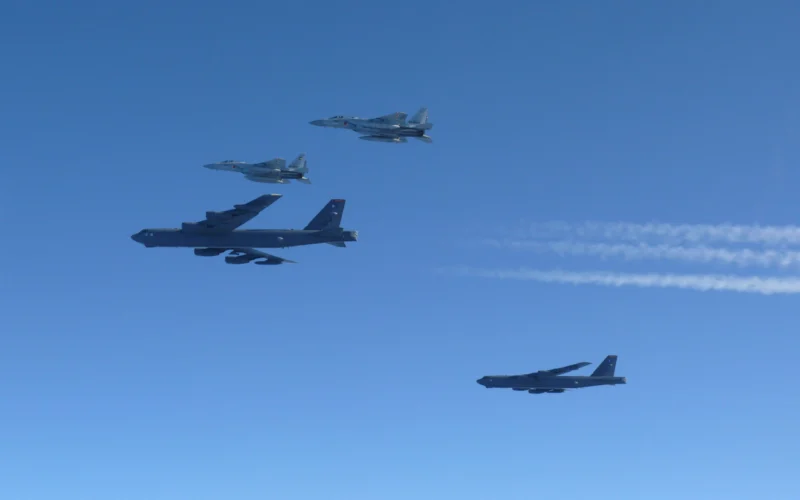
Japan’s Self-Defense Forces (JSDF) carried out joint military drills with the United States over the Sea of Japan on December 11, 2025, deploying US B-52 strategic bombers alongside Japanese fighter aircraft, Tokyo’s Ministry of Defense said.
According to the ministry, the exercise took place over the Sea of Japan and involved two US B-52 strategic bombers escorted by three JASDF F-35A stealth fighters and three F-15J fighters from the 6th Air Wing for the joint flight.
The drills were conducted as Japan faces what officials describe as an increasingly severe security environment, a point underscored by the Joint Staff in a public statement announcing the mission.
“In response to the deteriorating security situation surrounding Japan, the Japanese Self-Defense Forces and the US military conducted a joint training,” Japan’s Joint Staff said in the statement, adding that exercise demonstrated the two allies’ “strong determination not to allow unilateral changes to the status quo by force,” and confirmed the high level of responsiveness between the JSDF and US forces.
我が国を取り巻く安全保障環境がより一層厳しさを増す中、自衛隊と米軍は、下記のとおり #日米共同訓練 を実施しました。本訓練を通じて、力による一方的な現状変更を起こさせないとの日米の強い意思及び自衛隊と米軍の即応態勢を確認し、#日米同盟 の抑止力・対処力を一層強化しました。 pic.twitter.com/3LyXCC3HYq
— 防衛省統合幕僚監部 (@jointstaffpa) December 11, 2025
Reaction to Chinese and Russian activity in the region
The exercise followed several recent incidents involving Chinese and Russian military aircraft near Japan and its neighbors. On December 6, Tokyo lodged a protest after Chinese Navy J-15 fighters, operating from the carrier Liaoning, illuminated Japan Air Self-Defense Force F-15Js with fire-control radar during encounters southeast of Okinawa.
On December 9, Japan’s Joint Staff also reported that two Chinese H-6 bombers and two Russian Tu-95 bombers conducted a joint long-range flight from the East China Sea to the Pacific Ocean off Shikoku, prompting the Southwest Air Defense Force to scramble fighter jets.
Relations between Beijing and Tokyo have grown increasingly strained since Japan’s new prime minister, Sanae Takaichi, said on November 7, 2025, that Japan could intervene militarily if China attacked Taiwan.
Alliance signaling
Tokyo stated that the latest Japan–US drill validated the combined operational posture of both militaries and strengthened the alliance’s deterrence and response capabilities. Washington regularly deploys B-52s and other long-range assets to the Western Pacific for integrated training missions with regional partners.
Japan’s Ministry of Defense did not specify the exact location or duration of the December 11 exercise but affirmed that all activities were conducted in accordance with international law.