

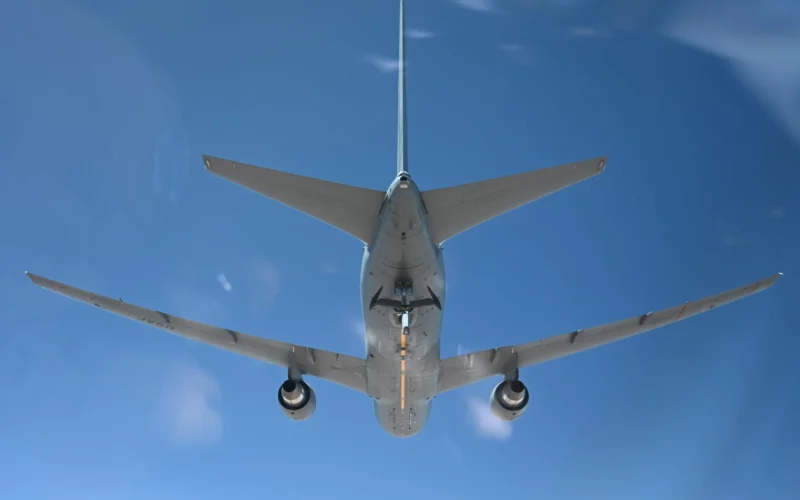
A US Air Force KC-46A Pegasus aerial refueling tanker lost its boom during a training mission on July 8, 2025, while refueling a flight of F-22 Raptors off the US East Coast. The incident marks the second known case of a boom separation involving the KC-46 and adds to the list of technical issues that have affected the aircraft’s development.
The aircraft, operating under callsign FELL 81 and assigned to the 22nd Air Refueling Wing at McConnell Air Force Base, was flying off the coast of Virginia when the boom detached, reportedly during contact with one of the Raptors. The crew declared an in-flight emergency and requested a diversion following the separation of the boom, according to ATC audio published by The War Zone via LiveATC.net.
The F-22 fighters returned safely to Joint Base Langley-Eustis, while the KC-46 diverted and landed without incident at Seymour Johnson AFB in North Carolina. No injuries or damage to the receiving aircraft were reported.
Second boom separation in a year
This marks the second known in-flight boom detachment involving the KC-46. In August 2024, a similar incident occurred during a refueling mission with F-15E Strike Eagles over California. While no injuries were reported in either case, the events have raised questions about the structural resilience of the boom system, particularly when refueling maneuverable fighter aircraft.
The KC-46 boom system has already undergone a redesign to address stiffness issues that prevented reliable contact with some receivers, including slower aircraft such as the A-10.
RVS 2.0 delays continue
The incident comes as Boeing and the US Air Force work to roll out the Remote Vision System 2.0 (RVS 2.0), a redesigned set of cameras and sensors used by boom operators to guide refueling. Deliveries of RVS 2.0 commenced in April 2025, but full integration is not anticipated until the end of fiscal year 2027. The original RVS was criticized for poor image quality, particularly in challenging lighting conditions.
According to Boeing, over 75 KC-46s have been delivered so far. The type is set to become the backbone of the US Air Force’s tanker fleet, replacing older KC-135 and KC-10 aircraft. However, the program has been marred by multiple technical issues, including fuel leaks, cargo lock malfunctions, and structural cracks.
In early 2025, deliveries were temporarily paused after cracks were discovered in structural components near the aircraft’s horizontal stabilizer. At least 23 aircraft were affected, though Boeing has since completed repairs on most of them.
Despite these setbacks, the KC-46 continues to be accepted by the US Air Force under a framework that allows deliveries while development issues are being resolved.
KC-135 to remain in service into the 2050s
Due to ongoing delays and capability gaps in the KC-46 program, the US Air Force now expects to retain a portion of its KC-135 Stratotanker fleet well into the 2050s. The aircraft, originally introduced in the late 1950s, has undergone successive modernization efforts to extend its service life.
While the Air Force had planned for the KC-46 to fully replace the KC-135, recurring technical setbacks and the absence of a next-generation tanker (KC-Z) have made a complete phaseout unlikely in the near term. According to Air Mobility Command planning documents, maintaining legacy tankers into the mid-21st century may be necessary to meet operational demand.