

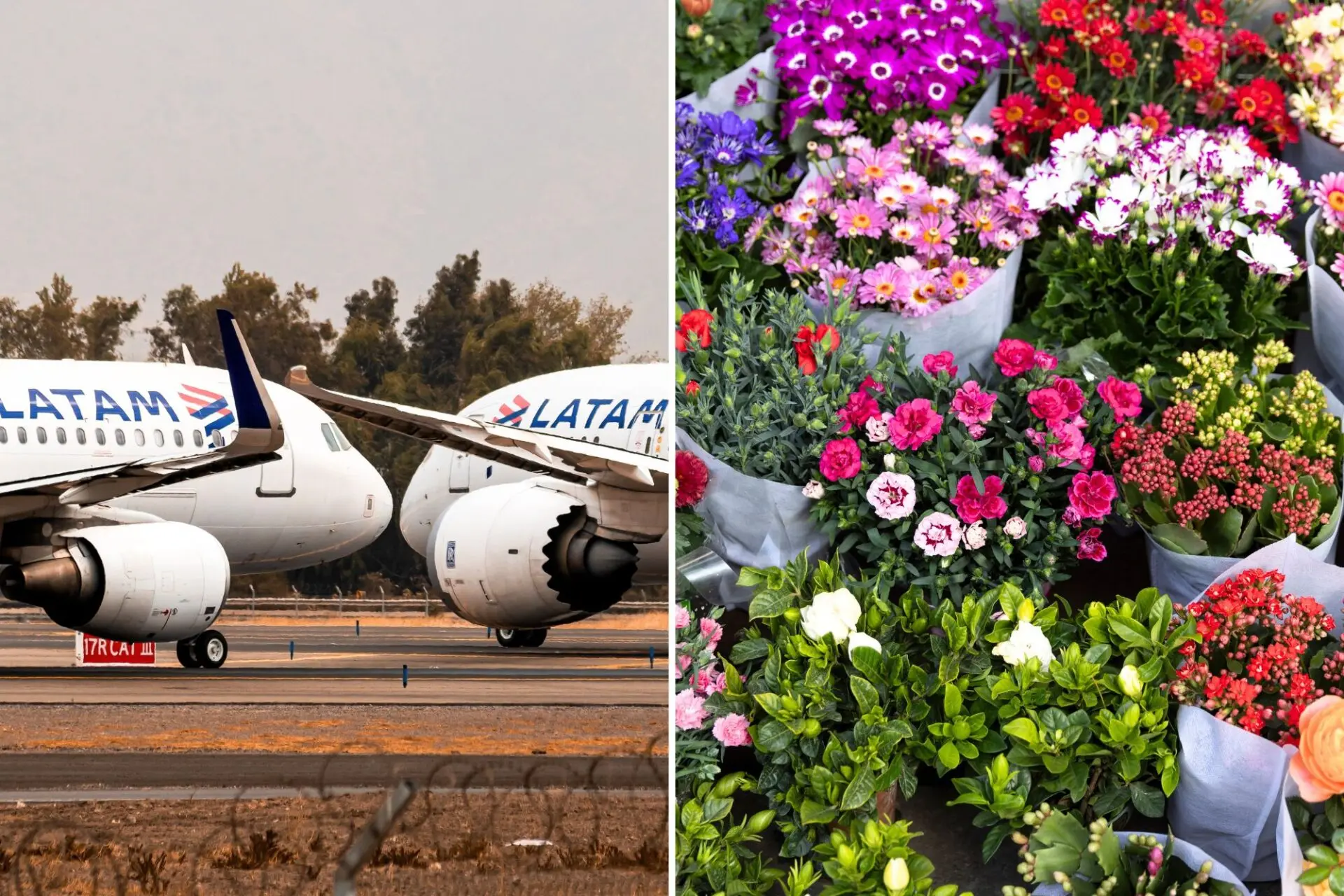
LATAM Cargo transported 24,400 tons of flowers from South America for the 2026 Mother’s Day season, solidifying its position as the leading carrier for floral air cargo from the region for the fourth consecutive year.
The operation spanned 21 days and involved more than 430 dedicated flights departing from three origin airports: El Dorado International Airport (BOG) and José María Córdova International Airport (MDE) in Colombia, and Mariscal Sucre International Airport (UIO) in Ecuador.
To handle the surge, ground crew staffing more than doubled compared to a typical week, reinforcing ramp, warehouse, and supervisory teams across all three hubs.
The numbers behind the blooms
The volume transported is equivalent to roughly 560 million stems. To put that in perspective, more than 300 stems per second left South America bound for markets across three continents during the season.
The United States accounted for the largest share of the shipments, consistent with historical demand patterns.
Claudio Torres Faini, International Commercial Director for South America at LATAM Cargo, said the operation’s success comes down to planning and coordination between commercial and operational teams.
“The prior alignment between commercial and operational teams means that certainty is not ours alone: it belongs to the producer who knows their product will arrive on time and in optimal condition, and to the importer who can make commercial commitments backed by real capacity,” Torres Faini said.
Close collaboration with growers and exporters was essential. Having volume data available several days in advance allowed the company to allocate the right resources at every point in the supply chain, from cargo receipt at the warehouse to the cutoff for each flight.
Background: South America’s flower industry
Colombia is the world’s second-largest flower producer after the Netherlands and the single largest supplier to the United States. The country exports more than $2 billion worth of cut flowers each year, with nearly 80% of that volume, roughly $1.62 billion, ending up in the US.
The country’s modern floral export industry traces its roots to the Cold War era. In 1961, US President John F. Kennedy launched the Alliance for Progress, a $100 billion initiative aimed at boosting economic cooperation between the US and Latin America. Colombia became a key focus, and one of the program’s early goals was developing the country’s agricultural sector.
The industry began to take off in the 1970s as improvements in air transportation made it easier to connect Colombia’s fertile soil with growing demand abroad. Entrepreneur Edgar Wells, whose company sent the first shipment of cut flowers from Bogotá to Miami in 1965, once compared Colombia’s flower trade to the legend of El Dorado, calling it “a permanent source of riches for all Colombians, for all time.”
A major boost came in 1991 with the passage of the Andean Trade Preference Act, which allowed many South American goods, including flowers, to enter the US duty-free.
Today, Colombia specializes in some of the most popular flowers found in bouquets: roses, carnations, and orchids. Around 73% of the country’s floral production takes place in the countryside surrounding Facatativa, just outside Bogota, while another 24% comes from the area around Medellín, a city known as the “city of eternal spring” for its mild, year-round weather.