

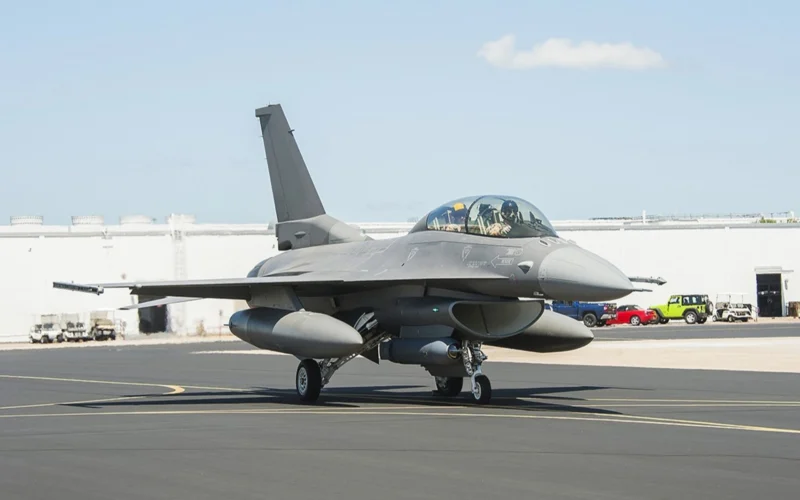
Lockheed Martin is to supply Taiwan with 55 Legion infrared search and track (IRST) pods under the US Foreign Military Sales program, strengthening the Taiwan Air Force’s ability to detect and track airborne targets using passive sensors. The US Department of Defense described the requirement as an urgent operational need for Taiwan.
Adding passive sensing to the F-16 fleet
Legion is an external podded sensor system built around Lockheed Martin’s IRST21. Unlike radar, IRST detects targets by their heat signature rather than emitting energy, allowing fighters to build situational awareness while limiting their electromagnetic footprint. This can be particularly relevant in environments characterized by dense electronic warfare and advanced air defenses.
Lockheed Martin presents Legion as a sensor designed for collaborative targeting, enabling multiple aircraft to share passive tracks and improve target localization without relying on active radar emissions. In US Air Force testing, aircraft equipped with Legion pods have demonstrated the ability to exchange infrared data and passively triangulate targets, supporting operations in radar-denied or emission-controlled scenarios.
Part of a broader modernization effort
The Legion pod order fits into a wider US-backed effort to sustain and modernize Taiwan’s F-16 fleet. In late 2024, Washington approved a $320 million package focused on F-16 sustainment and AESA radar support, aimed at maintaining readiness and supporting advanced sensor capabilities already fielded on Taiwan’s aircraft.

Taiwan completed the upgrade of its legacy F-16A/B fighters to the F-16V standard in 2023, introducing new avionics, electronic warfare improvements, and the AN/APG-83 AESA radar. The island is also awaiting the delivery of 66 new-build F-16V Block 70 fighters approved in 2019, a program that has faced schedule pressure amid broader US production bottlenecks.
Operational context
By adding IRST to its F-16 fleet, Taiwan is expanding the range of tools available to its fighters for air surveillance and targeting. In particular, it is a move against opponents equipped with advanced electronic warfare capabilities or aircraft designed to reduce radar detectability.
The emphasis on sensors, sustainment, and incremental upgrades reflects Taipei’s focus on maximizing the effectiveness and survivability of its existing combat aircraft within an increasingly contested regional environment.