

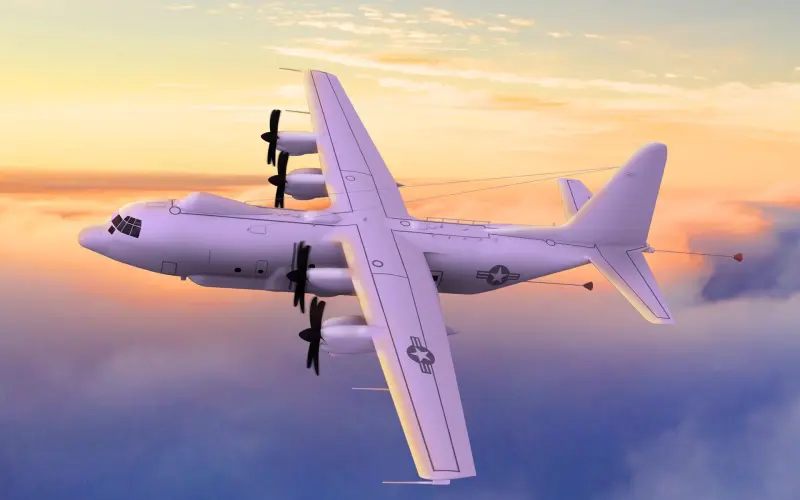
Lockheed Martin announced on April 29, 2026, that it will deliver training devices and services for the US Navy’s E-130J Phoenix II aircraft, as part of the Northrop Grumman-led industry team responsible for the service’s TACAMO recapitalization program.
Airborne nuclear command post
The E-130J is built on Lockheed Martin’s C-130J-30 Super Hercules airframe and will serve as a survivable airborne communications platform, ensuring uninterrupted connectivity between US decision-makers and the strategic weapons triad if ground-based links are compromised. As AeroTime previously reported, the aircraft is designed to operate as an airborne command post during a nuclear war or other catastrophic national emergency, hardened against electromagnetic pulses and capable of remaining airborne for extended periods through aerial refueling.
Northrop Grumman is the prime contractor for the program and leads an industry team that also includes Raytheon Intelligence and Space, Crescent Systems, and Long Wave Inc. The Pentagon awarded Northrop Grumman a $3.5 billion contract in December 2024 to act as the system integrator, bringing together Lockheed Martin’s C-130J-30 airframe with the Collins Aerospace-made Very Low Frequency (VLF) communications system and other mission equipment.
Training the fleet
As the original equipment manufacturer of the C-130J, Lockheed Martin said it is well-positioned to replicate the aircraft’s avionics and communications environments in training systems.
“Our expertise in the aircraft’s design and performance allows us to recreate real-world avionics and communications environments, ensuring highly realistic and effective training,” said Todd Morar, Vice President of Air and Commercial Solutions at Lockheed Martin.
By supplying E-130J training devices and services, Lockheed Martin will enable US Navy personnel to master the aircraft’s advanced mission systems, VLF communications, and integrated command and control capabilities ahead of the fleet’s operational entry.
The announcement builds on a broader training contract awarded to Northrop Grumman. In March 2026, the company secured a $225 million US Navy contract modification to design, develop, and deliver training weapons systems, training materials, and courseware for the E-130J platform, with work scheduled through March 2027.
Replacing the E-6B Mercury
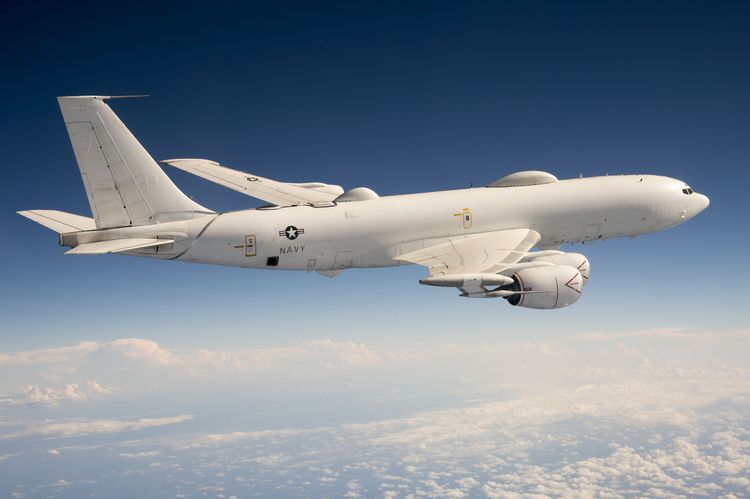
The E-130J Phoenix II will take over the TACAMO [Take Charge and Move Out – ed. note] role from the E-6B Mercury, which has been in service for more than 30 years. The mission is a key component of the United States’ Nuclear Command, Control, and Communications (NC3) system, providing a survivable link between the US president, secretary of defense, and US Strategic Command with Ohio-class ballistic missile submarines carrying submarine-launched ballistic missiles. The navy plans to field a minimum of eight to 12 aircraft, with initial delivery expected in 2026 and initial operational capability targeted for the early 2030s.
Strategic Communications Wing 1 (SCW-1), which operates out of Tinker Air Force Base in Oklahoma and comprises Fleet Air Reconnaissance Squadrons VQ-3, VQ-4, and VQ-7, will operate the type. The name Phoenix II was chosen as a nod to the EC-130Q, which performed the TACAMO mission from 1963 to 1993 before the Boeing 707-based E-6B took over.