

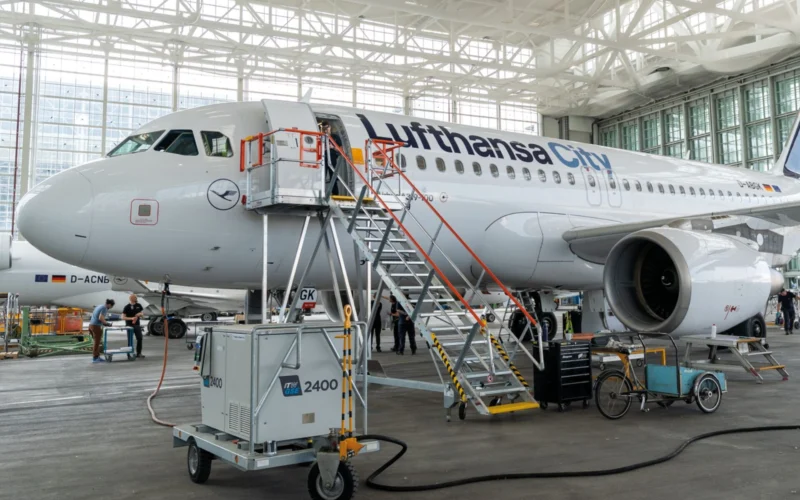
Lufthansa Technik has announced that testing has begun on a next-generation version of its fuel-saving AeroSHARK surface technology on a short-haul aircraft, marking the first time that the ‘shark skin’ material has been trialed outside of long-haul operations.
The tests, running through February 2027, involve an Airbus A319 from Lufthansa City Airlines, registered D-ABGK, flying regularly between Munich and Hamburg.
Lufthansa Technik is running the trial alongside development partner Surventis, formerly known as BASF Coatings.
Around 70 transparent film patches, each measuring 20 by 20 centimeters, have been applied to both the inside and outside of the aircraft’s engine cowlings, as well as selected areas of its fuselage. The patches will be monitored over the coming months during normal flight operations, with the goal of gathering data to guide further development of the technology.
Barely visible to passengers
For travelers flying on the aircraft, named ‘Starnberg’, the test will be largely unnoticeable.
The film itself is transparent, and flight operations remain unaffected. A welcome panel near the aircraft’s entrance, featuring the AeroSHARK design, is the only visible indication of the trial for curious passengers.
Extending the technology beyond the fuselage
AeroSHARK has so far been applied only to the fuselage and engine cowlings of long-haul aircraft that have been certified for the technology.
With this new research phase, Lufthansa Technik and Surventis are working to develop a material that could eventually be used on wings, and on horizontal and vertical stabilizers as well – surfaces that face higher aerodynamic loads than the fuselage.
The 70 test patches vary in material and layer composition, and the study aims to identify which combination offers the best durability while remaining easy to apply, clean and remove without leaving residue. Lufthansa Technik will be conducting regular inspections of the patches during the aircraft’s ground time in Hamburg.
How AeroSHARK technology works
AeroSHARK remains the only riblet technology currently approved for use in commercial aviation.
The film is designed with microscopic grooves, modeled after the structure of shark skin, which naturally reduces drag by aligning with the direction of water flow. Applied to an aircraft, the film’s riblets are only about 50 micrometers high and are precisely aligned with airflow, cutting aerodynamic drag during flight. The technology currently reduces fuel consumption and carbon dioxide emissions by about 1% per flight.
A growing fleet already using the technology
As of July 2026, the Lufthansa Group has equipped 22 long-haul aircraft across four of its airlines with AeroSHARK.
This includes SWISS’s entire fleet of 12 Boeing 777-300ERs; five Boeing 777Fs operated by Lufthansa Cargo; four Boeing 777-200ERs flown by Austrian Airlines; and one Lufthansa Boeing 747-400. Together, these aircraft save an estimated 19 metric tons of fuel and 60 metric tons of carbon dioxide emissions each day.
The technology has also started to gain traction beyond the Lufthansa Group, with other airlines adopting the film to improve fuel efficiency on their own long-haul fleets.
1 comment
This is minor, but I hope that the film is truly transparent so that one can see clearly out of the windows.