

The National Transportation Safety Board has confirmed that the UPS MD-11 freighter that crashed after takeoff from the cargo giant’s Kentucky hub on November 4, 2025, shed its left engine during the takeoff roll, causing a serious fire as the jet accelerated on the runway.
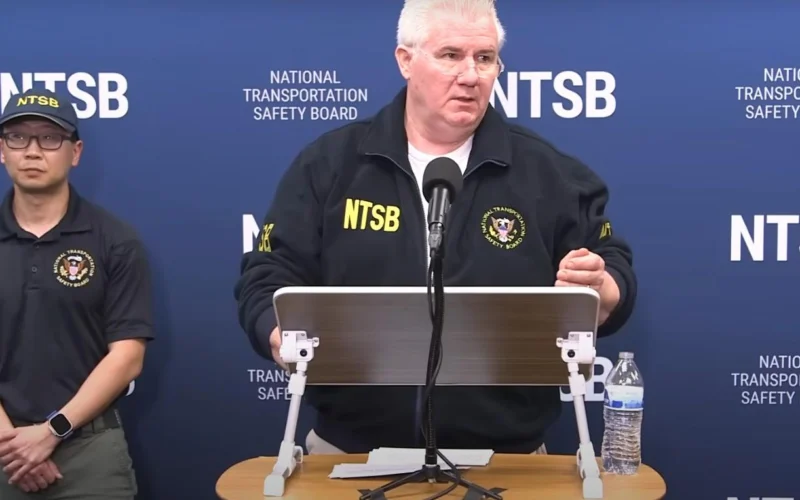
According to NTSB Board Member Todd Inman, CCTV footage captured the No. 1 engine separating from the wing as the aircraft gathered speed during its takeoff from Runway 17R at Louisville Muhammad Ali International Airport (SDF). “We have viewed airport security footage confirming the left engine detached during the takeoff roll,” Inman said at a media briefing.
The aircraft, operating at about 17:15 local time as UPS Flight 2976 bound for Honolulu, lifted briefly and cleared the airport perimeter fence before striking powerlines, buildings and terrain about half a mile beyond the runway. The impact and ensuing fire destroyed most of the fuselage.
Officials have now confirmed 12 fatalities, including one child, plus 15 injuries. Most of the victims were on the ground when the aircraft struck several industrial buildings near the airport. The UPS jet had three crewmembers.
Inman said both the cockpit voice recorder and flight data recorder, manufactured by L3Harris, have been recovered. “They suffered some heat, not intrusion,” he said. “Once we get these to our lab in D.C., we will be able to get a good readout of the applicable data.”
Investigators recover detached engine
The detached engine, a GE CF6-80C2, was found on airport property roughly 8,700 feet from the start of Runway 17R. Photos from the scene show fire damage along the runway and a large section of nacelle lying near a taxiway. Investigators confirmed that flames were visible before liftoff, though the sequence of events leading to the engine separation is not yet clear.
The loss of the left engine would have likely created serious control problems for the crew at the worst possible moment. The sudden loss of thrust and several tons of mass on one wing likely affected the aircraft’s controllability, possibly preceding an aerodynamic stall that made recovery impossible. Aerodynamic disruption around the damaged pylon may have also reduced lift on that side, while hydraulic and electrical systems powered by that engine could have been damaged. With the aircraft at high takeoff weight and at such a low altitude, it is questionable whether the crew could have maintained control once the engine separation occurred.
NTSB investigation begins
The NTSB has formed specialized groups to examine operations, structures, engines, systems and maintenance records. A 28-member team is on site, and investigators expect to remain in Louisville for about a week before moving their analysis to Washington.
The board has not said whether debris from the left-engine failure was ingested by the MD-11’s center or right engines or whether the fire damaged hydraulic or electrical systems critical to flight control. The agency said it will rely on flight-data and cockpit-voice recordings to reconstruct what happened in the cockpit in the seconds before the crash.
The left engine would not have been visible to the crew from the cockpit, meaning that they would have relied entirely on cockpit warnings and engine-instrument readings. The MD-11’s systems likely would have generated multiple indications for loss of thrust and hydraulic-pressure warnings as the engine separated and the fire began.
The aircraft, tail number N259UP, was built in 1991 and converted from passenger to freighter service in 2006. Records show that it was on the ground in San Antonio from early September to mid-October for maintenance, though investigators have not disclosed the scope of the work performed.
UPS temporarily halted operations at its Worldport hub on the night of the crash, but resumed limited sorting the next day. The company has said that it is cooperating fully with federal investigators and has established a family assistance line for employees and relatives.
A shelter-in-place order for nearby neighborhoods has been lifted, and one runway at Louisville Muhammad Ali International Airport reopened the day after the crash. Portions of the airfield remain closed while recovery and cleanup efforts continue.
14 comments
It is an absolute tragedy. I am so sad for the loss of the lives of the three crew members and all those on the ground. They showed a blurred footage on BBC which to me looked like the middle engine was on fire while plane was speeding on the runway. I keep thinking since then why the pilots not stop the plane and get off it. They also showed another video of this plane crash skidding at high speed in which the front half of the plane was not on fire. I so much wish if pilots had aborted take off. Everyone might have still been alive. I feel so sad on this tragedy.
Hi Thinktank, I can understand your point of view; however, during the takeoff run there are certain speeds the pilots have to comply with in order to make that decision to abort the takeoff! That speed is called V1 (takeoff decision speed). Before that speed the takeoff can be discontinued and still stop on the remaining runway! When the aircraft is at or past that speed, a successful abort on the remaining runway is most likely impossible! That means that if the crew would have discontinued their takeoff run after V1, the aircraft would have left the airport confines anyhow and most likely contacted buildings close to the airport! While you’re watching videos from different media outlets, please also realize that the pilots cannot see the engines being on fire from the cockpit! They are sitting too far forward of the engines even if they would have looked back! They might be able to see the wingtip, but that’s about it! This accident, like all accidents, is tragic since the number 1 engine (left side of aircraft) separated and apparently threw debris into the the number 2 (center engine), which means the aircraft was only getting airborne on the thrust of one engine! A heavily loaded MD-11 is not able to do that! I hope this helps you to better understand why the pilots did not discontinue the takeoff! God bless!
Hi Matt. Thank you for your note with such nice information. I am aware of these elements of flying.
At the time of posting my comment, there was no information available. I just wished at that time if pilots could possibly stop the plan on the ground. It was later on after I had posted my comment, NTSB released information and pictures of engine 1 coming off just when the plane took off [ just after Vr ]. Thats what made me even more sad because clearly fate had not left them with half a chance.
God bless you too and those who lost their lives in such tragedies.
Engine separation more than likely occurred after V1, though we should wait for the NTSB to confirm that. If you’re not familiar, that is the speed during the takeoff roll where there isn’t enough runway remaining to stop. It’s calculated at the gate prior to taxi, and is different on every flight based on wind, total weight, runway length, etc. Procedure and training for problems that occur after V1 is to proceed to rotate and circle back to land, but in this instance control of the aircraft was likely impossible due to the separation of the engine.
Hi Tyler, you are right that engine 1 detached after V1. The pictures released by NTSB after my first comment show the detachment frame by frame just when plane rotated; started the take off. For me to see such a catastrophe in happening was horrific.
Thank you for your response.
Stopping the plane at the point of the fire starting is NOT possible.
It is probable that the pilots had no indications of trouble until they were passed V1, the speed at which it is impossible to stop on the runway. Unfortunately the video(s) are all diminished in detail. These pilots were professional and well trained, you can be assured that they did whatever they were trained to do in this situation. Unfortunately there are some scenarios that are not surviavble and we all hope that we are not faced with such prospects on our flights.
Your comments ,while sincere, are not based upon a proper understanding of takeoff planning procedures. Every takeoff at every airline is carefully planned to accommodate both normal and irregular operations including loss of power at critical points. For each particular runway, takeoff weight, temperature and a myriad of other factors, “V” speeds are calculated. These speeds dictate what actions are required by the cockpit, and when. The incident aircraft had very likely already passed V1, the go/no-go decision speed. Upon achieving or passing this speed, stopping on the runway is No Longer possible and the takeoff MUST be continued. The crew made the proper decision and also likely encountered flight controllability issues which guaranteed a tragic outcome.
Best, Capt Bob (retired), major US airline
The number 2 engine (n the tail assembly) was the only 1 actually functioning and not spitting fire. The number 3 (right wing) was in a compressor stall, possibly from ingesting blades or other debris thrown off by the number 1 as it came apart, but it did appear to emit flames just as the plane was rotating for liftoff, on a witness’ video. NTSB says the pilon stayed attached, on this number 1, unlike the O’Hare crash on Memorial Day weekend in ’79.
I agree 100% about the compressor stall. It was plain to see. I wonder when the NTSB will get around to mentioning it?
I don’t care what the number is, it’s still a damn DC-10. That airframe has been cursed since before it was born. The American DC-10 in Chicago that LOST the left engine years ago is similar, but the airplane has been loosing parts, engines, fan blades, cargo doors in flight since early in it’s life. My dad worked for Vought and they supplied several flight control components to Boeing and Lockheed. He told me that the secretaries in his design office were threatened with being fired if they got their boss a flight in a DC-10. Read a book called Destination Disaster by Bruce Page, Paul Eddy, Elaine Potter published in 1976. I wouldn’t even stand underneath one sitting on the ground.
Once the MD-11 reached take off speed at V1 & V2 it would not have been possible to abort the flight especially with the controls inoperative due to the separation and possibly smoke in the cockpit! It is truly a catastrophic incident which I believe the pilots could not recover from!
I believe that UPS has contracted GE to perform all engine maintenance. I certainly don’t mean to imply any fault. I wonder how long it will be until they know definitively the occurrences that led to the accident. Such a catastrophic uncontained engine failure is so rare. This engine is not just used on the MD-11. Sometimes, these investigations seem to take forever. I’m starting to get uneasy with how long it’s taking for another update. To me, it means they have too few answers to say anything. With the 1979 crash, the engine that fell off was essentially intact. This crash had the left engine completely burned up. This implies to me that it wasn’t a simple failure of the mounting pylons. One thing I think they probably know, is whether the pilots were in a situation that was unavoidable or not and that is probably the most important thing for people to know right now. The metallurgical analysis will take a long time. People are saying it was the right engine that was damaged as a result of the left engine’s failure. Since the rear engine was aft I initially would’ve assumed that one would’ve been damaged. I don’t think there’s ever been a situation where an engine failure has damaged the engine on the other wing. Since most of our jetliners are now two engine. We really need to get to the bottom of this.
Since black box was found and hopefully the Cockpit Voice Recorder as well, I hope next report from NTSB might have answers to most of the questions there are.