

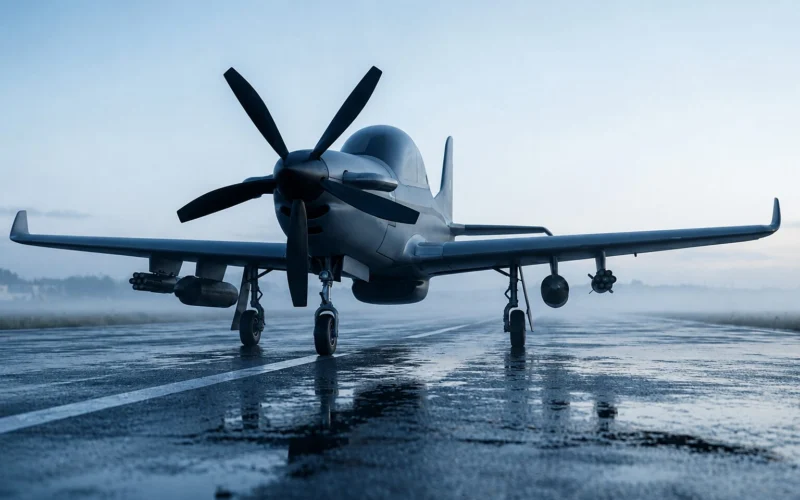
Quantum Systems unveiled the PULSE P19, a turboprop multi-mission aircraft designed for both crewed and uncrewed operations and envisioned as a potent new weapon to counter enemy drone threats.
The German drone and defense technology company introduced the aircraft at ILA Berlin 2026 with German Chancellor Friedrich Merz ceremoniously pulling aside a black shroud covering the PULSE P19 mockup at Quantum Systems’ show stand on June 10, 2026.

The product marks Quantum Systems’ move into a larger medium-altitude, multi-role aircraft segment after building its business around smaller reconnaissance drones and autonomous systems.
Quantum Systems says the aircraft responds to lessons from Ukraine and other recent conflicts, where traditional low-altitude and medium-altitude long-endurance drones have become more vulnerable to air defense and counter-drone systems.
The company designed the PULSE P19 to combine higher speed, long range, flexible payload options and a more scalable cost profile than conventional long-endurance unmanned aircraft.
The aircraft can support intelligence, surveillance and reconnaissance missions, training operations and counter-UAS missions, according to the company.
Quantum Systems says PULSE P19 can operate as a crewed aircraft or an unmanned system, giving operators a path from conventional flight testing and training toward increasing levels of autonomy.
“The changing nature of modern warfare has clearly demonstrated the limitations of traditional drones,” said Florian Seibel, co-CEO and co-founder of Quantum Systems. “Today’s armed forces need capabilities that are faster, more cost-effective and more scalable to keep pace with new threats. The PULSE P19 was developed to meet these requirements.”
The aircraft also connects to Quantum Systems’ MOSAIC UXS software ecosystem, the company’s command-and-control platform for unmanned systems. Quantum says the integration allows PULSE P19 to operate with other air and ground systems and support manned-unmanned teaming, reconnaissance-strike missions and rapid payload integration.

Chief Engineer Lars Peter said Quantum Systems designed the aircraft to bridge crewed and uncrewed operations rather than choose one path.
“Instead of choosing between a manned aircraft and an unmanned system, we have developed a platform that combines both worlds,” Peter said. “The result is an aircraft that combines speed, endurance and economy while opening up a clear development path towards greater autonomy.”
Quantum Systems has expanded rapidly during the war in Ukraine, where its smaller unmanned aircraft have been used for reconnaissance and targeting support. The company has also built a broader portfolio around air, ground and software-defined unmanned systems.
Quantum Systems did not announce suppliers for the PULSE P19’s engine, avionics or major subsystems.