

Russia’s Ministry of Defense said on January 9, 2026, that it launched its Oreshnik intermediate-range ballistic missile as part of what it described as a massive overnight attack targeting Ukrainian energy infrastructure and drone manufacturing sites.
Moscow claimed the strike was retaliation for a Ukrainian attack on President Vladimir Putin’s residence in Valdai in late December. Kyiv denied carrying out any such strike and said the claim was part of a Russian disinformation effort aimed at framing Ukraine as a spoiler to negotiations and justifying expanded long-range strikes on civilian infrastructure.
Different angle on the “Oreshnik” IRBM strike on Lviv. https://t.co/KhvXEYSqd7 pic.twitter.com/PFylyAaNat
— Special Kherson Cat 🐈🇺🇦 (@bayraktar_1love) January 9, 2026
Large drone and missile salvo overnight
The Ukrainian Air Force reported that Russia launched 36 missiles and 242 drones during the nighttime attack. Ukrainian air defenses said they shot down or neutralized 244 aerial targets before 9 a.m. local time, although 34 Russian projectiles, including 18 missiles and 16 drones, hit 19 sites across the country. Strikes were recorded in the Kyiv region and in western Ukraine, with damage reported to energy and industrial facilities.
In western Ukraine, the Air Force reported that a ballistic missile struck infrastructure in Lviv region at 11:47 p.m. on January 8. The aerial object was traveling at approximately 13,000 kilometers per hour along a ballistic trajectory, a speed consistent with the Oreshnik system.
Possible targeting of strategic gas storage in Lviv region
Analysts noted that the likely intended target may have been the Bilche-Volytsko-Uherske underground gas storage facility near the city of Stryi in the Lviv region. The site is the largest underground gas storage facility in Ukraine and the second largest in Europe.
It plays a critical role in Ukraine’s energy resilience during winter and facilitates gas flows for European customers. Hitting such infrastructure could have both domestic and regional consequences, as parts of Europe rely on Ukrainian transit and storage capacity for heating during cold months.
Kyiv has previously warned that Russian attacks on Ukraine’s power grid, gas network, and industrial capacity are aimed at undermining energy security and driving up economic and humanitarian pressures during winter.
Oreshnik precedent and hypersonic framing
This strike would not mark the first operational use of Oreshnik against Ukraine. In November 2024, Russia fired the system toward Dnipro without a conventional warhead, releasing six inert reentry vehicles in what analysts described as a signaling strike rather than a battlefield attack. At the time, President Putin hailed the missile as an “uninterceptable” hypersonic weapon.
Ballistic missiles reach hypersonic speeds by definition during midcourse flight, but Moscow has increasingly emphasized the term to underscore novelty, strategic reach, and perceived inevitability in its deterrence messaging.
Deployment to Belarus
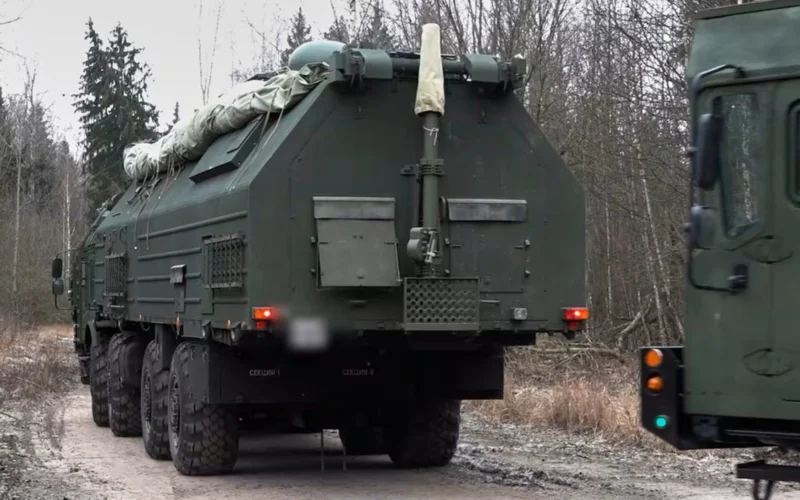
Official video declaring Oreshnik IRBM deployment in Belarus by the Russian Strategic Rocket Forces.
— Dmitry Stefanovich (@KomissarWhipla) December 30, 2025
Mostly support vehicles shown though. pic.twitter.com/jRAYEdd9Z8
On December 30, 2025, the Russian Ministry of Defense released the first images of Oreshnik systems in Belarus. Belarus amended its constitution in 2022 to allow nuclear weapons on its soil, followed by the transfer of Russian tactical warheads and preparations for the deployment of Oreshnik intermediate-range ballistic missiles. The presence of such systems in Belarus places additional pressure on Ukraine and alters planning considerations for NATO members in Eastern Europe.