

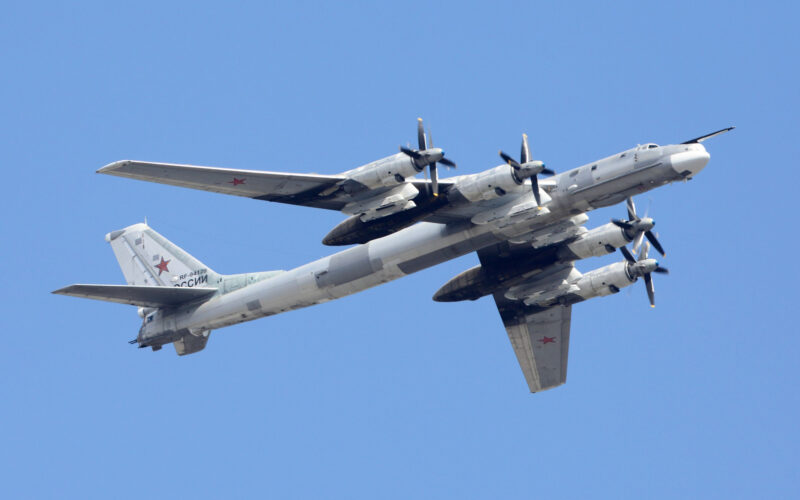
A Russian Tu-95 strategic bomber crashed during a training flight in the Amur region of Russia’s Far East on September 29, 2026, killing six of the seven crew members on board, the Russian Ministry of Defense said.
“The aircraft went down in an uninhabited area. According to preliminary data, six crew members were killed, and one was injured and evacuated to a medical facility,” the ministry said in a statement carried by Interfax.
The ministry said the bomber was flying without munitions and that a commission of the Russian Aerospace Forces had been sent to the site to establish the circumstances of the crash.
Moment of the crash of a Russian military aircraft in the Amur region.
— Exilenova+ (@Exilenova_plus) September 29, 2026
Based on the aircraft model and the sound of the crash, it is preliminarily identified as a Tu-95???, not a Tu-154.
Reports indicate that 6 people died.
1×300 (likely referring to a specific type of… pic.twitter.com/Lh6VZBq63a
The Amur regional government said the aircraft came down near the village of Krasnoyarovo. It said the crew “did everything possible to steer it away from residential buildings”.
Russian Tupolev Tu-95MS strategic bomber/missile carrier crashed in Amur Oblast, Far East Russia.
— Status-6 (@Archer83Able) September 29, 2026
Its six crew-members have perished, while one survived and was transferred to a medical facility with medium injuries, Russian Defense Ministry informed.
The crash occured shortly… pic.twitter.com/iQT8YEDEzD
Russia’s shrinking long-range bomber fleet

The Tu-95 entered Soviet service in 1956 and is no longer in production. Russia’s Long-Range Aviation uses the Tu-95MS variant to launch cruise missiles against Ukraine, and the fleet has also suffered significant losses on the ground.
Satellite imagery analyzed after Ukraine’s Operation Spiderweb drone strikes on June 1, 2025, indicated that at least seven Tu-95s were destroyed at the Olenya and Belaya air bases.
Russia continues to fly its remaining long-range bombers on patrols, including a Tu-160 sortie over the Barents and Norwegian seas on June 22, 2026.