

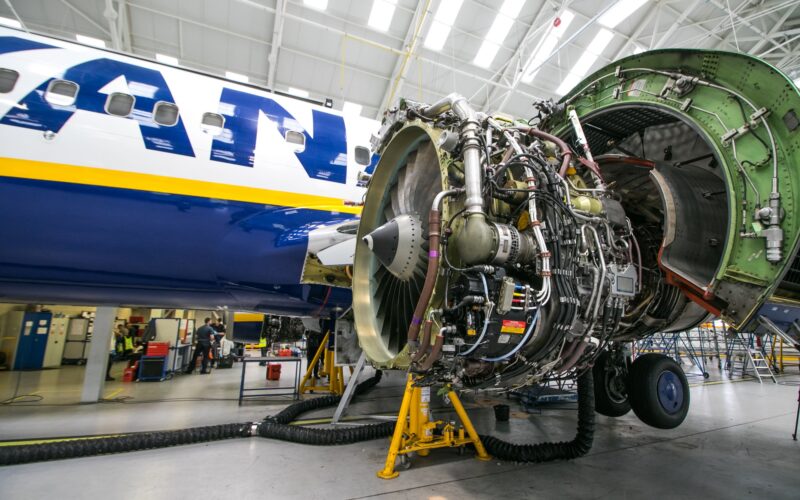
Bird remains and feathers were found inside the damaged engine of a Ryanair Boeing 737-800 that was involved in a July 2026 uncontained engine failure over Greece that left a passenger partially pulled through a shattered window, according to a preliminary report from the US National Transportation Safety Board (NTSB).
The same engine had been involved in four other suspected bird strikes during the previous 12 months, with bird remains found after two of those earlier incidents, the NTSB noted.
According to investigators, a fan blade in the aircraft’s right engine fractured shortly after takeoff from Thessaloniki on July 10, 2026, sending engine debris into the fuselage and horizontal stabilizer. One fragment struck and broke a passenger window in Row 11, causing a rapid loss of cabin pressure.
The 61-year-old passenger seated next to the broken window was partially pulled into the opening before other passengers dragged him back inside. He suffered neck and shoulder injuries and friction burns.
The aircraft, registered 9H-QEU and operated by Malta Air on behalf of Ryanair, had departed Thessaloniki International Airport for Memmingen, Germany. The Boeing 737-800 was climbing through about 16,000 feet when the engine began vibrating and a loud bang was heard.
Flight attendants reported a powerful, continuous vibration, along with a small amount of smoke or fog in the cabin before the oxygen masks deployed.
The NTSB declared that investigators found bird remains inside components of the No. 2 engine.
Maintenance inspections following the four earlier suspected bird strikes did not identify damage. The engine’s fan blades also underwent ultrasonic inspections in November 2025 and May 2026, with no damage reported.
Investigators recovered three loose fan blade fragments from the engine.
The accident has drawn comparisons with two earlier Boeing 737 Next Generation fan blade failures, including the 2018 Southwest Airlines Flight 1380 accident in which engine debris broke a passenger window and a woman was killed.
The FAA issued three airworthiness directives in 2025 requiring modifications intended to reduce the risk of engine inlet and cowling debris striking the aircraft following a fan blade failure. The changes include revised fasteners, spacers and maintenance procedures.
The Ryanair aircraft had not yet received the major modifications required by those directives, as operators have until July 2028 to complete them. The NTSB has not said the absence of those modifications contributed to the July accident.
The aircraft returned safely to Thessaloniki about an hour after departure.
Bird strikes remain a persistent hazard for commercial aviation, particularly during takeoff and landing when aircraft are operating at lower altitudes. While most bird strikes cause little or no damage, ingestion into a jet engine can result in serious engine damage and, in rare cases, an in-flight shutdown or failure.
1 comment
Why is there no fan blade confinement. How would it pass the blade out certification, something is very wrong with the engine certification . B1 tec