

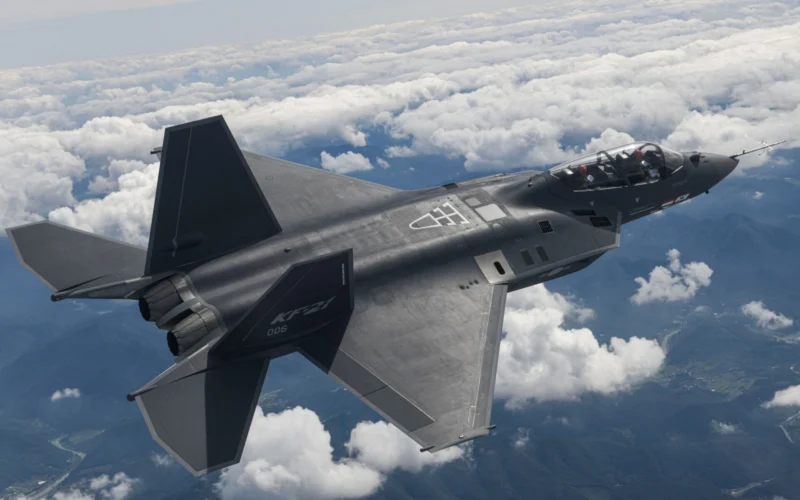
South Korea is preparing to retire its aging fleet of F-5 fighter jets by the end of 2027 as it moves closer to fielding its first domestically developed combat aircraft, the KF-21.
The Korea Herald reported on May 14, 2026, that Air Force Chief of Staff Gen. Son Seok-rak announced the accelerated retirement timeline during a press conference in Seongnam, Gyeonggi Province.
Son said the military is working to ensure the F-5 retires “honorably” before the end of 2027. South Korea first acquired the US-built Northrop F-5A/B in 1965 and introduced F-5E variants in the 1970s.
KF-21 nears operational deployment
The announcement comes as South Korea approaches a major milestone with the KF-21, a 4.5-generation fighter developed by Korea Aerospace Industries (KAI). The aircraft completed its first test flight in July 2022 and received final combat suitability approval earlier this month. Delivery to the Air Force is expected to begin in early September.
KAI CEO Kim Jong-chul said the first mass-produced KF-21, rolled out on March 25, 2026 completed its maiden flight in April 2026 and is currently undergoing test flights ahead of delivery. He described the program as a turning point for South Korea’s defense industry, noting that having an indigenous aircraft platform allows the country to test and integrate domestically developed weapons, paving the way for exports of fighters equipped with Korean-made missiles.
According to KAI, the program has completed more than 13,000 test conditions and logged around 1,600 sorties without incident. The company expects to produce more than 20 aircraft per year and said output could reach 30 to 40 units annually with additional investment.
Kim added that KAI sees potential overseas demand for more than 200 KF-21s, with discussions underway with Indonesia, the Philippines, Malaysia, and Poland. The company is also in talks with the United Arab Emirates and Saudi Arabia on partnerships for future development.
Cost pressures and potential delays
While the program is progressing, it is not without challenges. The second phase of production, known as Block-II, is now projected to cost KRW 18.44 trillion (US$12.5 billion), nearly 30% higher than the original 2024 estimate of KRW 14.24 trillion (US$10.5 billion).
South Korea’s Defense Acquisition Program Administration attributed the increase to inflation, a weakening Korean currency, and global supply chain disruptions.
The KF-21 program was launched in 2015 with the goal of replacing South Korea’s aging F-4 and F-5 fleets. The first prototype was unveiled in 2021. Under the initial Block-I phase, 40 aircraft focused on air-to-air combat are scheduled for production by 2028. Block-II aims to deliver 80 additional fighters equipped with long-range air-to-ground missiles by 2032.
However, rising costs may push back these timelines. Officials are reportedly considering delaying delivery of the first 40 jets by one year to 2029, while the second batch could enter service two to three years later than originally planned.
The KF-21 is a supersonic fighter capable of speeds up to Mach 1.81 with a range of 2,900 kilometers. It is equipped with an active electronically scanned array radar and is designed to accommodate future stealth upgrades.