


Aerospace and space manufacturers may have more industrial capabilities available to them than they realize. The challenge extends beyond finding suppliers to understanding what capabilities exist, where they are located and how they compare.
For Sara Ghoneim, founder and CEO of Spacioply, this lack of visibility makes it difficult for manufacturers, governments and industry leaders to assess the strengths, maturity and gaps within industrial ecosystems.
Launched in April 2026, Spacioply is an aerospace and space capability intelligence platform designed to transform fragmented industrial information into structured, comparable and actionable intelligence. In an interview with AeroTime, Ghoneim explains how mapping and benchmarking global capabilities can support better industrial and strategic decisions.
From aircraft manufacturing to capability intelligence
Ghoneim began her career as an industrial engineer at Boeing, working on commercial aircraft manufacturing. Her career subsequently expanded into supplier development, industrialization, supply chain strategy, program management, and the development of capabilities across industrial ecosystems. Working across these disciplines gave her different perspectives on the same challenge.
From the buyer’s perspective, organizations often rely on established supplier networks and familiar sources of information. From the supplier’s perspective, particularly among small and medium-sized enterprises (SMEs), technical capabilities may remain largely unknown outside existing customers and geographical markets.
Governments and industry development organizations face a different dimension of the problem: understanding not only which companies operate within an ecosystem, but also what those companies are capable of delivering and where critical capability gaps exist.
“From the buyer side, you may know a large number of suppliers, but that doesn’t necessarily mean that you can see the full ecosystem available to you,” Ghoneim said. “Somewhere outside that existing network, there may be a company that actually has the capabilities you need, and simply you don’t know about it.”
A company may possess highly specialized engineering or manufacturing expertise, yet never appear on a potential customer’s shortlist.
“Not because you lack the capabilities, but because the buyer doesn’t even know you exist,” Ghoneim explained.
These experiences shaped the idea behind Spacioply: industrial capabilities need to become visible independently of the networks through which companies are traditionally discovered.
Looking beyond established supplier networks
When a new requirement arises, procurement and engineering teams typically turn first to approved suppliers, internal databases, referrals, trade shows and professional networks. If those searches produce no suitable candidate, they look further afield.
“None of those methods are wrong,” Ghoneim said. “The limitation is that your starting point is naturally always influenced by who is already visible to you.”
The challenge is particularly acute in the aerospace and space industries, where requirements can be highly specific. A buyer might need a supplier with a particular manufacturing process, material expertise, certification, testing capability and production capacity, all in a given location.
Whether sourcing components for an aircraft, satellite or launch vehicle, finding a suitable partner therefore requires more than searching a database of company names.
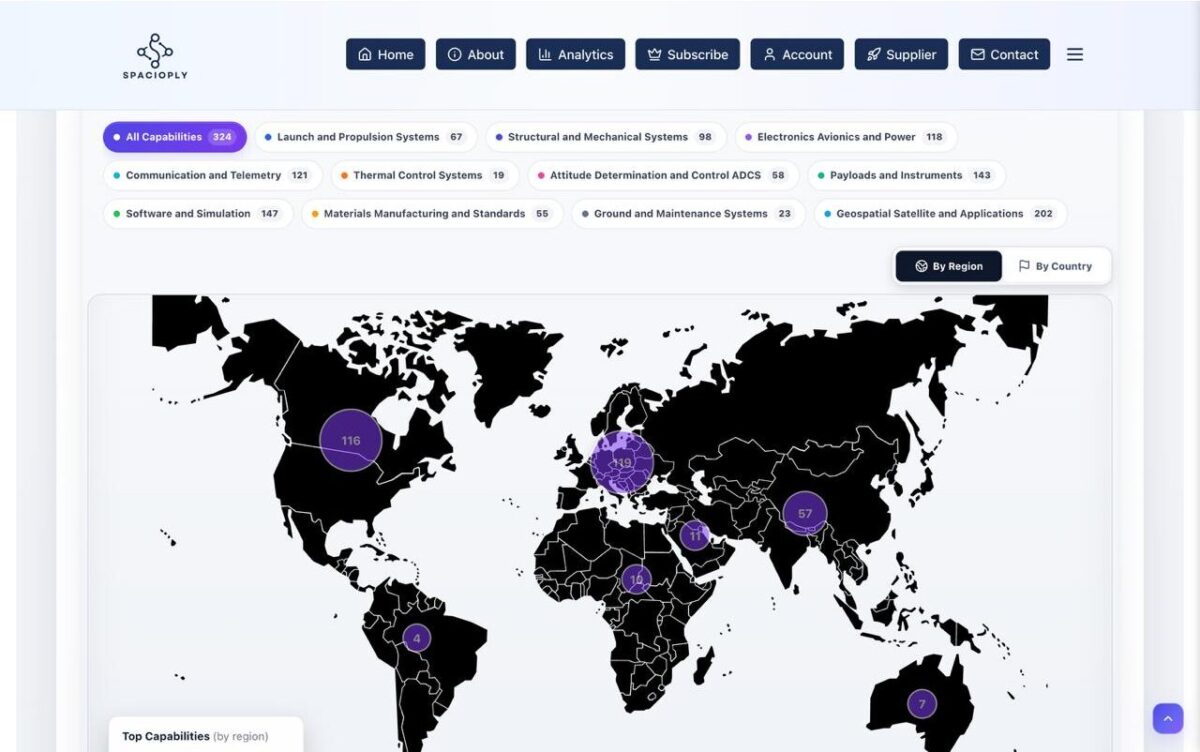
“You can’t search for a company by name if you don’t know that it exists, but you can search by the capability that you need,” Ghoneim said.
Why multiple suppliers do not always mean resilience
The pressure on aerospace supply chains is already evident. In October 2026, aviation analytics firm Cirium warned that supplier bottlenecks, engine availability and certification delays could constrain aircraft production until at least 2030.
While better supplier visibility cannot resolve every production constraint, Ghoneim argues that it can help manufacturers identify alternative sources and uncover dependencies that might otherwise go unnoticed.
“The size of a company doesn’t necessarily reflect the strategic importance of that capability that it provides,” she said.
A small specialist several tiers below an original equipment manufacturer (OEM) may provide a process or material that is difficult to replace. If that capability becomes constrained, the disruption can spread through multiple tiers of the supply chain.
As Ghoneim put it, the effect “propagates upwards through the supply chain” until it affects aircraft production and deliveries.
Having several suppliers does not necessarily eliminate that risk. A manufacturer may believe it has diversified its sources, only to discover that those suppliers depend on the same specialist further down the chain.
If several suppliers all rely on one lower-tier capability, Ghoneim warned, “that’s your bottleneck.”
How Spacioply maps and benchmarks space and aerospace capabilities
The idea for Spacioply emerged from Ghoneim’s experience of repeatedly piecing together information about industrial capabilities from fragmented sources.
“The objective wasn’t really to build another list of aerospace companies,” Ghoneim said.
Instead, Spacioply organizes industrial information around what companies can actually do, mapping capabilities, their geographical distribution and the supporting information available about suppliers.
Its scope covers aerospace manufacturing and the wider space industry, including satellites, launch systems and other space technologies.
The platform is designed for three main groups of users.
For suppliers, the platform provides greater visibility into their capabilities and competitive positioning, helping them identify areas of differentiation and potential development opportunities.
Buyers, including OEMs and prime contractors, can use the platform to identify potential suppliers based on specific technical and industrial requirements, while benchmarking capabilities to support more informed sourcing and supplier evaluation.
For governments, investors, agencies and industry bodies, the platform offers insight into industrial ecosystem maturity, capability gaps and potential development opportunities.
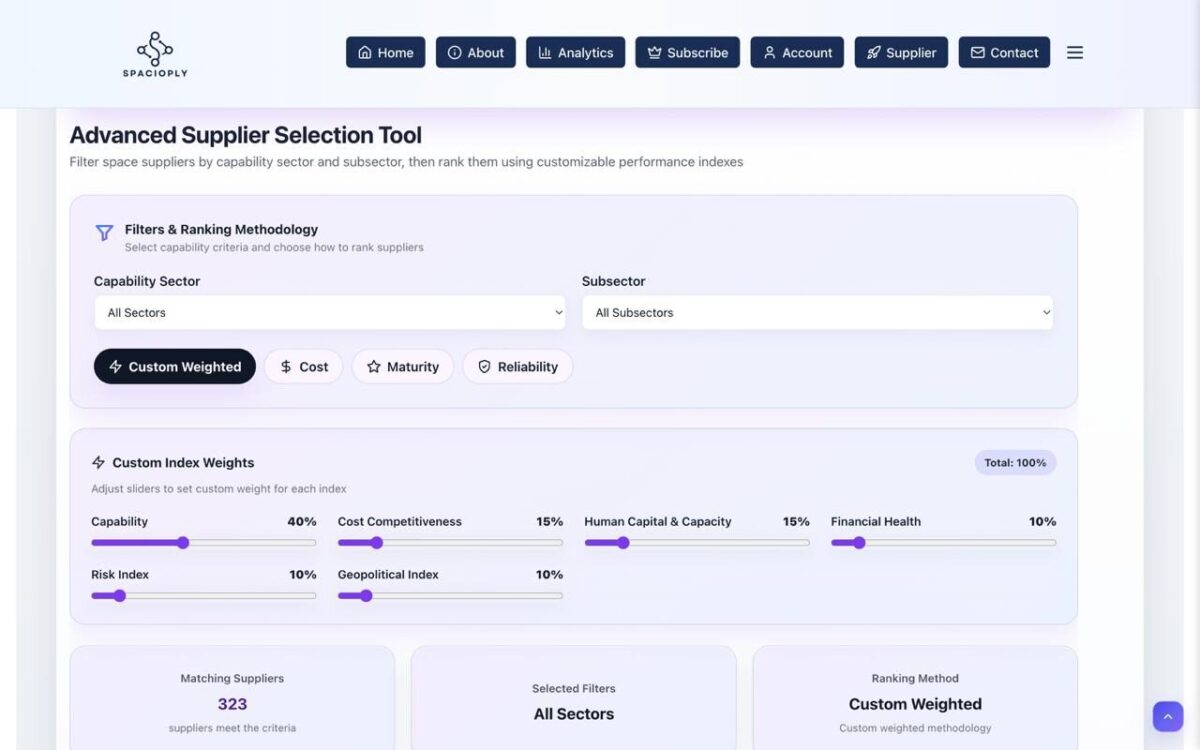
Spacioply combines publicly available information and company-submitted data with AI-assisted analysis to map and benchmark industrial capabilities. The company notes that its assessments are intended to support decision-making rather than replace independent supplier qualification and due diligence.
From visibility to comparability: the intelligence layer
Visibility is the starting point of Spacioply’s approach, but it is not the end goal.
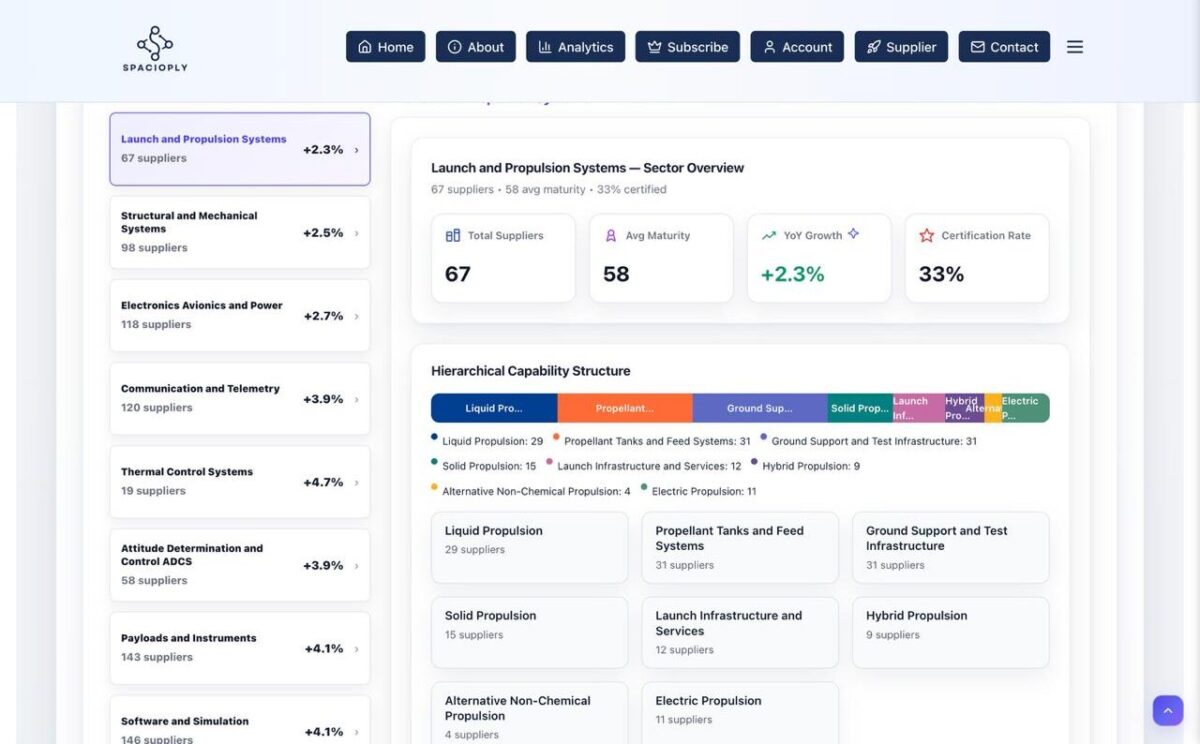
Through its intelligence layer, the platform enables suppliers to be benchmarked against one another across multiple dimensions, including relative strengths, operational maturity, growth potential and geographical positioning.
By comparing individual suppliers and aggregating capability information across sectors and countries, Spacioply aims to reveal patterns that would otherwise be difficult to identify through traditional supplier searches.
This progression, from visibility to comparability, intelligence and action, forms the foundation of Spacioply’s broader proposition.
“Visibility tells you what exists,” Ghoneim said. “Intelligence helps you decide what to do about it.”
Benchmarking national space and aerospace capabilities
Ghoneim believes the same approach can help governments make more informed decisions about developing their aerospace and space industries.
Simply counting the number of aerospace or space companies operating in a country, she argued, says little about the maturity of its industrial base. Policymakers also need to understand the depth of available capabilities, production capacity, competitiveness and dependencies on foreign suppliers.
Comparing industrial ecosystems can help policymakers prioritize strategic investments, assess localization opportunities and determine where international partnerships may offer greater value than developing capabilities domestically.
To support those decisions, Spacioply has developed what it calls a Strategic Investment Index. According to Ghoneim, the index is intended to help identify where investment, localization or partnerships could make the most strategic sense.
“Not every capability needs to exist in every country,” she said. “Sometimes partnerships and global sourcing is the strongest strategic decision, and that’s fine.”
Building a more visible and intelligent aerospace and space capabilities ecosystem
Spacioply’s longer-term ambition is to build a more connected and comprehensive understanding of global aerospace and space industrial capabilities.
Ghoneim encourages suppliers to register and accurately map their capabilities, while inviting manufacturers, OEMs, governments and other industry stakeholders to explore the platform’s intelligence and analytical tools.
Ultimately, Spacioply aims to move the industry from fragmented information toward more informed decisions, shifting the question from “Who do I know?” to “What can the world do?”