

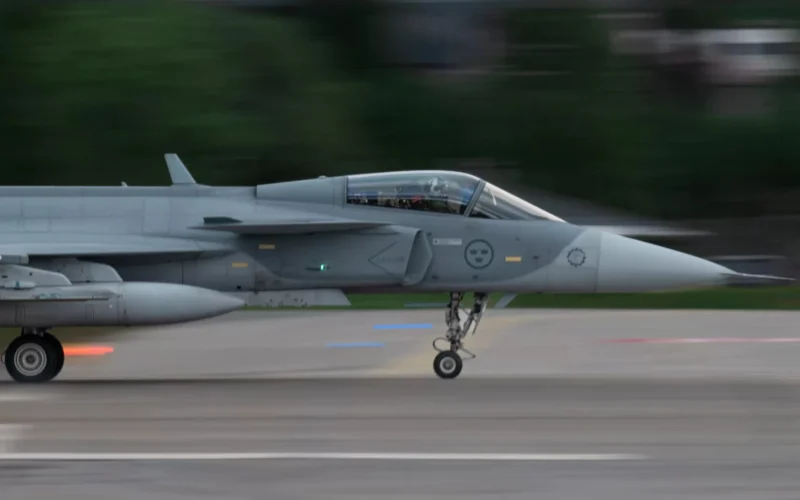
Swedish JAS 39 Gripen fighters begin contributing to the protection of the Rzeszów-Jasionka logistics hub supplying Ukraine from October 1, 2026, as Warsaw introduces new rules designed to allow its forces to engage airborne threats more quickly.
According to the Swedish government, the Gripens will contribute to NATO’s integrated air and missile defense and to the protection of military and civilian support flowing into Ukraine.
The Swedish Armed Forces said the mission will last two months and will be conducted by aircraft and personnel from the Blekinge Air Wing (F 17), based at Ronneby in southern Sweden. The Gripens will operate primarily from Sweden, supported by a smaller forward base in Poland. Neither statement gave the number of aircraft.
During operations, the Swedish contingent will come under NATO’s Combined Air Operations Centre (CAOC) at Uedem, Germany.
“Swedish fighter aircraft contribute to air defense over Poland and to protecting important logistics flows with military support to Ukraine,” Defence Minister Pål Jonson said, citing the security situation and repeated violations of NATO airspace as reasons for maintaining high military readiness on the alliance’s eastern flank.
Gripens to protect Rzeszów-Jasionka logistics hub
The facility being protected is POLLOGHUB at Rzeszów-Jasionka Airport (RZE), Poland’s main transshipment point for military equipment and other assistance heading to Ukraine.
Polish Defence Minister Władysław Kosiniak-Kamysz visited the hub and its air defenses on September 24, 2026, describing its role as coordinating and transiting military and humanitarian aid to Ukraine.
The airport lies roughly 80 kilometers (around 50 miles) from the Ukrainian border and has been a central part of the supply chain supporting Kyiv since Russia’s full-scale invasion in February 2022.

The Gripens add another layer to the air defenses around Jasionka. As of Kosiniak-Kamysz’s visit, two Dutch Patriot systems protected the airport area alongside Polish assets as part of NATO Security Assistance and Training for Ukraine (NSATU).
The Netherlands extended the Patriot deployment until early December 2026, while the NASAMS and counter-drone systems it deployed in December 2025 returned home in June 2026. Kosiniak-Kamysz said another NATO ally will take over once the Dutch mission ends.
Allied air activity over Poland has increased following a series of Russian incursions and suspected incursions around NATO’s eastern border. After Russian drones entered Polish airspace on the night of September 9 to 10, 2025, NATO launched Operation Eastern Sentry to reinforce the alliance’s eastern flank.
F 17 returns to the hub mission
The mission is familiar territory for the Blekinge Air Wing. F 17 provided Sweden’s contribution to the NATO air defense operation protecting the hub between June and August 2025. The Riksdag [the Swedish parliament, ed. note] had authorized up to eight fighters for the operation on March 20, 2025, approving a government bill.
That deployment was separate from Sweden’s first enhanced Air Policing mission as a NATO member, when six Gripens from the Norrbotten Air Wing (F 21) landed at Malbork Air Base on March 26, 2025.
The Swedish Armed Forces describe the October 2026 deployment as Sweden’s fourth NATO fighter mission since joining the alliance and the second undertaken by F 17.
The Polish mission adds to other demands on Sweden’s Gripen fleet. On August 28, 2026, Swedish public broadcaster SVT reported that the government had decided to send Gripens to patrol areas along Finland’s border with Russia.
Poland drops visual identification requirement for air threats
The Swedish deployment begins on the same day that Poland introduces new procedures intended to shorten the time needed to engage potential airborne threats.
Kosiniak-Kamysz told a press briefing in Warsaw on September 30, 2026, that Polish pilots will no longer always be required to visually identify an airborne object before it can be engaged.
Deputy Defence Minister Cezary Tomczyk, who first announced the change on X on September 28, 2026, said visual identification will be replaced by “positive verification,” drawing on information including radar data, flight parameters, entry into restricted airspace and information supplied by Ukraine.
The change is intended to accelerate the response to threats such as drones and missiles, where sending a fighter close enough to obtain visual identification can consume valuable time.