

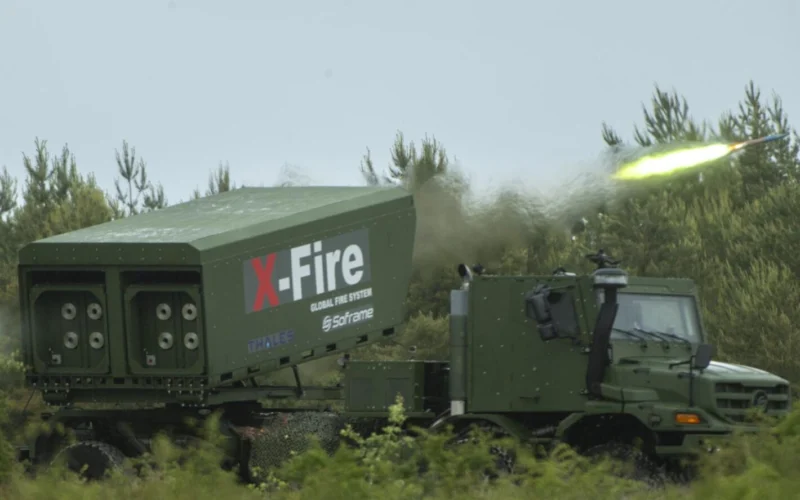
Thales has carried out the first firings of its X-Fire ground-based long-range strike launcher, the French defense electronics company announced on May 26, 2026, advancing its bid alongside ArianeGroup to replace the French Army’s aging fleet of Lance-Roquettes Unitaires (LRU) multiple rocket launchers.
The trial, conducted on May 20, 2026, employed the Thales X-Fum 68mm induction rocket, an existing training munition also fielded on the Tigre attack helicopter. The low-intensity training round was mainly used to validate the launcher and give French units their first hands-on familiarization, rather than to prove the performance of an operational munition.
“This successful firing demonstrates the system’s performance, and we are already preparing for the ramp-up of production,” said Julien Assoun, Vice-President Vehicles and Tactical Systems at Thales.
𝗫-𝗙𝗶𝗿𝗲: first successful test firings! Developed by Thales and Soframe, this versatile system has proven its readiness for long-range strikes. A new step towards French independent capability. More info: https://t.co/EQ8shxtDF8 #Defence #Thales pic.twitter.com/x3Wu9YZJjM
— Thales Group (@thalesgroup) May 26, 2026
A multi-munition launcher
X-Fire is developed by Thales, in partnership with vehicle integrator Soframe, as part of France’s Frappe Longue Portée terrestre (FLP-T) program. The system is mounted on an 8×8 truck compatible with the French Army’s existing logistics fleet, and integrates Thales navigation systems, including the TopStar Smart Receiver anti-jam GNSS unit and the TopAxyz inertial reference platform.
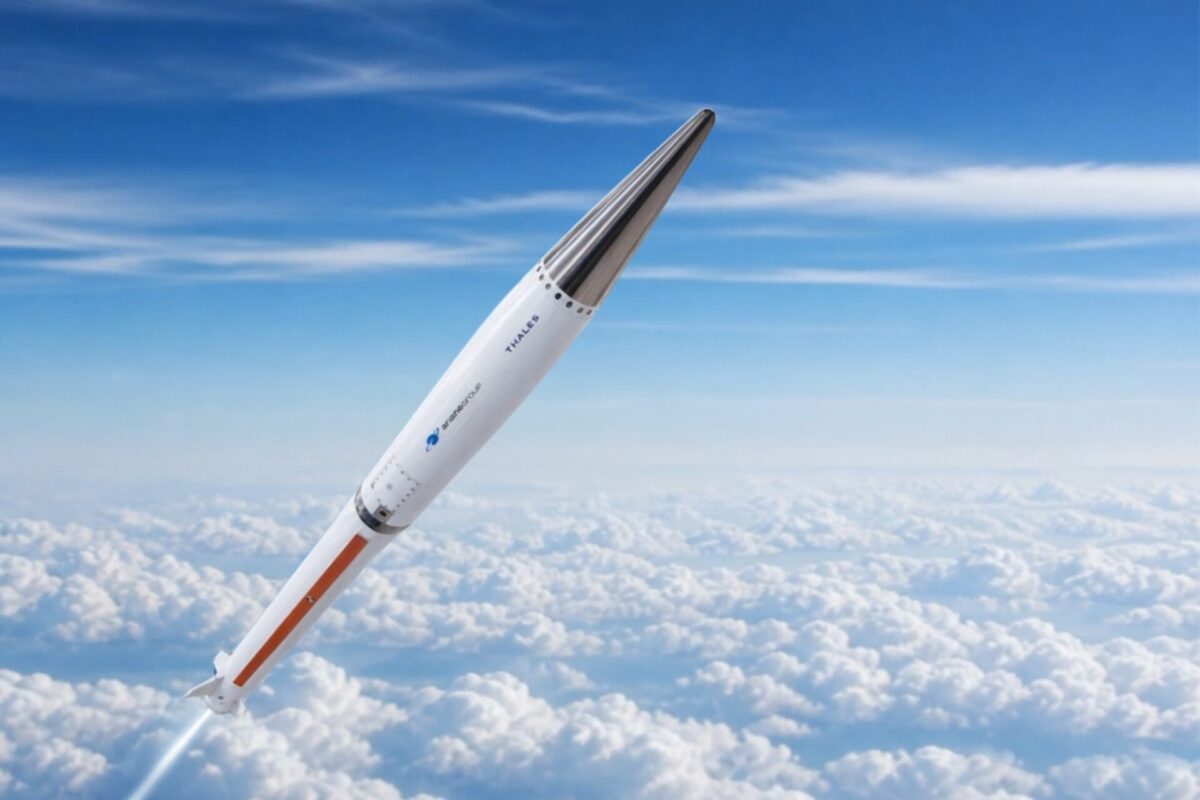
According to Thales, the launcher’s defining feature is its ability to fire both sovereign French and foreign munitions at ranges of 150 kilometers and beyond. The dual compatibility is designed to address two timelines: the eventual fielding of France’s sovereign FLP-t 150 ballistic munition, developed jointly with ArianeGroup, and the immediate capability gap as the LRU fleet approaches the end of service, which parliamentary documents place around 2027.
The FLP-t 150 munition completed its own first firing in early May 2026 at the DGA Essais de Missiles range on Île du Levant, off France’s Mediterranean coast.
Race against Thundart
The Thales-ArianeGroup team faces a competing bid from MBDA and Safran, whose Thundart rocket was fired for the first time on April 14, 2026, also at Île du Levant. Both consortia hold innovation partnership contracts from France’s defense procurement agency, the DGA, with a winner expected later in 2026.
The FLP-T program is intended to replace the nine LRU systems currently fielded by the French Army’s 1st Artillery Regiment, following the donation of several to Ukraine. The LRU is a French M270-based launcher procured in the early 2010s. French Defense Minister Catherine Vautrin said that the upcoming actualization of the Military Programming Law (LPM) will double the planned FLP-T fleet from 13 to 26 systems.
HIMARS bid considered?
The competition is unfolding against a broader debate in Paris over whether France should wait for a sovereign system, buy an interim foreign solution, or accept a hybrid approach. Alongside the Thales-ArianeGroup and MBDA-Safran bids, Turgis & Gaillard has also positioned its Foudre launcher as a French alternative designed to integrate various munitions, with potential deliveries starting in late 2027.
But that interoperability argument has already run into political limits. According to Euractiv, the United States has not authorized the integration of GMLRS rockets on the French-made launchers, complicating assumptions that they could rely on the widely used US munition family as a near-term bridge. In parallel, Lockheed Martin has reportedly offered France its M142 HIMARS system as an alternative to FLP-T.
The possibility has already triggered concern in the French Senate. Foreign Affairs and Defense Committee Chairman Cédric Perrin pressed Vautrin to rule out the separate Lockheed Martin proposal. Vautrin pointed to the two French partnerships and said she “hoped” the new system would be sovereign, without categorically excluding a foreign solution.