

The International Air Transport Association (IATA) expects the aggregate net profit of airlines worldwide in 2026 to be US$41 billion, which represents an average margin of 3.9% on total revenue at US$1.053 trillion.
These figures were shared by the international industry organization during the IATA Media Day, which took place in Geneva on December 9, 2025.
The organization’s Chief Economist, Marie Owens Thomsen highlighted that while these numbers have been achieved with record-high passenger load factors (83.8%) and are high for the airline industry’s historical record, airlines continue to operate at comparatively lower profit margins than other industries. To underline this point, Owens Thomsen shared a historical data series showing that never in its history has the airline industry been able to average a 5% profit margin.
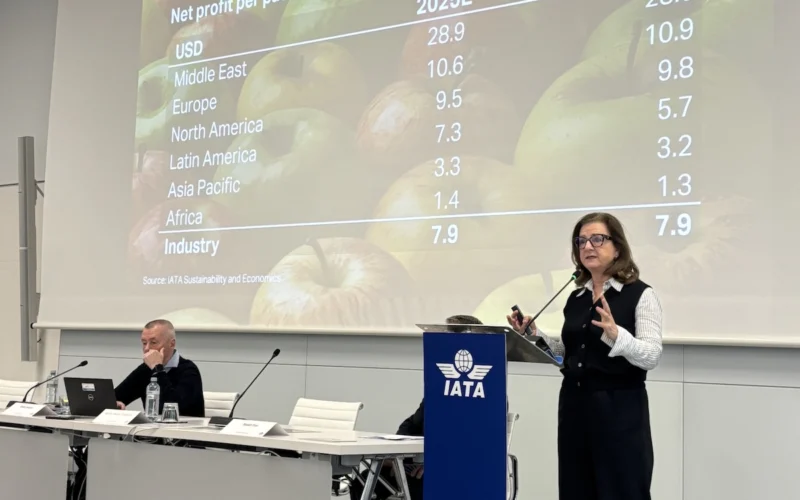
This aggregate picture, however, hides wide regional differences. Airlines in the Middle East, for example, show significantly healthier profit margins than their counterparts elsewhere. In 2025, Middle Eastern airlines were able to generate US$28.9 in profit per passenger, almost triple that of the next most profitable region, Europe, with US$10.9 per passenger. In fact, European airlines surpassed their North American counterparts when it came to profitability.
Africa remains the region with a more challenging operational and financial environment for airlines, with barely US$1 of profit per passenger carried. Political fragmentation and fuel costs that are around 20% higher than in other regions are two of the main factors behind this reality.
Willie Walsh comments on safety, delays and sustainability
Willie Walsh, IATA’s Director General spoke about a number of matters which concern the industry in areas such as safety, policy and regulation and sustainability.
When it comes to safety, Walsh expressed IATA’s concern about the all-too-common occurrence of passengers evacuating aircraft carrying their hand luggage in emergency situations and, alongside the relevant authorities, vowed to work on the matter to bring an end to this practice.
Walsh also addressed another problem affecting airlines around the world: delays. These are often attributable to external factors, Walsh said, singling out air traffic control (ATC) as a major cause of disruption.
During the press conference, IATA shared data that showed ATC-related delays have more than doubled in Europe in the period between 2015 and 2024, with France and Germany alone responsible for more than half of them. Walsh criticized the EU’s Directive 261, which makes airlines liable for compensation in the case of delays, stating that it had failed to address the root causes of most delays while placing a large financial burden on airlines.
SAF mandates, failing to do their job
On the sustainability front, Walsh also criticized the European Union’s Sustainable Aviation Fuel (SAF) mandates as they currently stand.
He voiced profound disappointment regarding SAF production, emphasizing that the industry is failing to achieve the necessary volumes to meet ambitious climate targets. The figures originally set for SAF production are now impossible to achieve, with even the goal of 10% SAF usage by 2030, once considered achievable, now beyond reach.
Walsh stressed that this is fundamentally not an issue of price but rather an issue of availability. The failure of supply has caused airlines to reevaluate their SAF commitments, which is deeply disappointing for carriers that entered into these agreements with genuine intent to reduce their environmental impact.
What makes this situation even more frustrating, according to the IATA chief, is that EU regulators and lawmakers appear to be standing back while witnessing prices going up without corresponding increases in actual supply. On this particular point, Walsh reiterated his complaint, already expressed during the 2025 IATA World Sustainability Symposium, about the current mandate framework having driven prices up while doing little to alleviate supply scarcity.
Walsh also slammed taxes and charges which have been introduced on purported environmental grounds. He stated this has led to economic damage without delivering meaningful reductions in carbon emissions.
He referred, as an example, to the UK’s Air Passenger Duty (APD), which, he stated, is not really an environmental tax but rather a mechanism to fill the government coffers.
Asked about the soundness of the EU mandate’s goal of using 70% SAF by 2050, Walsh answered that while challenging, he still sees this as achievable. The production of e-SAF will be key to meeting that goal, but he stated, Europe should considerably increase its renewable energy production capacity, a key ingredient for e-SAF production, in order to be able to do so.
Talking about e-SAF, Owens Thomsen added that all currently planned e-SAF projects should be started no later than 2026 to be on track to meet the current mandate goals. However, the rate of growth in SAF supply is slowing down.
Between 2024 and 2025, total global SAF production capacity nearly doubled, from one million tons to 1.9 million tons, while in 2026 this is expected to increase only to 2.4 million tons.
Owens Thomsen explained that energy companies are generally reluctant to invest in SAF, since returns, around 5%, tend to be much lower than those from investments in conventional oil (20%) and other renewables (10% approx.).
To put these figures into perspective, Owens Thomsen compared the investment requirements of the SAF industry to the amounts investors are pouring into other emerging industries, such as artificial intelligence (AI). If the US$217 billion invested by AI companies last year had gone into SAF, the airline industry would have all its SAF supply needs covered until 2036, she said. Using data from the International Monetary Fund (IMF), Owens Thomsen compared these figures to the one trillion per year which, she said, the conventional oil industry receives annually in subsidies of different sorts.
Owen Thomsen also mentioned the emergence of an SAF industry in China as having a potentially stimulating effect in the industry. Once Chinese producers start pumping SAF into the market, she stated, we can expect others to follow.
1 comment
Compliments to Willi Walsh for his Statement concerning SAF.
In Europa it’s all about erratic ideologie and nothing about sciences.
Thank you to him for his clear and pragmatic conclusion.