

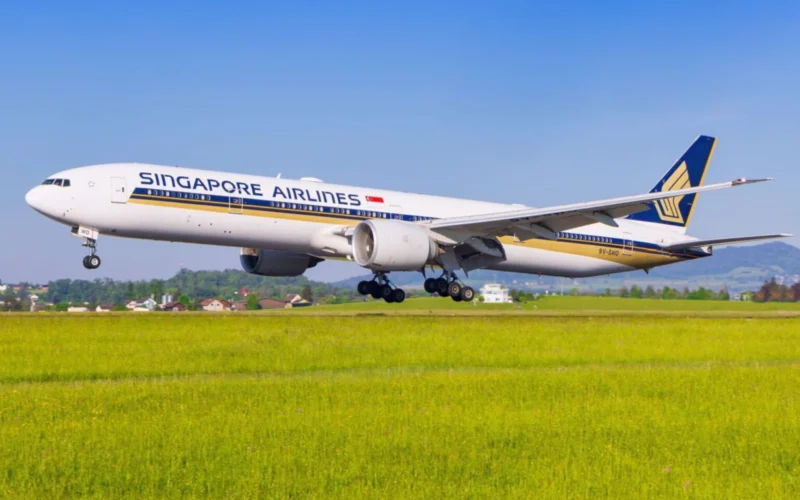
Three passengers injured during severe turbulence on Singapore Airlines flight SQ321 have filed a personal injury claim against the carrier at the UK High Court, nearly a year after the incident killed one passenger and hospitalized more than 100 others.
Bradley Richards, Benjamin Read, and Alison Read are pursuing damages through Keystone Law following the May 21, 2024, incident, which occurred approximately 11 hours into the 13-hour flight from London-Heathrow (LHR) to Singapore.
Singapore Airlines has not yet responded to the claim.
What happened on SQ321
The Boeing 777-300ER was carrying 211 passengers and 18 crew when it encountered severe clear-air turbulence over Myanmar. Flight data showed the aircraft dropped 178 feet in just over four seconds, with vertical acceleration swinging from negative 1.5G to positive 1.5G, briefly making the cabin weightless before slamming occupants back down.
Passengers and crew who were not wearing seatbelts at the time were flung to the ceiling as the aircraft dropped due to the turbulence. 104 people were hospitalized following an emergency landing in Bangkok, with at least 20 required intensive care or surgery.
Geoff Kitchen, a 73-year-old retired insurance worker from Thornbury near Bristol, died from a suspected heart attack during the incident. He had been traveling with his wife on what friends described as a six-week trip through Southeast Asia, Indonesia, and Australia. Kitchen’s family is not part of the current legal action.
The claimants
Bradley Richards, a 31-year-old telecoms engineer from Essex, was catapulted into the aircraft ceiling during the drop. He suffered multiple spinal fractures, a spinal epidural hematoma, and a head laceration requiring 20 stitches. He was removed from the aircraft in a wheelchair upon landing in Bangkok and has said he feared the injuries could end his career.
Benjamin Read said he was pinned to the ceiling during the turbulence. His two-year-old son was flung backward but was found uninjured. His wife Alison suffered a concussion that led to a seizure, while he sustained neck injuries.
Compensation framework
Singapore Airlines had previously offered $10,000 to passengers with minor injuries and $25,000 in advance payments to those with serious injuries requiring long-term care, along with full fare refunds for everyone on board. The airline described these as partial payments toward final settlements.
The High Court filing suggests the claimants consider those amounts insufficient given the severity of their injuries.
Under the Montreal Convention, airlines face strict liability for death or bodily injury on international flights without passengers needing to prove fault. The liability ceiling sits at approximately 128,821 Special Drawing Rights, roughly £128,000 or US$175,000 at current rates. Courts can award beyond that threshold if the airline cannot prove it took all reasonable measures to avoid the harm.
Investigation findings
The Civil Aviation Authority of Singapore led the formal investigation, with the UK’s Air Accidents Investigation Branch and the US National Transportation Safety Board as accredited representatives. Preliminary findings confirmed no aircraft maintenance faults.
The turbulence was classified as sudden clear-air turbulence, which appears without visual warning and cannot be detected by standard onboard weather radar. Investigators noted that the seatbelt sign was illuminated at the time of the incident.
The final investigation report is expected in the second half of 2026.
3 comments
Quisiera saber qué sucedió con vuelo LATAM en sector New Zealand con un incidente muy similar y que aún no se ha hablado nada de la investigación e indemnizaciones. ( hace ya uno o dos años )
Porque demoran tanto las investigaciones?
I find it ridiculous that an individual is allowed proceed with a court case against an airline on the issue of turbulence.
I agree with Steve G. How can you blame someone for something you can’t see or pick up. People know the risks of flying – and the fact the ‘Wear Seatbelt’ sign was on – that’s their fault, not the airline. Wake up people – too much suing going on just to make a quick buck.
Plus, they have travel insurance, don’t they……..