


René Armas Maes is a strategic advisor specializing in commercial development and strategy, with a focus on revenue optimization and margin enhancement.
As part of founding teams, he contributed to building a VIP business aviation operation from inception in the UAE and supported restructuring initiatives in Kuwait and Saudi Arabia.
The views and opinions expressed in this column are solely those of the author and do not necessarily reflect the official policy or position of AeroTime.
Accurately sizing a charter market requires more than relying on a single dataset or metric. The UAE-UK corridor functions as a bidirectional charter market, with material activity originating in both the UAE and the UK, reinforcing its role as a structurally interconnected high-yield, long-haul business aviation lane characterized by pronounced seasonality, a fleet mix weighted toward ultra-long-range and large jets, and operator economics shaped by scarcity and scheduling constraints.
This analysis defines market size as the estimated gross retail charter transaction value generated by in-scope flights. Throughout the article, references to market size or charter revenue refer consistently to this gross annual transaction value available within the defined corridor for commercially operated A6, T7, and G-registered business jets between 2023 and 2025.
The scope excludes turboprops, government and medevac operations, and owner-only flights. Only point-to-point flights originating in either the UAE or the UK and terminating in the counterpart country are included. Beyond or behind traffic is excluded to prevent double counting and unnecessary complexity.
Accordingly, the figures presented represent the addressable gross retail charter market within the defined registry and operational scope, rather than the entirety of global charter activity between the UAE and the UK.
Methodology overview and scope
The market size estimates presented in this analysis were calculated using three methodologies (Methods A to C) that triangulate from different angles.
Method A: Observed corridor hours monetized at charter rates
Method A is the most intuitive and, in many respects, the most defensible approach to sizing the corridor market. It begins with observed charter hours flown between the UAE and the UK, sourced from WingX and ARGUS TRAQPak and segmented by aircraft category. These hours reflect realized activity, shaped by actual demand, fleet availability, and regulatory scope.
Applying benchmark average gross retail charter rates by aircraft segment and year converts this operational activity into a revenue estimate. The key drivers are total corridor hours, aircraft mix, and yield assumptions. Given the dominance of ultra-long-range and large jets on this long-haul lane (AMSTAT data), modest shifts in fleet composition can materially influence revenue outcomes.
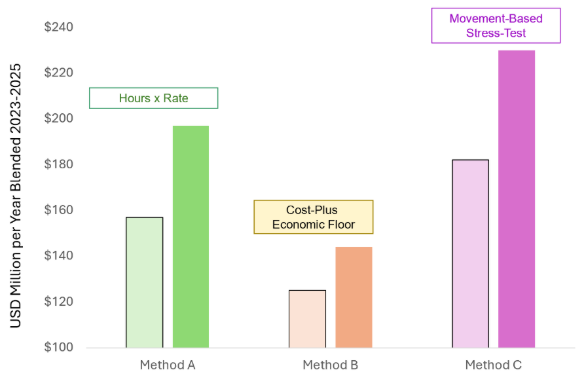
Importantly, the model monetizes observed annual hours rather than extrapolating peak-period pricing. Seasonal yield spikes are therefore embedded within the annual data, reducing the risk that peak-month conditions distort full-year estimates. Retail benchmarks are applied on a gross basis to capture total transaction value and maintain consistency across methodologies. Under Method A, the gross retail charter market for the defined corridor is estimated at approximately US$157 to US$197 million per year.
Method B: Cost-plus economic requirement as an economic floor
Method B approaches market sizing from an economic sustainability perspective rather than observed pricing. It asks: given the aircraft and hours flown on the corridor, how much revenue must be generated to cover operating costs and provide a reasonable margin?
Direct operating costs are calculated by aircraft segment using fuel burn assumptions, UAE and UK Jet A-1 prices, non-fuel variable costs, and annual fixed costs. A 15% operating margin is applied to these direct costs to estimate the minimum gross retail revenue required to sustain activity. This margin is deliberately conservative and excludes overhead, making Method B a cost-recovery floor rather than a profitability target.
The method is sensitive to the annual utilization assumption used to allocate fixed costs. The 525-hour allocation base reflects assumed total annual aircraft productivity, not corridor-specific flying. Fixed costs are divided by this utilization base to derive a per-hour burden, which is then proportionally applied to corridor hours. Increasing the allocation base to 650 or 750 hours would reduce the fixed-cost burden per hour by approximately 19% and 30%, respectively, lowering Method B’s implied revenue floor as illustrated in Chart 1.
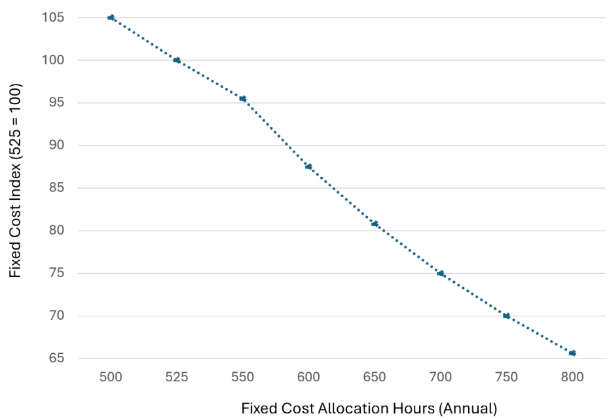
Using a 525-hour annual allocation base represents a conservative-to-moderate productivity assumption, implying seasonal deployment and higher fixed cost per hour, thereby establishing a disciplined cost-plus economic floor. This reflects the reality that long-haul charter aircraft operate across multiple markets and do not dedicate full annual utilization to a single corridor.
The strength of Method B lies in its constraining function. If a rate-based approach such as Method A implies revenue below the cost-plus economic threshold, it signals that pricing or utilization assumptions may be overstated. Method B therefore serves as an economic reality check grounded in operator cost structure. Under this framework, the gross retail cost-plus economic floor for the defined corridor is estimated at approximately US$125 to US$144 million per year.
Method C: Movement-based stress-test
Method C provides an independent validation of corridor activity by reconstructing total hours from flight movements rather than relying on observed hours. It estimates corridor hours using movement counts and assumed stage lengths, then applies the same gross retail rate logic as Method A to derive a revenue range.
This method is intended as a cross-check rather than a primary estimator, ensuring that implied corridor hours are consistent with observed movement patterns. Under Method C, the gross retail charter market for the defined corridor is estimated at approximately US$182 to US$230 million per year.
As illustrated in Chart 2, Method C produces a deliberately wider range than Methods A and B because small changes in stage-length assumptions compound across a large number of flights, materially affecting total estimated hours before pricing is applied. Unlike Method A, which provides a moderate range anchored in observed charter hours, or Method B, which defines the narrowest range as a cost-plus economic floor, Method C introduces additional operational uncertainty reflecting movement-driven reconstruction and stage-length sensitivity. This broader dispersion is intentional and serves as a structural stress test, reinforcing the robustness of the final triangulated estimate.
Triangulation and interpretation of results
The triangulation framework reconciles three distinct methodologies (Methods A through C) to answer a single economic question: what is the gross retail charter value generated by business jet activity on the UAE–UK corridor? Rather than relying on one estimator, the model integrates Method A (observed hours × average rates), Method B (cost-plus economic floor), and Method C (movements-based reconstruction), each capturing a different dimension of market reality.
The weighting reflects confidence hierarchy rather than statistical averaging. Method A receives the greatest emphasis because it is anchored in observed corridor activity. Method B serves as an economic constraint, defining the lower bound by ensuring consistency with sustainable cost structures. Method C is weighted more lightly, as its movements and stage-length assumptions introduce wider variability. The triangulated range therefore converges toward Method A, bounded by Method B’s floor and validated by Method C’s structural cross-check. This approach reduces the risk that pricing, cost, or utilization assumptions disproportionately drive the outcome.
On this basis, the triangulated UAE↔UK gross retail charter market size for A6, T7, and G-registered for-hire business jets is estimated at US$159 to US$205 million per year, reflecting blended outcomes across 2023–2025.
While this estimate captures corridor-level gross transaction value, realized profitability remains sensitive to monetization and repositioning efficiency, paid-hour ratios, competitive fleet supply, and channel dynamics. The corridor’s attractiveness therefore depends not only on demand magnitude, but on an operator’s ability to optimize deployment and protect yield across seasonal cycles.
Testing corridor scale against premium airline capacity
To further test the proportionality of the triangulated estimate, the analysis compares implied charter passenger volume against the broader premium airline ecosystem.
An important external validation of the UAE–UK charter market sizing is to compare implied charter passenger volume with the total premium airline ecosystem serving the same corridor. OAG data indicates that First and Business class seat capacity from the UAE to the UK totaled approximately 611,000 seats in 2023, 675,000 in 2024, and 674,000 in 2025, establishing the scale of the broader high-yield one-way travel market between the two regions.
This comparison is used as a proportionality benchmark rather than a substitution model. It provides context on structural demand without implying direct behavioral conversion between airline and charter passengers. To maintain directional consistency, the analysis compares one-way premium seat capacity with one-way charter equivalents and applies a load factor assumption. Using a 1.5% charter penetration sensitivity and a 94% load factor, the 2025 premium seat base implies roughly 9,500 potential charter passengers annually.
Converted into flight equivalents, this equates to approximately 1,590 flights at an average of six passengers per aircraft or 1,060 flights at nine passengers per aircraft. When compared against actual one-way charter activity, implied charter passengers represent roughly 0.99% of premium airline passenger volumes at six passengers per flight and 1.32% at nine passengers per flight, both below the 1.5% stress assumption.
These results confirm that charter represents a small fraction of total premium mobility on the corridor. As such, the triangulated gross retail revenue estimate sits proportionately within the broader high-yield travel ecosystem, reinforcing the robustness and defensibility of the market sizing.
Corridor seasonality, airport concentration and fleet
While OAG premium capacity validates the scale of high-yield demand between the UAE and the UK, charter activity manifests differently from scheduled airline traffic. Business aviation demand is shaped by seasonal travel patterns, aircraft availability, and airport-system dynamics, creating pronounced peaks and troughs. The following section therefore examines seasonality, airport concentration, and fleet to explain how the corridor functions in practice.
Data from ARGUS TRAQPak and WingX confirm that seasonality is a defining structural characteristic of the UAE–UK corridor. Across A6, T7, and G-registered charter activity, Chart 3 illustrates the structural seasonality of the UAE↔UK corridor. Between June and September, 41% of annual charter hours are flown, confirming a clear summer concentration. July represents the single strongest month, while January and February mark the weakest demand period. March, April, and November function as shoulder months, while December reflects a premium shoulder supported by holiday-driven demand.
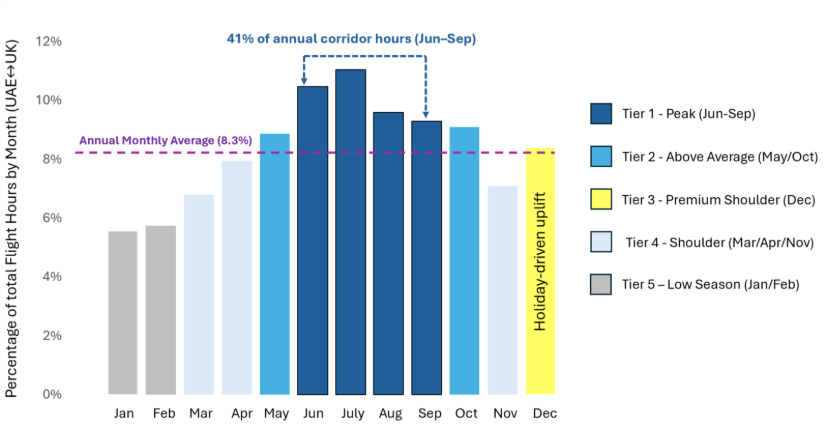
Shoulder season should not be confused with low season. Low season reflects structurally weakest demand and lowest yields, whereas shoulder months represent transitional periods between peak and trough. On the UAE–UK corridor, summer months form the clear peak; January and February represent the primary low period, and March, April, and November function as shoulder months. While demand moderates during shoulder periods, pricing and aircraft utilization remain materially stronger than in true low season, an important distinction when assessing corridor economics and annual productivity.
The corridor does not operate as a steady utilization market. Activity clusters into defined tiers, with peak summer months materially exceeding the annual monthly average. Given that pricing power is strongest during peak periods, revenue concentration is likely more pronounced than hour concentration alone implies.
This seasonality reinforces a central conclusion: the UAE–UK corridor is a concentrated, high-yield long-haul seasonal market rather than a uniform year-round lane. Economic performance is driven by peak-period pricing and aircraft availability. Operators that pair strong summer demand with complementary winter deployment in Europe or Asia are better positioned to stabilize paid-hour ratios and sustain profitability.
Airport concentration further clarifies demand structure. On the UAE side, activity is heavily centered in the Dubai–Abu Dhabi system, led by Al Maktoum International (DWC) and Al Bateen Executive Airport (AZI), with additional volume from Abu Dhabi. On the UK side, charter movements are concentrated within the London airport system, particularly London-Luton (LTN), Farnborough (FAB), Biggin Hill (BQH), and London-Stansted (STN). This reflects both demand concentration and business aviation infrastructure realities, including runway capability, slot access, handling capacity, and proximity to corporate and wealth centers.
Route-level analysis reinforces that the corridor functions primarily as a Dubai and Abu Dhabi to London system market rather than a dispersed country-to-country network, with the most frequent pairings between DWC, Al Bateen, Abu Dhabi and London-Luton, alongside significant activity at Farnborough as illustrated in Chart 4.
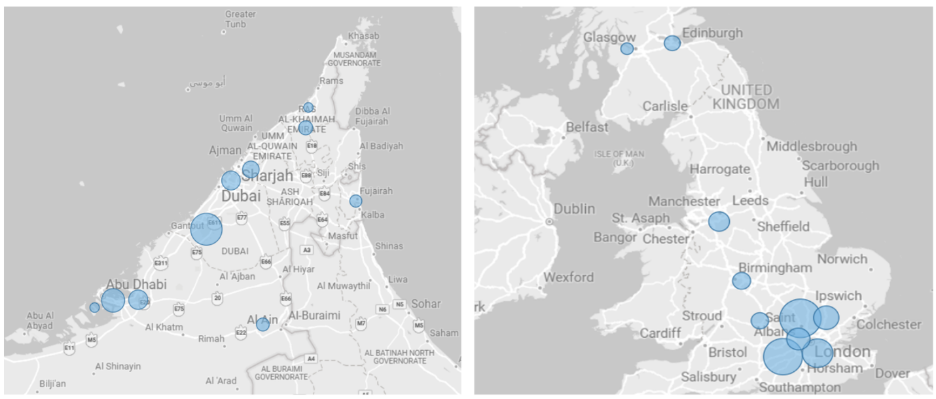
The dominance of ulta-long-range and large jets on the most frequently flown routes underscores the corridor’s long-haul, premium profile and explains why overall market value is highly sensitive to fleet composition. Even modest changes in the share of long-range aircraft operating the lane can materially influence gross retail revenue outcomes.
While additional long-range aircraft entering A6, T7, or G fleets could increase capacity and place downward pressure on realized pricing, structural constraints such as slot access, parking availability, and FBO capacity particularly within the London airport system may act as implicit supply limits that help sustain yield.
Conclusion
Taken together, the triangulated framework and the premium airline capacity benchmark provide both internal and external validation of market size. The revenue estimates are anchored in observed charter activity, bounded by operating economics, and stress-tested against the broader premium travel ecosystem using one-way seat capacity and load factor assumptions.
A central insight is that the UAE↔UK corridor functions primarily as a yield-driven long-range mission lane rather than a utilization-driven market. Revenue is concentrated in peak periods where pricing power likely accounts for a disproportionate share of annual profitability, while trough months materially affect paid-hour ratios for operators without complementary deployment options.
Ultimately, market size defines opportunity, and monetization efficiency determines outcome and profitability. Realized performance depends on paid-hour ratios, repositioning efficiency, fleet mix, airport concentration, competitive capacity dynamics, and network depth.
Operators that understand the corridor’s role as a premium, seasonal revenue contributor, manage broker exposure in off-peak periods, align deployment strategy accordingly and optimize maintenance scheduling during troughs are most likely to capture its full economic value.