

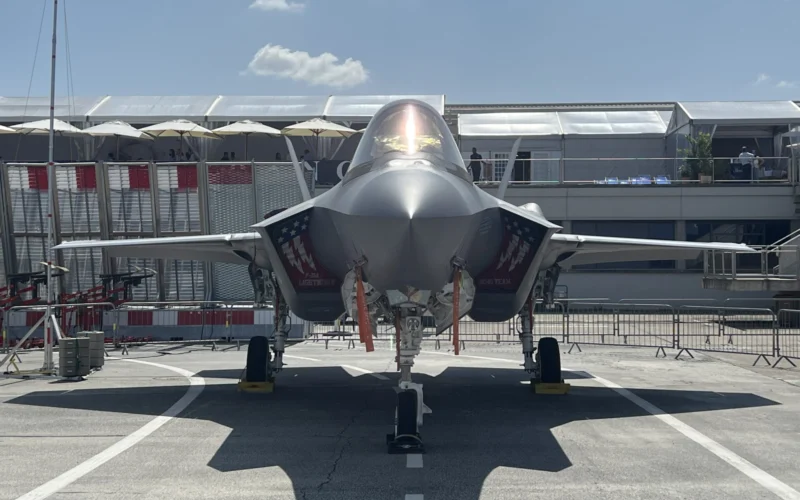
The United States’ ambassador in Lisbon, John Arrigo, has urged Portugal to buy Lockheed Martin’s F-35, pushing the fifth-generation fighter as the preferred successor to the Portuguese Air Force’s aging F-16 fleet.
Arrigo made the remarks in an interview with CNN Portugal, framing the aircraft choice around NATO interoperability and arguing that joining the large and growing European F-35 user community would place Portugal among the continent’s “top tier” air forces.
Portugal has not launched a formal selection process for a new fighter. Defense Minister Nuno Melo said in November 2025 that the replacement program had not yet begun, and that Lisbon had not placed any orders for new combat aircraft. On March 13, 2025, Melo said Portugal was reassessing plans that had previously pointed toward the F-35 as a potential replacement for the F-16, while stressing that no purchase decision had been made.
Even so, Portuguese Air Force Chief of Staff General João Cartaxo Alves has indicated that internal work is moving ahead. In a lengthy December 2025 interview with Diário de Notícias, Alves argued the F-16 replacement should have started about two decades ago and noted the fleet’s longevity, 31 years for the newest aircraft and nearly 40 for older jets.
Alves said it was “clear” the F-16 would be replaced and described the process as already underway with the relevant authorities, adding that a likely purchase range would be between 14 and 28 aircraft. He framed that as a potential stopgap tied to a longer horizon, suggesting Portugal could buy a smaller number first if it is already working on a sixth-generation successor, rather than sizing the fleet solely around an F-16 one-for-one replacement.
Melo has said Portugal would like to participate in one of Europe’s two sixth-generation fighter programs, the Future Combat Air System (FCAS) or the Global Combat Air Programme (GCAP). He framed the near-term objective as joining as an observer, and argued it would put Portugal in an “advanced” position as it looks toward what comes after the F-16.
US ambassadors as procurement messengers
Portugal’s hesitation reflected a broader debate within Europe over dependence risks, sustainment, and the long-term freedom of action for high-end US systems, even as the F-35 continues to expand its footprint across NATO. In August 2025, it was reported that discussions between Spain and Washington over the F-35 had been “suspended indefinitely.”
Arrigo’s intervention also fits a pattern of unusually direct public messaging by US envoys on allied fighter procurement, with senior diplomats publicly tying aircraft choices to wider alliance integration.
In Canada, US Ambassador Pete Hoekstra has repeatedly linked Ottawa’s internal F-35 debate to continental air defense. In late January 2026, as Canada weighed the possibility of a smaller F-35 buy or a mixed fleet, Hoekstra warned that NORAD “would have to be altered” if Canada pulls back from its planned 88-aircraft purchase.