

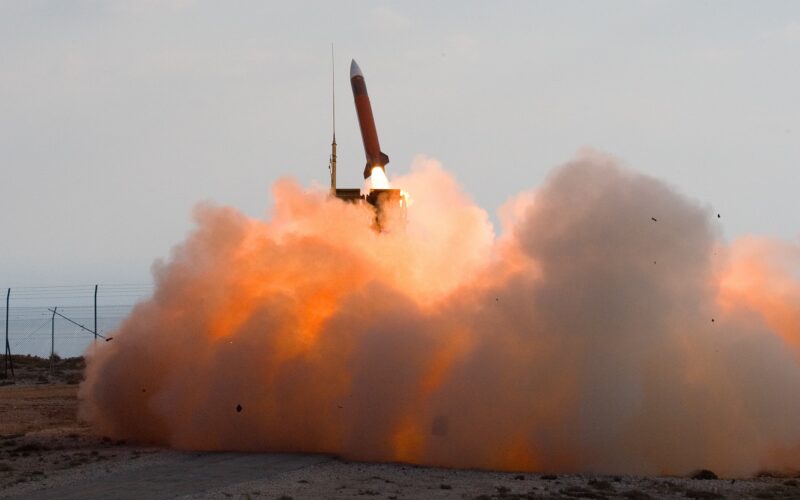
The US Army has launched a new prize competition offering up to $8 million to accelerate the development of low-cost interceptor technologies, the largest prize pool in the history of its xTech program.
The competition, called xTech|Apex Intercept, was launched by the Army FUZE xTech Program in partnership with Capability Program Executive Defensive Fires on July 7, 2026. It seeks technologies across four areas: low-cost interceptor all-up rounds and fire control, low-cost solid rocket motors, low-cost seekers, and fire control and flight guidance implementation.
The initiative follows the US Army’s Low-Cost Interceptor (LCI) Industry Day, held in Arlington, Virginia, on June 23, 2026, where Secretary of the Army Daniel Driscoll outlined the need to expand participation beyond traditional defense contractors and accelerate the delivery of low-cost interceptor capabilities. Driscoll said at the event that the service wants demonstrations within six months and procurement to begin within a year.
A two-part competition
Companies must submit a concept white paper of up to five pages between July 7 and July 24, 2026. The US Army will then invite up to 30 finalists, each awarded $25,000, to a live demonstration event in the October-November 2026 timeframe, which will take place at White Sands Missile Range in New Mexico. Up to 18 final winners will compete for the remaining $7.25 million across the four problem statements. Winners will be announced on December 31, 2026.
The competition is open to both domestic and foreign businesses, provided they are incorporated in the US or an allied country.
Rebalancing the cost of air defense
The program responds to a cost imbalance laid bare by the wars in Ukraine and Iran, where air defenses relying on interceptors worth millions of dollars, such as the PAC-3 missiles used by the Patriot system, have been pitted against drones costing a few thousand dollars each. Driscoll initially set a cost target of $250,000 per interceptor, before describing the figure as a constraint on industry, saying the US Army would buy a more expensive solution if it proved to be the right answer.
Rather than selecting a finished weapon, the US Army intends to evaluate each subsystem separately and retain ownership of the intellectual property, allowing it to switch manufacturers and scale production.
The approach mirrors a broader US effort that includes the Missile Defense Agency’s own Low-Cost Interceptor initiative. In Europe, companies such as Estonia’s Frankenburg Technologies are building factories to mass-produce cheap anti-drone missiles.