

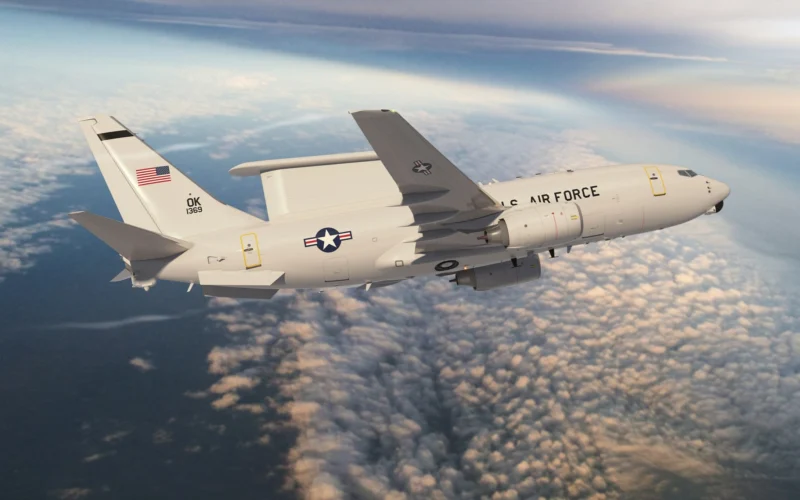
US lawmakers have moved to keep the Boeing E-7 Wedgetail program alive, after the Pentagon previously sought to cancel the airborne early warning and battle management aircraft.
The House Appropriations Committee has included $1.55 billion for the US Air Force’s E-7 Wedgetail program in its fiscal year 2027 defense appropriations bill.
The funding would support continued development of the aircraft, which is intended to replace part of the aging E-3 Sentry Airborne Warning and Control System fleet.
The move marks another turn in a program that has been pulled in various directions by Air Force modernization plans, cost concerns, aircraft survivability questions and pressure from Congress to avoid a capability gap.
The US Air Force selected the E-7 as its planned replacement for the E-3 Sentry, a Boeing 707-based aircraft that has served for decades as the service’s primary airborne warning and control platform.
Boeing received a $2.56 billion contract from the US Air Force in 2024 for two E-7A rapid prototype aircraft. At the time, the service had planned to buy 26 E-7s.
But the program’s future grew murky after the Pentagon moved to cancel the aircraft, citing concerns over cost, schedule and survivability. Defense officials also argued that future space-based systems could take on some of the missions now performed by airborne command-and-control aircraft.
Congress has repeatedly pushed back against ending the program.
The House funding would continue the program by putting nearly $1.6 billion behind the Wedgetail in FY2027. The committee’s bill also keeps separate funding for the US Navy’s E-2D Advanced Hawkeye program, avoiding an offset that would have shifted money away from the carrier-based airborne early warning aircraft.
The E-7 is based on the Boeing 737-700 Next Generation airframe and uses a fixed Northrop Grumman Multi-role Electronically Scanned Array radar mounted above the fuselage.
Unlike the E-3, which uses a rotating radar dome, the E-7’s fixed radar array provides 360-degree coverage without the large rotodome associated with older AWACS aircraft.
The aircraft is already in service with the Royal Australian Air Force and has been selected by other allied air forces, including that of the United Kingdom.
The House bill is not the final word on the program’s future, however. It still has to move through the full congressional appropriations process and be reconciled with Senate legislation before becoming law.