

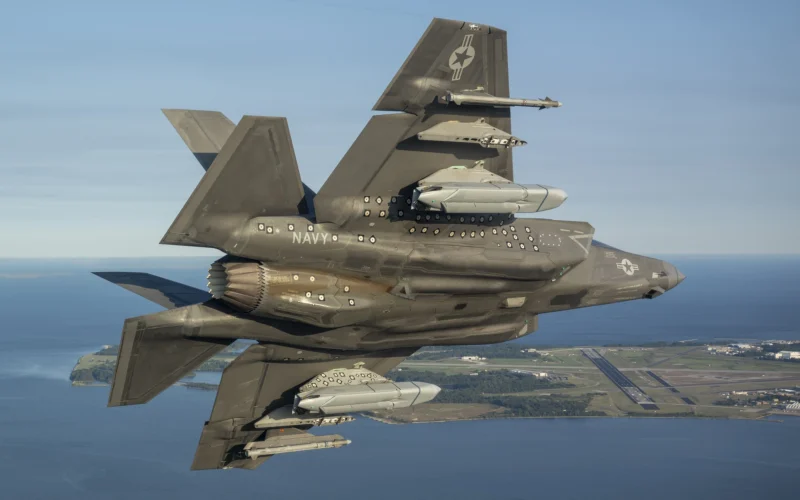
The US Navy is working on integrating the AGM-158C Long-Range Anti-Ship Missile (LRASM) with the F-35 Lightning II.
A test pilot at Naval Air Station Patuxent River conducted a flight test of the F-35C, the carrier-borne variant of the fighter, on September 10, 2024. The Pax River F-35 Integrated Test Force (Pax ITF) team conducted two days of flights to assess key performance factors.
These flights evaluated flutter, loads, and flying qualities with two AGM-158 missiles loaded on external stations, as they do not fit in the F-35’s internal weapons bay.

“LRASM is a defined near-term solution for the Offensive Anti-Surface Warfare (OASuW) air-launch capability gap that will provide flexible, long-range, advanced, anti-surface capability against high-threat maritime targets,” the US Navy said in a statement.
The missile integration with the F-35 will enhance the aircraft’s ability to carry out anti-ship missions over extended ranges. Eventually, the weapon should be used by the carrier-based F-35C and the short take-off and vertical landing (STOVL) F-35B, operated by the US Marine Corps.
The US Navy F/A-18 Super Hornets and the US Air Force B-1B strategic bombers are currently certified to use the LRASM.
In April 2023, the US Naval Air Systems Command awarded Lockheed Martin and Raytheon a $116 million contract to develop a successor to the LRSAM under the Hypersonic Air Launched Offensive Anti-Surface (HALO) program.