

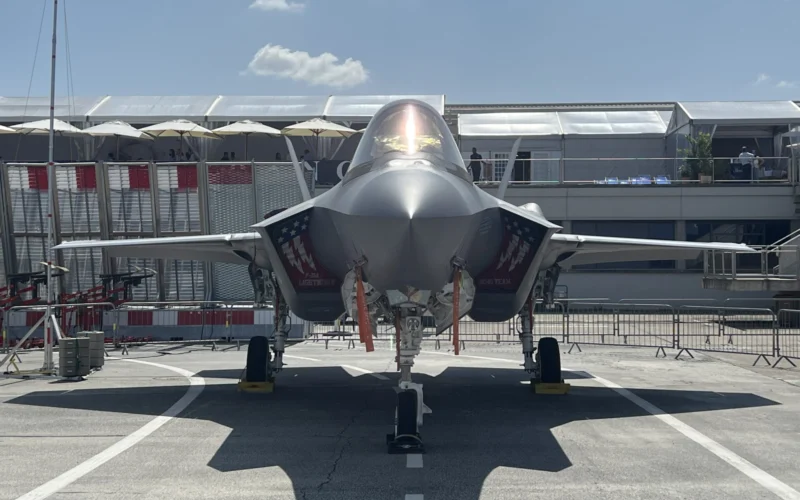
The United States has moved forward with a $24.3 billion sale of 48 F-35 Lightning II fighters to Saudi Arabia. This brings the kingdom a step closer to becoming the first Gulf operator of the stealth aircraft, despite fresh warnings from US intelligence agencies about the risk of sensitive technology reaching China.
The State Department formally notified Congress of the proposed sale on September 17, 2026, a day after reports emerged detailing US intelligence concerns over Saudi Arabia’s military and technological ties with Beijing.
If completed, the deal would make Saudi Arabia only the second F-35 operator in the Middle East after Israel. It would also mark a major expansion of the Royal Saudi Air Force’s capabilities, adding a stealth fighter with advanced sensors and networked warfare capabilities to a combat fleet currently centered on the F-15.
The notification marks the latest step in a process that began well before the announcement. President Donald Trump confirmed his intention to sell F-35s to Riyadh in November 2025, ahead of a White House visit by Saudi Crown Prince Mohammed bin Salman. The proposed package was subsequently submitted to two congressional committees for informal review in June 2026.
US intelligence warnings cast a shadow over the sale
Washington’s decision comes as questions persist over how Saudi Arabia would protect some of the most sensitive technology in the US military inventory.
A Defense Intelligence Agency assessment, detailed in a recent report, raised concerns about potential Chinese access to Saudi air bases, as well as the kingdom’s use of telecommunications equipment supplied by Chinese companies Huawei and ZTE.
The assessment questioned whether Washington and Riyadh could adequately secure facilities housing F-35 technology. It also examined possible restrictions on Chinese military and intelligence personnel accessing Saudi installations.
The issue has already complicated another attempted F-35 export to the Gulf. In 2020, Washington agreed to sell the aircraft to the United Arab Emirates, but the proposed deal subsequently stalled amid disagreements over security conditions and concerns about Abu Dhabi’s relationship with China.
Israel presents a separate challenge. The country remains the region’s sole F-35 operator, and Israeli officials have raised concerns that supplying the same aircraft to Saudi Arabia could erode its so-called “qualitative military edge”, which US law requires Washington to preserve.
In its notification, the State Department maintained that the proposed sale would not alter the regional military balance. However, the public document does not explain what specific safeguards or aircraft configuration would address the concerns surrounding China and Israel.
What is included in Saudi Arabia’s $24.3 billion F-35 package?
The proposed sale covers 48 conventional takeoff and landing F-35s, the variant operated by the US Air Force, along with 49 Pratt & Whitney F135-PW-100 engines, including one spare.
The package also includes secure communications and cryptographic equipment, electronic warfare database support, spare parts, simulators, training, and logistics support.
Lockheed Martin’s facility in Fort Worth, Texas, and Pratt & Whitney Military Engines in East Hartford, Connecticut, are identified as the principal contractors.
Notably, no air-to-air or air-to-ground weapons are listed in the notification. The absence of munitions means that the package does not provide a complete picture of how Saudi Arabia intends to arm its prospective F-35 fleet.
Riyadh has pursued separate weapons purchases from Washington, including a $5 billion package of Joint Direct Attack Munitions, as notified on September 4, 2026. That transaction is separate from the F-35 proposal and does not establish which weapons would be cleared for use on the new fighters.
No Saudi F-35 order has been signed yet

The notification provides no delivery schedule, and producing and delivering the fighters would take years. The final contract value could also differ from the $24.3 billion estimate.
In the meantime, Saudi Arabia will continue to rely on its existing F-15 fleet, for which Washington approved a $3 billion support package in February 2026.
The aircraft remain actively engaged in combat operations. On September 16, 2026, the Houthi movement claimed to have shot down a Royal Saudi Air Force F-15 over Yemen’s Marib Governorate.