

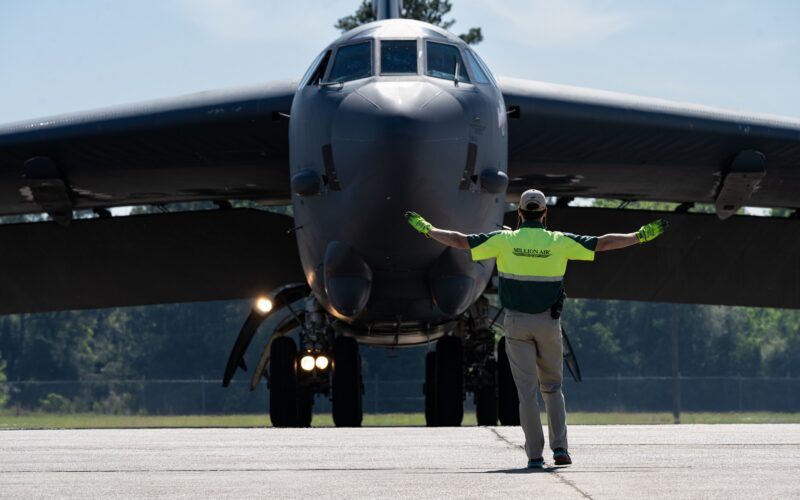
The US Air Force’s B-52 Commercial Engine Replacement Program has completed its Critical Design Review, clearing the way for the first two B-52H Stratofortress bombers to be modified into the future B-52J configuration.
The review, announced by the Air Force Life Cycle Management Center (AFLCMC) on May 4, 2026, marks one of the most important technical milestones in the long-running effort to replace the bomber’s 1960s-era Pratt & Whitney TF33 engines with modern Rolls-Royce F130 turbofans.
The CDR brought together independent experts from the US Air Force, Boeing, and Rolls-Royce to assess the complete system design before major modifications begin. According to AFLCMC, the process confirmed that the design meets “all warfighter and technical requirements” and allows the program to move from engineering work toward physical aircraft modification.
“This CERP critical design review is the culmination of an enormous amount of engineering and integration work from Boeing, Rolls-Royce, and the Air Force that will enable the B-52J to remain in the fight for future generations,” Lieutenant Colonel Tim Cleaver, CERP Program Manager at the Bombers Directorate, said in the AFLCMC release.
First B-52H to enter modification later in 2026
Boeing, the prime contractor for integration, is now procuring and manufacturing parts ahead of converting the first two aircraft at its facility in San Antonio, Texas. The first B-52H is scheduled to arrive there later in 2026.
Once modified, the two B-52J test aircraft will be transferred to Edwards Air Force Base, California, for an extensive test campaign to validate the new engines, associated subsystems, and integration work. After testing is complete, the program is expected to move toward modification of the remaining B-52H fleet.
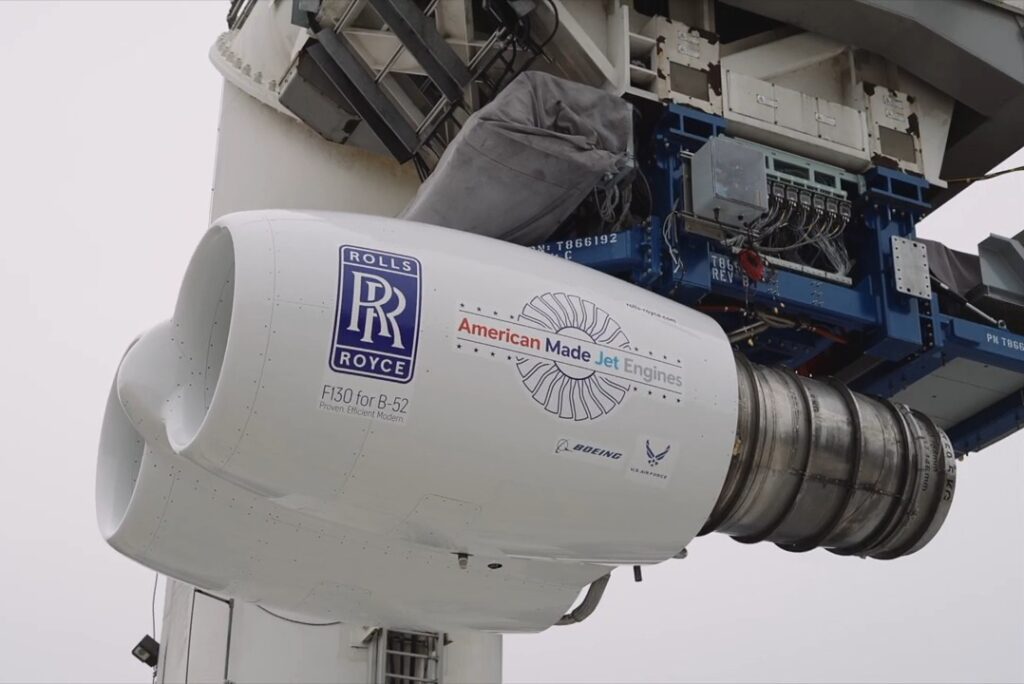
In February 2026, Rolls-Royce completed altitude and operability testing of the F130 at the US Air Force’s Arnold Engineering Development Complex in Tennessee. That campaign evaluated the engine under representative mission conditions, including long-duration high-altitude profiles, airflow distortion, and electrical power generation scenarios with Boeing.
The F130 itself passed its own Critical Design Review in late 2024, clearing the way for flight-test engine production. Initial flight-test engine builds were already underway by early 2026, with deliveries expected in 2027 to support the B-52 flight-test campaign.
From B-52H to B-52J
The F130, derived from Rolls-Royce’s BR725 commercial engine, will replace the TF33 engines that have powered the B-52H since the early 1960s.
The new engines are expected to improve fuel efficiency, reliability, maintainability, and electrical power generation, while reducing the logistics burden associated with the aging TF33 fleet. Aircraft modified with the new engines and associated subsystems will be redesignated B-52J.
The engine replacement is only one part of a broader B-52 modernization effort. The bomber is also receiving new avionics, updated mission systems, and a new radar. In December 2025, a B-52 had completed its ferry flight to Edwards AFB after receiving the Raytheon AN/APQ-188 active electronically scanned array radar, replacing the older AN/APQ-166 mechanically scanned system.
Together, these upgrades are intended to keep the B-52 in service into the 2050s, nearly a century after the type first entered operational service in 1955. The bomber is expected to remain part of the US long-range strike force alongside newer platforms such as the Northrop Grumman B-21 Raider.