

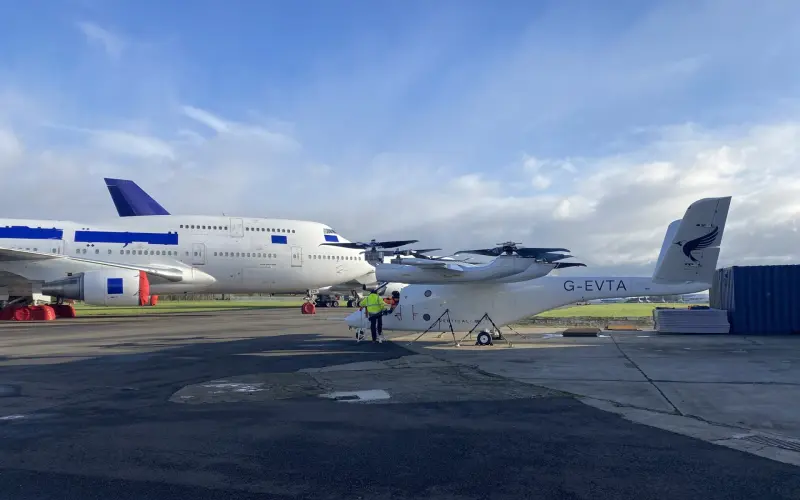
Vertical Aerospace have signed a new agreement with long-term partner Honeywell to strengthen their alliance on the path towards certifying the VX4, an electric vertical take-off and landing (eVTOL) aircraft.
The companies announced on May 9, 2025, that the expanded partnership will enter a significant new stage in the VX4’s development, with the contract thought to be worth up to $1 billion over the next decade.
Honeywell and Vertical will work together to certify two of the most critical systems that will need to be certified for the production version of VX4.
These include the aircraft management system which operates the Honeywell Anthem Flight deck, plus the flight controls system which uses Honeywell’s compact fly-by-wire system.
The Anthem flight deck combines cockpit displays, software, controls and connectivity into one digital platform, designed to be intuitive and highly automated.
Meanwhile the fly-by-wire system allows the aircraft to be controlled electronically instead of mechanically, helping to improve stability, safety and ease of flight.
“As we accelerate toward global certification and scalable production, Honeywell’s aerospace expertise and proven track record in flight-critical systems make it the ideal partner for this next phase,” said Stuart Simpson, CEO of Vertical Aerospace. “By integrating production-ready technologies, we’re helping build an aircraft that meets the highest safety standards in aviation, solidifying its certifiability and exportability across global markets.”
The companies will share expertise, personnel and testing environments, which are collectively expected to speed up the VX4’s development and help both parties achieve certification and quickly move on to production.
Vertical and Honeywell have been working closely for six years, with the latter having invested in the eVTOL developer since 2021.
The VX4 prototypes rely on integrated Honeywell flight systems, which have played a significant role in two separate flight test campaigns so far.
“We have long believed in the importance of advanced air mobility and the significant potential we can unlock by harnessing our deep expertise in integrated avionics and flight controls in new and exciting ways,” said David Shilliday, Vice President and General Manager of Advanced Air Mobility at Honeywell Aerospace Technologies. “With a shared commitment to innovation, reliability and safety, we’re excited to deepen our partnership with Vertical to help scale the technology necessary to bring even more advanced, efficient, safe and reliable solutions to the skies.”
As part of their expanded partnership, Vertical has also selected newly designed Honeywell inceptors for its production aircraft.
The VX4 pilot will use two of these advanced hand controllers to maneuver the aircraft by providing inputs to the flight control computer.
“We designed our inceptor to be the lightest and most compact in the industry, and we could not be happier that Vertical is the launch customer for this new technology,” said Rich DeGraff, President, Control Systems, Honeywell Aerospace Technologies. “Our inceptor will pair seamlessly with the Honeywell Compact Fly-byWire system already selected by Vertical, and we’re excited to work together to integrate these advanced flight technologies into the VX4.”
Vertical intends to gain VX4 certification in 2028 and deliver at least 150 aircraft to customers by 2030.
1 comment
A lot of activity on certifying systems, although without final regulations and rules this seems to be a wasted effort.
Is anyone looking at the critical objective of airspace and actual approvals for flying these aircraft?
In most countries, trying to get a flight plan is a laborious task, and yet has anything been done about this yet?
And how can any of these aircraft expect to operate if they require flight plans? Can a on-demand “taxi” afford to operate if it needs to get a flight plan approved for operating the flight? What is the flight patch and flight plan even look like when the aircraft is designed to fly unrestricted, without typical navigation?
Can a profitable operation be expected when the aircraft has to spend almost the same amount of time plugged in to a charger as it does flying? Is the range of 25-100km enough to be financially sustainable? Is their baggage space and weight capacity for each of the seats it is expected to have onboard? Has inspection, pre-flight, and maintenance downtime been considered?