

Business class cabins are gradually becoming the highest-margin product, and it’s the highest-paying passengers who are now dictating the direction. According to a report by McKinsey & Company, the business class ticket revenue almost equaled economy class revenue on a standard transatlantic flight from London to New York.
Reacting to the change, airlines have invested billions of dollars into retrofitting their premium cabins these past few years. Singapore Airlines alone is amid spending S$1.1 billion to install its new cabin products across 41 Airbus A350-900s. American Airlines, meanwhile, is overhauling 20 of its Boeing 777-300ERs, and growing business class from 52 to 70 seats per jet.
The trend is clear – demand for premium travel is increasing, and privacy, extra space, as well as brand identity remain the primary drivers.
One great feature isn’t enough
A decade ago, it was fully lie-flat seats, lounge bars, bottomless champagne, and fast track that attracted premium travelers. Now, while all of this still matters, it has become the baseline, not what sets business apart from the other classes.
What actually makes a business class seat worth the extra cost is usually a mix of features. A product offering a fully enclosed suite with sliding doors, but a narrow lie-flat bed and meager amenity kit wouldn’t be competitive. A good business class seat has to have it all and then some. It has to have a recognizable identity.

As many airlines launch refreshed business class cabins, 1-2-1 layouts, privacy doors, smarter technology, wide lie-flat seats, sofas, and personalization are among the features undergoing constant improvement.
The new SWISS Senses business class product (launched in late 2025) is a great example, showing where good business class stands today.
SWISS offers five distinct, individualized seating options within the business class cabin: Classic Seat, Privacy Seat, Extra Long Bed Seat, Extra Space Seat, and Business Suite. Multi-choice business cabins are something passengers don’t often see in the market, and they offer passengers more options that better fit their specific needs. Of course, all of these seats offer direct aisle access.

SWISS’s Senses also offers relatively unique technology choices, including seat heating and cooling, with control independent of the general cabin climate. Worth noting that Lufthansa’s Allegris business seat was the world’s first to offer on-demand heating and cooling. SWISS, as part of the Lufthansa Group, followed suit.
Beyond this and its styling, Senses offers a solid, refreshed product with all the important business class features of today. Still, SWISS’s identity lives more in styling than in the seat concept itself, which shares much of its DNA with Lufthansa’s Allegris and therefore could lack recognizability.
Compare that to Qatar Airways’ Qsuite, launched in 2017. Its quad configuration and convertible double bed were a seat architecture no one else had at the time. Qatar is even fighting to keep it that way, switching seat manufacturers for its next-generation suite to retain full control over the design.
Not surprisingly, Qatar Airways has won Skytrax’s Best Business Class award every year since Qsuite’s 2017 release (with awards suspended in 2020).
Privacy doors aren’t going anywhere
In 2026, privacy is king. Most of the legacy airlines are moving towards enclosed seats with sliding doors in their business class. But the privacy doors are not a new feature. With Emirates being the sliding door pioneer in 2003, it was first reserved for first class passengers.
Meanwhile, JetBlue became the world’s first airline to introduce sliding doors in business class, in 2014. Three years later, Qatar Airways perfected the concept. While both airlines introduced this relatively long ago, other well-known FSCs only followed suit relatively recently.
United’s Polaris, Lufthansa’s Allegris, Cathay Pacific’s Aria Suite, among others, all now offer sliding doors in business class, and nearly all of them arrived within just the past couple of years. Other airlines with business class overhauls ahead will also offer the same feature.

Despite the popularity of sliding doors, discussions exist whether this privacy feature is actually worth paying the extra price or is yet another clever marketing trick. Participants on the Australian Frequent Flyer forum question the privacy element, arguing that “the doors are normally low enough that anyone walking past could see over them anyway.” Another frequent flyer wrote:
“If airlines are really serious about fuel saving, carbon emission they would remove gimmicks like sliding doors.”
Indeed, airlines are going out of their way to install privacy doors on their business class products, despite the regulatory difficulties they pose. United’s Polaris suite on the Boeing 787-9 faced FAA certification delays over its sliding doors up until 2026, as regulators needed assurance that passengers and crew could easily open them during an emergency. American Airlines and Lufthansa shared similar regulatory difficulties over their sliding doors.
So where is the premium market heading next?
The gap between business and first class is narrowing, while the gap between premium and economy experience widens. Airlines are taking the hint and are redesigning aircraft around their highest-paying passengers rather than continuing the decades-long push to make air travel more accessible.
In an interview with Fortune Magazine, Delta Air Lines’ CEO, Ed Bastian said that two decades ago, 80% of the time people would choose an airline based on the lowest price, and “brand was almost nothing.” But he notes the shift.
“Today, if you ask people why they choose Delta, 80% would say because it’s Delta,” he said.
Bastian’s formula for what he calls a successful airline shows a changing dynamic, namely from offering the cheapest to offering the best.
“We can’t win by trying to provide the cheapest,” he added. “We have to be able to win by providing the best.”
And indeed, Delta is investing in business class upgrades. In spring 2026, the US carrier announced its next-generation Delta One suite for Airbus A350-1000s and expanded its suite offering to the A330 fleet. Delta anticipates launching the upgrades in 2027.
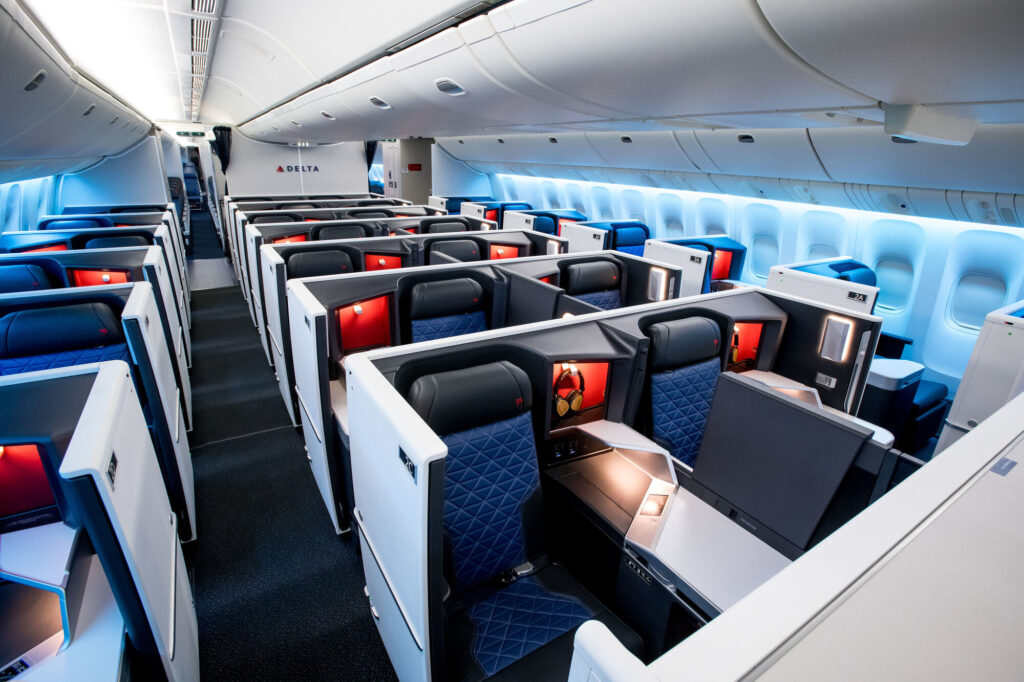
Other airlines are taking a similar approach by heavily investing and enlarging their premium product offerings. This year, United Airlines debuted a new “Elevated 787” Polaris business class. Cathay Pacific will offer their new “Aria Studio” business class experience exclusively for regional flights on its A330s towards the end of 2026. Additionally, Thai Airways, Air India, and Turkish Airlines will have upgraded premium products on newly delivered widebodies.
The biggest mystery is Singapore Airlines’ yet to be unveiled business class design. One thing is clear from their mysterious advertisement image, and it’s the privacy door. The airline will unveil for the public it in its entirety in early November 2026, ahead of the first and business class 2027 rollout.
Looking at these airlines’ offerings, there are three common denominators when it comes to what makes a great business class: exclusivity, recognizability, and comfort. Comfort, according to the latest trends, means a seat with an uninterrupted, highly private, residential-style micro-environment.