

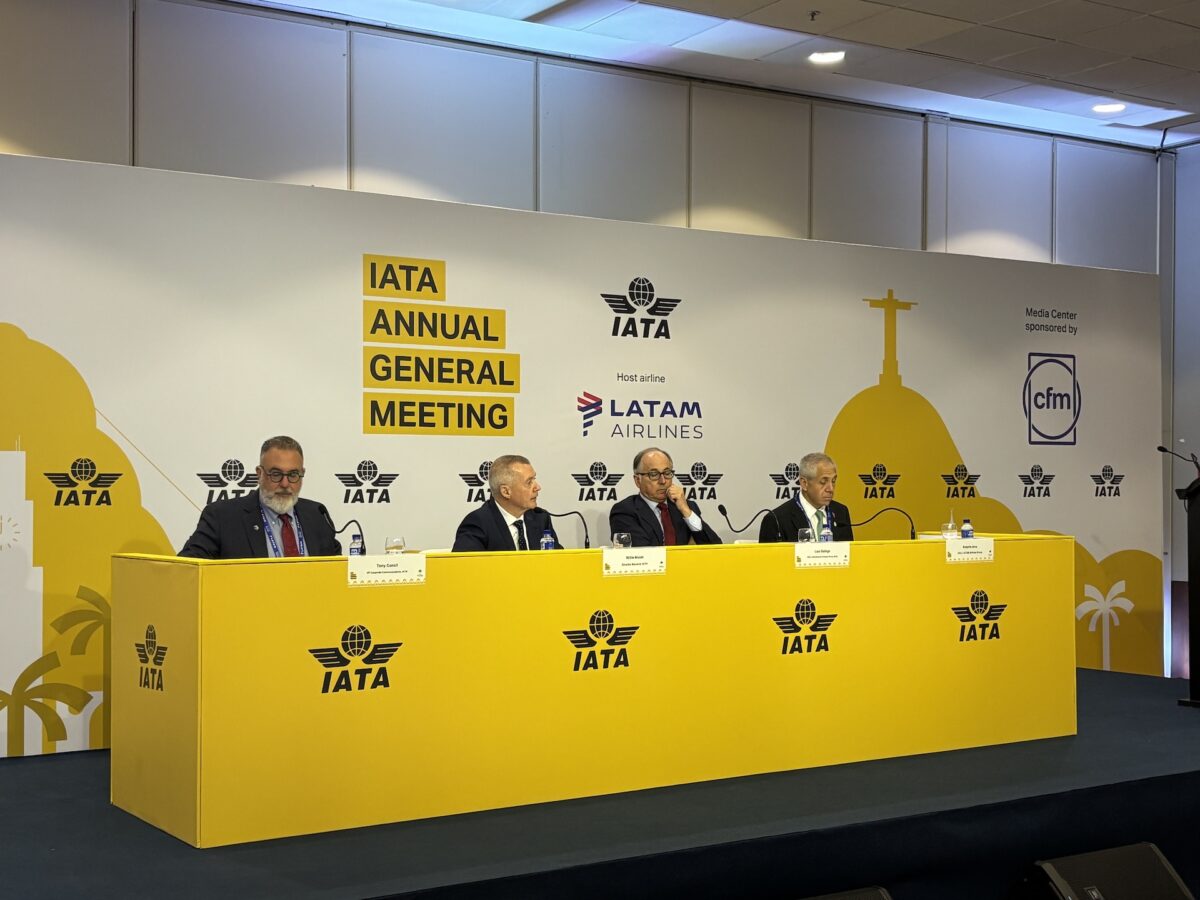
As leaders of the airline industry gathered in Rio de Janeiro for the 82nd Annual General Meeting (AGM) of the International Air Transport Association (IATA), the organisation’s outgoing Director General Willie Walsh expressed confidence in the industry’s future outlook despite the current environment of high global fuel costs and geopolitical uncertainty affecting the Middle East.
Nonetheless, Walsh delivered a strongly worded speech warning against multiple forces converging to threaten the industry’s already razor-thin margins.
The airline executive, who will shortly be taking up the CEO role at India’s low-cost carrier IndiGo, directed some of its sharpest criticisms to engine manufacturers. Without naming any specific firm, Walsh accused the engine OEMs of having posted significant profit increases in recent years while failing to solve the persistent technical issues that have plagued several types of new-generation engines, seriously hampering the operations of numerous airlines.
While he celebrated the agreement CFM signed with IATA in January 2026 to facilitate competition in aftermarket services, remained highly critical of the sector’s overall behaviour.
Walsh drew an ovation from the assembled airline executives when he told engine makers to “stop gouging us.”
Speaking to the media later in the day, Walsh reiterated this criticism, while pointing out that he is not upset about engine makers posting healthy profits, but in doing so while they had failed to deliver on the performance of their products.
Walsh also took aim at governments on two areas that are seen of major importance by the airlines: charges and taxation and passenger rights.
On taxation, while Sweden was hailed as a positive example of a country that has decided to lower charges on aviation, Walsh expressed his concern about other countries piling up new taxes and charges on air travel, undermining the framework laid out by the International Civilian Aviation Organization (ICAO), which has served as a basis of the industry’s past growth.
Walsh singled out Brazil, which is planning to introduce a 26.5% VAT rate on international airline tickets, stating that the revenue the Brazilian government expects to raise through this measure will be more than cancelled out by the losses to the economy resulting from smaller visitor fluxes.
Brazil also stands out in another area of concern for airlines: passenger rights and litigation. During a media briefing held during the AGM, IATA shared that Brazil represents an astounding 98% of the world’s airline passenger claims, or one every 227 passengers (for reference, this figure is one claim for every 1.2 million passengers in the United States).
Whose burden?
Speaking at the IATA plenary, Walsh focused part of intervention precisely on the area of passenger rights. The airline executive was very critical of the proposed reform of the EU261 directive currently under discussion, qualifying both the current proposal and the proposed amendments as poorly drafted and suggesting it would be better to start this discussion from scratch.
As it stands, the EU261is costing the industry around €8 billion a year, Walsh said, pointing out that operational disruption is often due to factors beyond the airlines’ control.
Walsh also suggested that there may be better ways to balance consumers’ interests with the realities of airline operations, noting that passenger surveys show travelers value the option of getting to their destination through alternative routings over the imposition of financial penalties to the airline. It is in this context that Walsh celebrated the fact that countries such as Australia and the UAE have steered clear of adopting a EU-style approach to passenger compensation.
As in the case with passenger compensation, IATA considers that the airline industry is being made to carry more than its fair share of the burden when it comes to decarbonization measures.
When it comes to sustainability, Walsh acknowledged that the 2050 net zero goal remains technically achievable if the right decisions are taken, but called for an honest industry-wide discussion on burden-sharing, reiterating IATA’s long-standing position that airlines are currently carrying a disproportionate share of the decarbonisation effort.
Walsh accused the EU of undermining the CORSIA regime it helped develop. As of June 2026, only 10 countries worldwide have allocated Eligible Emissions Units (EEUs), the CORSIA-eligible carbon credits airlines need to meet their offsetting obligations, and none of them is in Europe. The 38 million units made available by those countries, none of which is in Europe, fall well short of the 170 to 236 million required.
Another sour point for IATA, and one which has been repeatedly brought up by the airline industry body in its public statements, is the failure of the energy industry to scale up Sustainable Aviation Fuel (SAF) production in large enough quantities.
On this particular topic, Walsh was again critical of the approach taken by the European authorities, noting that introducing mandates where the supply simply isn’t realistically available, only leads to price increases. He pointed out that incentives may provide a more effective way to increase SAF production, as proven by the US experience. Walsh also expressed his disappointment that a number of SAF projects have been cancelled recently in Europe and Asia, despite the fact that fuel may also offer some strategic resilience benefits in a world of increased geopolitical volatility.
According to Walsh, having seen that the current approach has failed to deliver the expected results, it would make no sense to persevere on this path when it comes to trying to bolster e-SAF supply.