

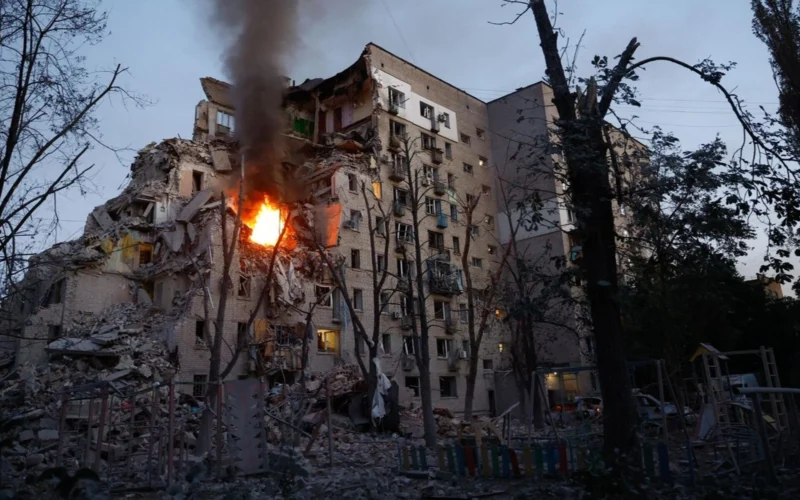
Ukrainian President Volodymyr Zelenskyy called for a United States decision on licenses to produce Patriot interceptors after a massive Russian missile and drone attack killed at least 13 people in Kyiv on the night of July 1 to 2, 2026.
More than 70 missiles in a single night
Russia launched over 70 missiles of various types at Ukraine overnight, with nearly half being ballistic missiles and including Zircon hypersonic missiles. Additionally, almost 500 attack drones were used, including jet-powered Shahed models, as Zelenskyy stated. The primary target of the strikes was Kyiv.
The Ukrainian Air Force reported downing or suppressing 48 of the 74 missiles and 476 of the 496 drones, with 25 ballistic missiles and 12 drones hitting 33 locations. The attack on the capital lasted around 11 hours, according to city officials.
The response to the aftermath of Russia’s attack is still ongoing in Kyiv: first responders are clearing the rubble, searching for people, and providing assistance. Damage has been reported at more than 20 sites across the city, most of them ordinary residential buildings. There… pic.twitter.com/rtfrS1gFVU
— Volodymyr Zelenskyy / Володимир Зеленський (@ZelenskyyUa) July 2, 2026
Zelenskyy said damage was recorded at more than 20 sites across Kyiv, most of them residential buildings, as well as an ambulance station, a research institute, a hotel, and businesses. Six floors of a nine-story residential building in the Darnytskyi district collapsed after a direct hit, Mayor Vitali Klitschko said. More than 90 people were injured, according to the president, and Ukrainian Foreign Minister Andrii Sybiha warned the toll could still rise.
Search-and-rescue work was still ongoing at the damaged residential building in Darnytskyi district, Klitschko said, adding that rescuers were “still looking for people under the rubble.” At the time of his statement, 13 people were known to have been killed in Kyiv.
Five people were also wounded in the Kharkiv region, including a child, and two in the Kyiv region, while the Sumy, Dnipro, Zaporizhzhia, and Cherkasy regions were struck as well. Russia’s Ministry of Defense claimed the attack targeted military and energy infrastructure.
The scale of the barrage triggered precautionary responses beyond Ukraine’s borders. Poland briefly scrambled fighter jets and raised its ground-based air defense and radar reconnaissance to a state of readiness, the Polish Armed Forces Operational Command said, before standing the aircraft down and reporting no airspace violation. Finland’s defense forces briefly issued a temporary aviation restriction zone over the eastern Gulf of Finland, which was lifted later in the day.
Zelenskyy presses US on Patriot production licenses
Calling air defense supplies “an absolute and critical priority,” Zelenskyy urged partners to keep funding NATO’s Prioritized Ukraine Requirements List (PURL), under which European allies pool funds to buy US-made arms for Kyiv, and to implement existing agreements on the production of anti-ballistic capabilities.
“We also very much count on a decision by the United States regarding licenses for Patriots and other forms of cooperation,” he said, calling such steps a way to prevent similar attacks.
Zelenskyy first asked US President Donald Trump for licenses covering US-designed anti-ballistic systems and interceptors, including for the Patriot, on June 16, 2026, on the sidelines of the G7 summit in Évian, France. Trump reacted positively without confirming a decision.
The request lands as stocks of PAC-3 interceptors, the Patriot’s main round against ballistic missiles, were strained by Operation Epic Fury, the US-Israeli campaign against Iran launched on February 28, 2026. The Pentagon has weighed redirecting PURL-funded interceptors to the Middle East and has warned European buyers of delivery delays.
Ukraine seeks Western weapons production at home
The Patriot push mirrors a parallel effort with France. On June 29, 2026, Ukrainian Defense Minister Mykhailo Fedorov said talks with the French government and MBDA on a license to produce SCALP cruise missiles in Ukraine were progressing, though questions tied to intellectual property, components, and the launch of production remain open.
Both tracks reflect the same shift. With partner stockpiles committed on several fronts, Kyiv is seeking to manufacture Western designs on its own soil, from long-range strike weapons to the interceptors defending its cities, rather than depend on deliveries alone.