

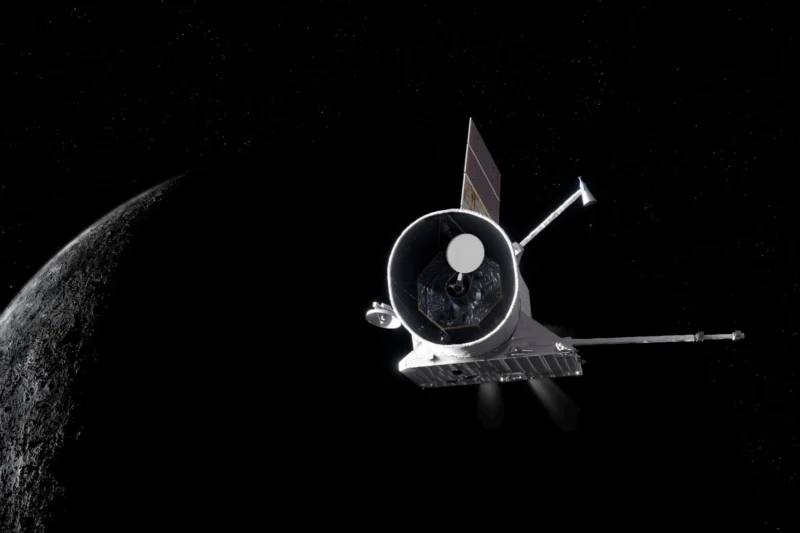
The European-Japanese BepiColombo mission has entered orbit around Mercury, completing a nearly eight-year journey to the Solar System’s innermost planet.
The European Space Agency (ESA) confirmed the successful orbital capture on November 21, 2026, after its mission control team received signals from the spacecraft and assessed the initial telemetry.
The manoeuvre involved firing four thrusters on ESA’s Mercury Planetary Orbiter (MPO) to reduce the spacecraft’s speed enough for Mercury’s gravity to capture it. BepiColombo initially entered an elliptical polar orbit measuring approximately 590 by 11,640 kilometres.
Launched in October 2018, BepiColombo has travelled around 9.9 billion kilometres through the inner Solar System and completed nine planetary flybys: one of Earth, two of Venus and six of Mercury.
Two orbiters travelling together
BepiColombo is a joint mission between ESA and the Japan Aerospace Exploration Agency (JAXA). It consists of two scientific spacecraft: ESA’s Mercury Planetary Orbiter and JAXA’s Mercury Magnetospheric Orbiter, known as Mio.
The two orbiters are currently still connected and travelling together. Mio remains protected by a sunshield, while MPO is responsible for the spacecraft stack’s manoeuvres during the final stages of arrival.
The orbiters are scheduled to separate on December 9–10, 2026. Mio will then move into its planned orbit to study Mercury’s magnetic field and magnetosphere, while MPO will perform additional manoeuvres to reach its own final science orbit.
Once the two spacecraft are operating separately around Mercury, BepiColombo will become the first mission to conduct simultaneous orbital observations of the planet using two spacecraft.
Science mission to begin in 2027
The mission’s scientific operations are scheduled to begin in April 2027, following the completion of orbital manoeuvres and spacecraft commissioning.
MPO will investigate Mercury’s surface, composition and internal structure. Mio will focus on the planet’s magnetic environment and its interaction with the solar wind.
BepiColombo is the second mission to enter orbit around Mercury, following NASA’s MESSENGER spacecraft, which operated there from 2011 to 2015. The joint ESA-JAXA mission is expected to provide complementary measurements from different orbital altitudes, helping scientists better understand Mercury’s formation, evolution and unusual magnetic environment.